Armenia was an East Syriac diocese (and briefly a metropolitan province) of the Church of the East between the fifth and fourteenth centuries. The diocese served members of the Church of the East in Armenia, and its bishops sat at Halat. The diocese is last mentioned in 1281, and probably lapsed in the fourteenth century during the disorders that attended the fragmentation of the Mongol empire.
The East Syriac Rite or East Syrian Rite, also called Assyrian Rite, Persian Rite, Chaldean Rite, or Syro-Oriental Rite is an Eastern Christian liturgical rite that uses the East Syriac dialect as its liturgical language. It is one of two main liturgical rites of Syriac Christianity.
The Church of the East, also known as the Nestorian Church and the Persian Church, was an Eastern Christian denomination that in 410 organised itself within the Sasanian Empire and in 424 declared its leader independent of other Christian leaders. From the Persian Empire it spread to other parts of Asia in late antiquity and the Middle Ages.
Armenia, officially the Republic of Armenia, is a country in the South Caucasus region of Eurasia. Located in Western Asia on the Armenian Highlands, it is bordered by Turkey to the west, Georgia to the north, the de facto independent Republic of Artsakh and Azerbaijan to the east, and Iran and Azerbaijan's exclave of Nakhchivan to the south.
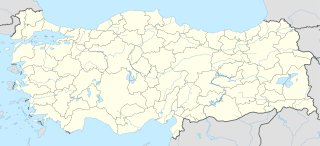
The East Syrian diocese of Armenia, whose bishops sat in the town of Halat on the northern shore of Lake Van, is attested between the fifth and fourteenth centuries. In the fifth century the diocese of Halat was not assigned to a metropolitan province, but was later included in the province of Nisibis, probably shortly after the Arab conquest of Persia. The patriarch Timothy I created a short-lived metropolitan province for Armenia, presumably by raising the status of the diocese of Halat. By the second half of the eleventh century Halat was once again a suffragan diocese of the province of Nisibis. By the thirteenth century the jurisdiction of the bishops of Halat included the towns of Van and Wastan. The thirteenth-century Nestorian metropolitan Shlemun of Basra, author of the Book of the Bee (c.1222), was a native of Halat. [1]
Ahlat, is a historic town and district in Turkey's Bitlis Province in Eastern Anatolia Region. From 1929-1936, it had been included as a district of Van Province. The town of Ahlat is situated on the northwestern shore of Lake Van. The mayor is Abdulalim Mümtaz Çoban (AKP).
Van is a city in eastern Turkey's Van Province, located on the eastern shore of Lake Van. The city has a long history as a major urban area. It has been a large city since the first millennium BC, initially as Tushpa, the capital of the kingdom of Urartu from the 9th century BC to the 6th century BC, and later as the center of the Armenian kingdom of Vaspurakan. Today, Van has a Kurdish majority and a sizeable Turkish minority.
The bishop Artashahr of Armenia was among the signatories of the acts of the synod of Dadishoʿ in 424. At this period the diocese, probably based on Halat, was not assigned to a metropolitan province. [2]
The bishop Yaʿqob of Halat, a writer mentioned in the list of Syriac authors compiled in the fourteenth century by ʿAbdishoʿ Bar Brikha, flourished during the reign of the patriarch Pethion (731–40).
Pethion was patriarch of the Church of the East from 731 to 740.
An unnamed bishop of Armenia was present at the consecration of the patriarch ʿAbdishoʿ II in 1074. [3]
A note of 1137 by the copyist of the Mukhtasar mentions the recent suppression of the metropolitan province of Bardaʿa (in Azerbaijan) and the attribution of responsibility for the remaining Christians in the province to Eliya, bishop of Halat. [4]
The bishop Yuwanis of Halat was appointed metropolitan of Kashgar and Nevaketh by the patriarch Eliya III (1176–90). [5]
The bishop Sliba-zkha of Halat was present at the consecration of the patriarch Denha I in 1265. [6]
The bishop Hnanishoʿ of Halat was present at the consecration of the patriarch Yahballaha III in 1281. [7]
The Metropolitanate of Nisibis was an East Syriac metropolitan province of the Church of the East, between the fifth and seventeenth centuries. The ecclesiastical province of Nisibis had a number of suffragan dioceses at different periods in its history, including Arzun, Beth Rahimaï, Beth Qardu, Beth Zabdaï, Qube d’Arzun, Balad, Shigar (Sinjar), Armenia, Beth Tabyathe and the Kartawaye, Harran and Callinicus (Raqqa), Maiperqat, Reshʿaïna, Qarta and Adarma, Qaimar and Hesna d'Kifa. Aoustan d'Arzun and Beth Moksaye were also suffragan dioceses in the fifth century.
Metropolitanate of Fars was an East Syriac metropolitan province of the Church of the East between the sixth and twelfth centuries. It was centered in what is now Fars Province, the historic cradle of ancient Persian civilisation, and besides a number of centres in Fars region itself, this East Syriac ecclesiastical province also included a number of dioceses in Arabia and a diocese for the island of Soqotra.
The Metropolitanate of Rai was an East Syriac metropolitan province of the Church of the East, between the eighth and twelfth centuries. The province of Rai had a suffragan diocese for Gurgan.
The Diocese of Tirhan was an East Syriac diocese of the Church of the East, within the central ecclesiastical Province of the Patriarch. The diocese is attested between the sixth and fourteenth centuries.
Diocese of Kashkar, sometimes called Kaskar, was the senior diocese in the Church of the East's Province of the Patriarch. It see was in the city of Kashkar. The diocese is attested between the fourth and the twelfth centuries. The bishops of Kashkar had the privilege of guarding the patriarchal throne during the interregnum between the death of a patriarch and the appointment of his successor. As a result, they are often mentioned by name in the standard histories of the Nestorian patriarchs, so that a relatively full list of the bishops of the diocese has survived.
Sliba-zkha was patriarch of the Church of the East from 714 to 728.
Ishoʿ bar Nun was Patriarch of the Church of the East from 823 to 828. He succeeded Timothy I, widely considered to be the most impressive of the Nestorian patriarchs.
Ahadabui was a legendary primate of the Church of the East, who is conventionally believed to have sat from 204 to 220.
Shahlufa was a legendary primate of the Church of the East, who is conventionally believed to have reigned from 220 to 224 A.D.
Sabrishoʿ II was Patriarch of the Church of the East from 831 to 835. He sat during the reigns of the caliphs al-Maʿmun (813–33) and al-Muʿtasim (833–41).
Israel was Patriarch of the Church of the East in 961.
ʿAbdishoʿ I was Patriarch of the Church of the East from 963 to 986.
Sabrishoʿ IV bar Qayyoma was Patriarch of the Church of the East from 1222 to 1224.
Mari bar Toba was Patriarch of the Church of the East from 987 to 999.
Ishoʿyahb IV bar Ezekiel was Patriarch of the Church of the East from 1020 to 1025. He was an unpopular patriarch, who was defied by many of his metropolitans and bishops.
Sabrishoʿ III Zanbur was Patriarch of the Church of the East from 1064 to 1072.
The Diocese of Shigar and Beth ʿArabaye was an East Syriac diocese of the Church of the East in the metropolitan province of Nisibis, centred on the town of Sinjar. The diocese is attested between the sixth and fourteenth centuries.
Giwargis II was Patriarch of the Church of the East from 828 to 831.
Makkikha I was Patriarch of the Church of the East from 1092 to 1110.
Theodosius was Patriarch of the Church of the East between 853 and 858.