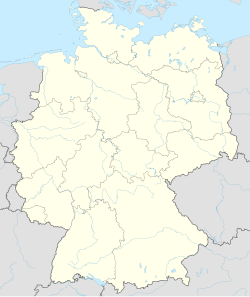
North Rhine-Westphalia or North-Rhine/Westphalia, commonly shortened to NRW, is a state (Land) in Western Germany. With more than 18 million inhabitants, it is the most populous state in Germany. Apart from the city-states, it is also the most densely populated state in Germany. Covering an area of 34,084 square kilometres (13,160 sq mi), it is the fourth-largest German state by size.

The Ruhr, also referred to as the Ruhr area, sometimes Ruhr district, Ruhr region, or Ruhr valley, is a polycentric urban area in North Rhine-Westphalia, Germany. With a population density of 2,800/km2 and a population of over 5 million (2017), it is the largest urban area in Germany. It consists of several large cities bordered by the rivers Ruhr to the south, Rhine to the west, and Lippe to the north. In the southwest it borders the Bergisches Land. It is considered part of the larger Rhine-Ruhr metropolitan region of more than 10 million people, which is the third largest in Western Europe, behind only London and Paris.

Essen is the central and, after Dortmund, second-largest city of the Ruhr, the largest urban area in Germany. Its population of 584,580 makes it the fourth-largest city of North Rhine-Westphalia after Cologne, Düsseldorf and Dortmund, as well as the ninth-largest city of Germany. Essen lies in the larger Rhine-Ruhr metropolitan region, second largest by GDP in the EU, and is part of the cultural area of Rhineland. Because of its central location in the Ruhr, Essen is often regarded as the Ruhr's "secret capital". Two rivers flow through the city: the Emscher in the north, and in the south the Ruhr River, which is dammed in Essen to form the Lake Baldeney (Baldeneysee) and Lake Kettwig reservoirs. The central and northern boroughs of Essen historically belong to the Low German (Westphalian) language area, and the south of the city to the Low Franconian Bergish area.

Gelsenkirchen is the 25th most populous city of Germany and the 11th most populous in the state of North Rhine-Westphalia with 262,528 (2016) inhabitants. On the Emscher River, it lies at the centre of the Ruhr, the largest urban area of Germany, of which it is the fifth largest city after Dortmund, Essen, Duisburg and Bochum. The Ruhr is located in the Rhine-Ruhr Metropolitan Region, one of Europe's largest urban areas. Gelsenkirchen is the fifth largest city of Westphalia after Dortmund, Bochum, Bielefeld and Münster, and it is one of the southernmost cities in the Low German dialect area. The city is home to the football club Schalke 04, which is named after Gelsenkirchen-Schalke. The club's current stadium Veltins-Arena, however, is located in Gelsenkirchen-Erle.

Herne is a city in North Rhine-Westphalia, Germany. It is located in the Ruhr area directly between the cities of Bochum, and Gelsenkirchen.

Fußballclub Gelsenkirchen-Schalke 04 e. V., commonly known as FC Schalke 04, Schalke 04, or abbreviated as S04, is a professional German football and multi-sports club originally from the Schalke district of Gelsenkirchen, North Rhine-Westphalia. The "04" in the club's name derives from its formation in 1904. Schalke have been one of the most popular professional football teams in Germany, even though the club's heyday was in the 1930s and 1940s. Schalke play in the 2. Bundesliga, the second tier of the German football league system, following relegation from the Bundesliga in 2022–23. As of 2023, the club has 178,000 members, making it the second-largest football club in Germany and the fourth-largest club in the world in terms of membership. Other activities offered by the club include athletics, basketball, handball, table tennis, winter sports and eSports.

Gladbeck is a town in the district of Recklinghausen in North Rhine-Westphalia, Germany.

The Rhine-Ruhr metropolitan region is the largest metropolitan region in Germany, with over ten million inhabitants. A polycentric conurbation with several major urban concentrations, the region covers an area of 7,110 square kilometres (2,750 sq mi), entirely within the federal state of North Rhine-Westphalia. The Rhine-Ruhr metropolitan region spreads from the Ruhr area (Dortmund-Bochum-Essen-Duisburg) in the north to the urban areas of the cities of Mönchengladbach, Düsseldorf, Wuppertal, Leverkusen, Cologne, and Bonn in the south. The location of the Rhine-Ruhr at the heart of the European Blue Banana makes it well connected to other major European cities and metropolitan areas such as the Randstad, the Flemish Diamond and the Frankfurt Rhine Main Region.

Herten is a town and a municipality in the district of Recklinghausen, in North Rhine-Westphalia, Germany. It is situated in the industrial Ruhr Area, some 5 km (3.1 mi) west of Recklinghausen.

Ernst Kuzorra was a German footballer of the pre-war era. During his entire career, he played for Schalke 04, whom he led to six national championships and one national cup. He is commonly regarded as the greatest Schalke player of all time alongside Fritz Szepan. A highly athletic, technical and prolific forward, Kuzorra is also commonly regarded as one of the greatest German forwards.
Friedrich "Fritz" Szepan was a German footballer in the period leading up to and including World War II. He spent his entire career with Schalke 04 where he won six national championships and one German Cup. He is commonly regarded as one of the greatest Schalke players of all time. To celebrate the 100th birthday of the club, the supporters voted the Schalker Jahrhundertelf, the "Team of the century": he was included in the midfield. From 1929 to 1938 he played for the Germany national team which he led as captain in 30 matches and during two World Cups.

The Province of Westphalia was a province of the Kingdom of Prussia and the Free State of Prussia from 1815 to 1946. In turn, Prussia was the largest component state of the German Empire from 1871 to 1918, of the Weimar Republic and from 1918 to 1933, and of Nazi Germany from 1933 until 1945.

The Rhine–Herne Canal is a 45.6-kilometre-long (28.3 mi) transportation canal in the Ruhr area of North Rhine-Westphalia, Germany, with five canal locks. The canal was built over a period of eight years and connects the harbour in Duisburg on the Rhine with the Dortmund-Ems Canal near Henrichenburg, following the valley of the Emscher. It was widened in the 1980s. The Rhein-Herne canal ship was designed specifically for this canal; normally of about 1300–1350 ton capacity, it has a maximum draft of 2.50 metres (8.2 ft), a length of approximately 80 metres (260 ft), and maximum beam of 9.50 metres (31.2 ft).

The Gauliga Westphalia was the highest football league in the Prussian province of Westphalia and the small Free State of Lippe from 1933 to 1945. Shortly after the formation of the league, the Nazis reorganised the administrative regions in Germany, and the GaueWestphalia-North and Westphalia-South replaced the Prussian province and the Free State.

Henrich Friedrich Theodor Ernst Grillo was a prominent industrialist in the Ruhr area of Germany, particularly in Essen and Gelsenkirchen.
The actual boundaries of the Ruhr vary slightly depending on the source, but a good working definition is to define the Lippe and Ruhr as its northern and southern boundaries respectively, the Rhine as its western boundary, and the town of Hamm as the eastern limit.
Gesamtschule Berger Feld is a gesamtschule in Gelsenkirchen. It is located in the Erle region and has 1325 pupils and 118 teachers. It is known for the fact that a great number of its former students have become professional football players.
Schalker Eisenhütte Maschinenfabrik GmbH is a German engineering company, a manufacturer of industrial locomotives and coking furnaces.
The Bochum–Essen/Oberhausen railway was built by the Bergisch-Märkische Railway Company to the north of its main line through the central Ruhr to tap traffic from mines and factories in the northern Ruhr region, which is now in the German state of North Rhine-Westphalia.

STV Horst-Emscher was a German association football club from the city of Gelsenkirchen, North Rhine-Westphalia. The club's greatest success has been to qualify for the 1950 German football championship, where it was knocked out by SpVgg Fürth. Between 1947 and 1959 it spent eight seasons in the tier one Oberliga West. In 1967 the club also won the German amateur football championship. The club also made two appearances in the DFB-Pokal, the German Cup, in 1954–55 and 1988–89. STV folded in mid-season in 2007 because of financial trouble.