Related Research Articles

The House of Wittelsbach is a former Bavarian dynasty, with branches that have ruled over territories including the Electorate of Bavaria, the Electoral Palatinate, the Electorate of Cologne, Holland, Zeeland, Sweden, Denmark, Norway, Hungary, Bohemia, and Greece. Their ancestral lands of Bavaria and the Palatinate were prince-electorates, and the family had three of its members elected emperors and kings of the Holy Roman Empire. They ruled over the Kingdom of Bavaria which was created in 1805 and continued to exist until 1918.

Eugène Rose de Beauharnais was a French nobleman, statesman, and military commander who served during the French Revolutionary Wars and the Napoleonic Wars. Through the second marriage of his mother, Joséphine de Beauharnais, he was the stepson of Napoleon Bonaparte. Under the French Empire he also became Napoleon's adopted son. He was Viceroy of the Kingdom of Italy under his stepfather, from 1805 to 1814, and commanded the Army of Italy during the Napoleonic Wars. Historians consider him one of Napoleon's most able relatives.

The House of Hanover is a European royal house with roots tracing back to the 17th century. Its members, known as Hanoverians, ruled Hanover, Great Britain, Ireland, and the British Empire at various times during the 17th to 20th centuries. Originating as a cadet branch of the House of Welf in 1635, also known then as the House of Brunswick-Lüneburg, the Hanoverians ascended to prominence with Hanover's elevation to an Electorate in 1692. In 1714 George I, prince-elector of Hanover and a descendant of King James VI and I, assumed the throne of Great Britain and Ireland, marking the beginning of Hanoverian rule over the British Empire. At the end of his line, Queen Victoria's death in 1901, the throne of the United Kingdom passed to her eldest son Edward VII, a member of the House of Saxe-Coburg and Gotha, through his father Albert, Prince Consort. The last reigning members of the House of Hanover lost the Duchy of Brunswick in 1918 when Germany became a republic.
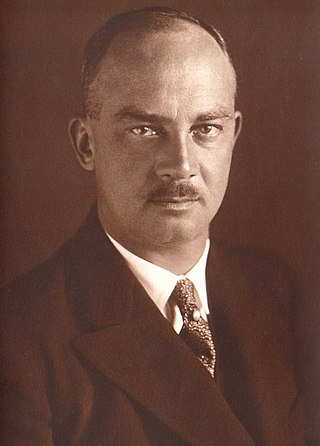
Ernest Augustus ; 17 November 1887 – 30 January 1953) was Duke of Brunswick from 2 November 1913 to 8 November 1918. He was a grandson of George V of Hanover, thus a Prince of Hanover and a Prince of the United Kingdom. He was also a maternal grandson of Christian IX of Denmark and the son-in-law of German Emperor Wilhelm II. The Prussians had deposed King George from the Hanoverian throne in 1866, but his marriage ended the decades-long feud between the Prussians and the Hanoverians.

Georg Friedrich Karl Freiherr von Hertling, from 1914 Count von Hertling, was a German politician of the Catholic Centre Party. He was foreign minister and minister president of Bavaria, then chancellor of the German Reich and minister president of Prussia from 1 November 1917 to 30 September 1918. He was the first party politician to hold the two offices; all the others were non-partisan.

Franz Joseph Strauss was a German musician. He was a composer, a virtuoso horn player and accomplished performer on the guitar, clarinet and viola. He was principal horn player of the Bavarian Court Opera for more than 40 years, a teacher at the Royal School of Music, Munich, and a conductor.
Royal warrants of appointment have been issued for centuries to tradespeople who supply goods or services to a royal court or certain royal personages. The royal warrant enables the supplier to advertise the fact that they supply to the issuer of the royal warrant; thus lending prestige to the supplier. Royal families of the United Kingdom, the Netherlands, Belgium, Luxembourg, Monaco, Denmark, Sweden, and Japan among others, allow tradesmen to advertise royal patronage.

Georg Friedrich Ferdinand Prinz von Preussen is a German businessman who is the current head of the Prussian branch of the House of Hohenzollern, the former ruling dynasty of the German Empire and of the Kingdom of Prussia. He is the great-great-grandson and historic heir of Wilhelm II, the last German Emperor and King of Prussia, who abdicated and went into exile upon Germany's defeat in World War I in 1918. Thus he is a fourth great-grandson of Queen Victoria of the United Kingdom and a distant cousin of many European monarchs.

Countess Marie Louise Larisch von Moennich was a niece and lady-in-waiting of Empress Elisabeth of Austria. She was implicated in the Mayerling Incident which resulted in the death of her married cousin Crown Prince Rudolf and his mistress Baroness Mary Vetsera, who was also her friend. She published several books with a ghostwriter about the Imperial household.
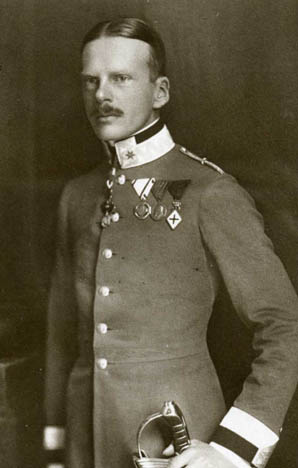
Prince Georg of Bavaria was a member of the Bavarian Royal House of Wittelsbach and a Catholic priest.
Prince Joseph Wenzel of Liechtenstein, Count of Rietberg is the eldest child of Alois, Hereditary Prince of Liechtenstein, and his wife, Duchess Sophie Elizabeth Marie Gabrielle in Bavaria, He is also the eldest grandchild of the current ruling prince of Liechtenstein, Hans-Adam II, and Countess Marie Kinsky of Wchinitz and Tettau.

Heinz Pernet was a German military officer and Erich Ludendorff's stepson. He was a top figure in the Beer Hall Putsch of November 1923. He was among the nine men tried and convicted along with Adolf Hitler and Erich Ludendorff in 1924. He later became an SA-Brigadeführer.

DukeMaximilian Joseph of Bavaria, known informally as Max in Bayern, was a member of a junior branch of the royal House of Wittelsbach who were Kings of Bavaria, and a promoter of Bavarian folk-music. He is most famous today as the father of Empress Elisabeth of Austria ("Sisi") and great-grandfather of King Leopold III of Belgium.
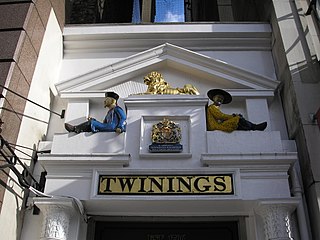
The Twinings Museum was a small temporary museum adjacent to the Twinings shop at 216, Strand, in London, England.

Otto Ritter von Dandl was a Bavarian politician and lawyer who was the last Minister-President of the Kingdom of Bavaria.
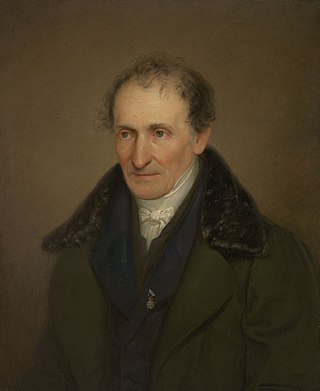
Johann Georg von Dillis was a German painter.

Archduchess Isabella Maria Theresia Christine Eugenie of Austria-Teschen was a daughter of Archduke Friedrich, Duke of Teschen and his wife, Princess Isabella of Croÿ. She was a member of the House of Habsburg-Lorraine.

The Monarchy of Germany was the system of government in which a hereditary monarch was the sovereign of the German Empire from 1871 to 1918.

L. Ostermayr was a glass and porcelain manufacturer and art products shop in Nuremberg, Bavaria.
References
- 1 2 "Welcome to Stein Marks". www.steinmarks.co.uk.
  | This German biographical article is a stub. You can help Wikipedia by expanding it. |