
Pope Pius IV, born Giovanni Angelo Medici, was head of the Catholic Church and ruler of the Papal States from 25 December 1559 to his death, in December 1565. Born in Milan, his family considered itself a branch of the House of Medici and used the same coat of arms. Although modern historians have found no proof of this connection, the Medici of Florence recognised the claims of the Medici of Milan in the early 16th century.

The unification of Italy, also known as the Risorgimento, was the 19th century political and social movement that in 1861 ended in the annexation of various states of the Italian peninsula and its outlying isles to the Kingdom of Sardinia, resulting in the creation of the Kingdom of Italy. Inspired by the rebellions in the 1820s and 1830s against the outcome of the Congress of Vienna, the unification process was precipitated by the Revolutions of 1848, and reached completion in 1870 after the capture of Rome and its designation as the capital of the Kingdom of Italy.

Tullio Levi-Civita, was an Italian mathematician, most famous for his work on absolute differential calculus and its applications to the theory of relativity, but who also made significant contributions in other areas. He was a pupil of Gregorio Ricci-Curbastro, the inventor of tensor calculus. His work included foundational papers in both pure and applied mathematics, celestial mechanics, analytic mechanics and hydrodynamics.

The Roman Ghetto or Ghetto of Rome was a Jewish ghetto established in 1555 in the Rione Sant'Angelo, in Rome, Italy, in the area surrounded by present-day Via del Portico d'Ottavia, Lungotevere dei Cenci, Via del Progresso and Via di Santa Maria del Pianto, close to the River Tiber and the Theatre of Marcellus. With the exception of brief periods under Napoleon from 1808 to 1815 and under the Roman Republics of 1798–99 and 1849, the ghetto of Rome was controlled by the papacy until the capture of Rome in 1870.

Girolamo Rainaldi was an Italian architect who worked mainly in a conservative Mannerist style, often with collaborating architects. He was a successful competitor of Bernini. His son, Carlo Rainaldi, became an even more notable, more fully Baroque architect.

The Victor Emmanuel II National Monument, also known as the Vittoriano or Altare della Patria, is a large national monument built between 1885 and 1935 to honour Victor Emmanuel II, the first king of a unified Italy, in Rome, Italy. It occupies a site between the Piazza Venezia and the Capitoline Hill. The monument was realized by Giuseppe Sacconi.

Borgo is the 14th rione of Rome, Italy. It is identified by the initials R. XIV and is included within Municipio I.
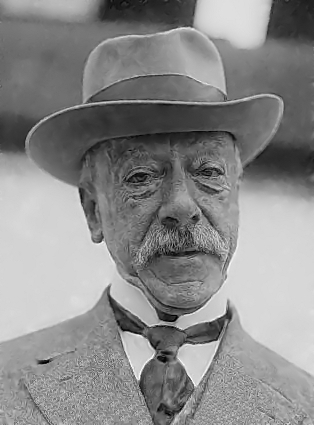
Ernesto Nathan was an English-Italian politician who was the mayor of Rome from November 1907 to December 1913.

Porta Pia was one of the northern gates in the Aurelian Walls of Rome, Italy. One of Pope Pius IV's civic improvements to the city, it is named after him. Situated at the end of a new street, the Via Pia, it was designed by Michelangelo to replace the Porta Nomentana situated several hundred meters southwards, which was closed up at the same time. Construction began in 1561 and ended in 1565, after the artist's death. A 1561 bronze commemorative medal by Gian Federico Bonzagna shows an early plan by Michelangelo, very different from his final design. The façade on the outside of the city was completed in 1869 under the Neo-Classicist design by Virginio Vespignani.

The Basilica of San Giovanni dei Fiorentini is a minor basilica and a titular church in the Ponte rione of Rome, Italy.
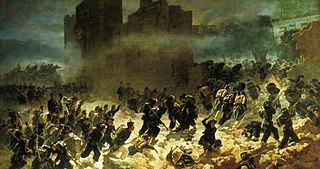
The Capture of Rome occurred on 20 September 1870, as forces of the Kingdom of Italy took control of the city and of the Papal States. After a plebiscite held on 2 October 1870, Rome was officially made capital of Italy on 3 February 1871, completing the unification of Italy (Risorgimento).

Porta San Giovanni is a gate in the Aurelian Wall of Rome, Italy, named after the nearby Archbasilica of Saint John Lateran.

Racism in Italy refers to the existence of antagonistic relationships between Italians and other populations of different ethnicities which has existed throughout the country's history.

Gerolamo Induno was an Italian painter and soldier, best known for his military scenes. His older brother, Domenico, was also a well-known artist and they often worked together.
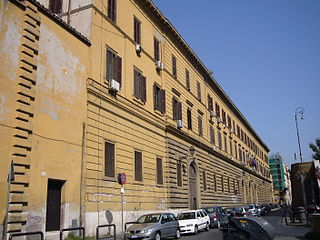
Regina Coeli is the best known prison in the city of Rome. It was formerly a Catholic convent and became a prison in 1881.
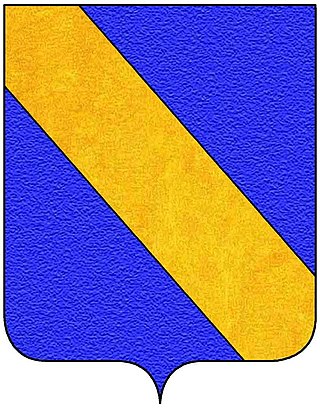
The Capizucchi family was a noble Roman family. Considered one among the oldest families in Rome, it was deeply rooted in the Roman nobility because of the gallantry of many members. The family died out in the 17th century, and its name came to an end in 1813. The Capizucchis had their homes in Campitelli rione, at the foot of Capitoline Hill, and there also lay their palace. This still exists and is located between two squares, Piazza Campitelli and the one that took its name from the family, Piazza Capizucchi.

La presa di Roma, also known as La breccia di Porta Pia or Bandiera bianca, and distributed in English-speaking countries under the title The Capture of Roma is a 1905 Italian short black-and-white silent film directed by Filoteo Alberini.
Guido Bedarida was an Italian Jewish writer. He is notable for being the main source of Judeo-Livornese literature.
The Jewish community in Rome is one of the oldest in Europe, with its origins tracing back to at least 161 BCE.

 Kingdom of Sardinia
  Kingdom of Italy