
Cesare Cantù was an Italian historian, writer, archivist and politician. An immensely prolific writer, Cantù was one of Italy's best-known and most important Romantic scholars.

Emanuele Severino was an Italian philosopher.

Università Cattolica del Sacro Cuore, known as UCSC or UNICATT or simply Cattolica, is an Italian private research university founded in 1921. Its main campus is located in Milan, Italy, with satellite campuses in Brescia, Piacenza, Cremona and Rome.
Santo Mazzarino was an Italian historian considered to be a leading 20th-century historian of ancient Rome. He was a member of the Accademia dei Lincei.

Gianfranco Miglio was an Italian jurist, political scientist, and politician. He was a founder of the Federalist Party. For thirty years, he presided over the political science faculty of Milan's Università Cattolica. Later on in his life, he was elected as an independent member of the Parliament to the Italian Senate for Lega Nord. The supporters of Umberto Bossi's party called him Prufesùr, a Lombard nickname to remember his role.

Alessandro Verri was an Italian author.
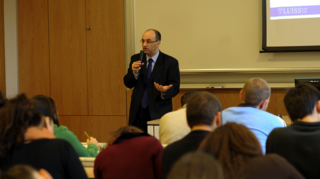
Michele Sorice is an Italian sociologist and political scientist known for his work in the fields of political communication, political science and critical media studies. He is the author of over 25 books and 50 articles.

Giuseppe Lazzati was an Italian Roman Catholic rector of the Sacred Heart college in Milan and a former parliamentarian. He was also the founder of the Secular Institute of Christ the King. Lazzati served as a professor and for a time served as a politician at the close of the Second World War despite initial hesitance in doing so. He later resigned to further dedicate himself to his lecturing while instituting the Secular Institute of Christ the King to bring together men who wished to consecrate themselves to God though not as religious. He was a collaborator of several well-known figures in Italian politics such as Giorgio La Pira and Aldo Moro while he maintained close relationships with Pope Paul VI and Pope John Paul II.
Luca Serianni was an Italian linguist and philologist.

Giovanni Reale was an Italian historian of philosophy.
UCSC Student Associations are students' group of Università Cattolica del Sacro Cuore. They organize cultural and social activities among the students of the university. Some associations are linked to Italian political parties, others are nonpartisan.

Paolo Bolpagni is an Italian art historian, critic and curator.
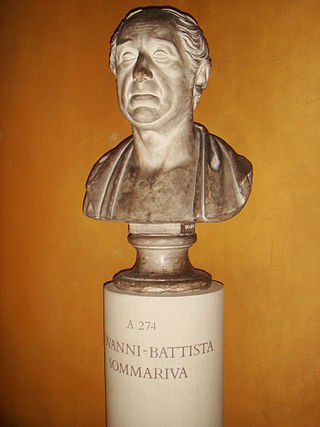
Giovanni or Gian Battista Sommariva was an Italian politician of the Cisalpine Republic and a notable arts patron.
Quirino Principe is an Italian philosopher of music, Germanist, translator and dramatist. actor.

Bernardino Corio was an Italian humanist and historian of the Renaissance. His Patria historia (1503), which traces the history of Milan from its remote origins to 1499, is the earliest scholarly study of Italian history to be written in Italian vernacular rather than Latin.
Eugenio Manni was an Italian ancient historian.
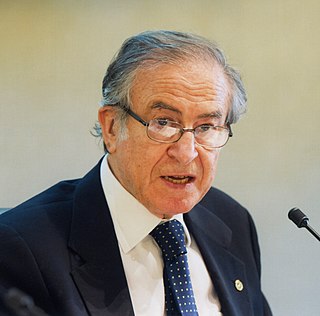
Alberto Quadrio Curzio is an Italian economist. He is Professor Emeritus of Political Economy at Università Cattolica del Sacro Cuore, Milan, President Emeritus of the Accademia Nazionale dei Lincei and President of the International Balzan Foundation "Prize".

Rivista Internazionale di Scienze Sociali, established in 1893, is the oldest Italian academic journal in economics and social sciences.
Dario del Bufalo is an Italian mosaic and antiquity expert, architect, author, and restorer.
Marta Sordi was an Italian historian of classical antiquity, best remembered for her various publications on Greek and Roman history. A graduate of the University of Milan, she was an assistant to Silvio Accame, and taught at the University of Messina, the University of Bologna and the Università Cattolica del Sacro Cuore. She was a member of the Istituto Lombardo Accademia di Scienze e Lettere, the Pontifical Academy of Archaeology, and the Istituto Nazionale di Studi Etruschi ed Italici. She was awarded a Medal of the City of Paris in 1997, and a Rosa Camuna from the regional council of Lombardy in 2002.


