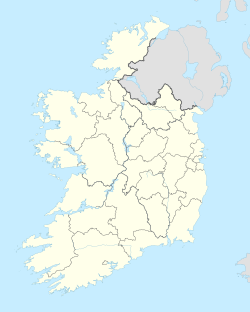
Glin North is located 4.9 kilometres (3.0mi) north-northwest of Dingle, to the south of the Milltown River and west of Scragg mountain.[5][6]
Description
Drystone-masonry within the monument
The national monument consists of a clochán, stone fort and cashel. The cashel (stone ringfort) covers 650m2 (0.16 acres) internally.[citation needed][7]
The archaeologist and author Peter Harbison described the monument in his 1970 work "Guide to the National and Historic Monuments of Ireland": A stone fort with two concentric walls enclosing the remains of some beehive huts. One of these had a stone-paved path leading up to its entrance.[8]
↑"KE043-026----: Ringfort - rath: NA GLEANNTA THUAIDH". National Monuments Service. 7 August 2013. Retrieved 20 December 2025– via heritagedata.maps.arcgis.com. Description: National Monument No. 10055. Internal diam. 25m N-S, 26.7m E-W. A bivallate rath situated on the lower SW slopes of Ballysitteragh mountain, with good clear views along the valley of the Milltown river. The subcircular interior, containing the remains of 2 or possibly 3 hut-sites, is enclosed by 2 earthen banks and an intervening fosse. The inner bank averages 3.8m in width and 2.8m in height above the base of the fosse. It is faced internally with well-preserved drystone-masonry which stands to a maximum height of 1.7m. The fosse is c. 4m wide. The outer bank is less substantial than the inner one. It varies from 1 to 2m in height above the fosse and from .2 to .9m above the external ground level. It is chiefly composed of earth, but sections of drystone revetment walling are preserved on both the inner and outer faces. A small, stony projection at S may simply be field clearance debris. The entrance gap at WNW is probably secondary. The original entrance faces SW. The gap through the inner bank is .65m wide and the drystone walling lining both sides is a maximum of .5m high. The gap through the outer bank is 2.2m wide but is somewhat confused by the field wall which runs up to its S side. The fosse in this area is very shallow and there is no clearly-defined causeway, but a single stone on edge may mark its S side.
This page is based on this Wikipedia article Text is available under the CC BY-SA 4.0 license; additional terms may apply. Images, videos and audio are available under their respective licenses.