Related Research Articles
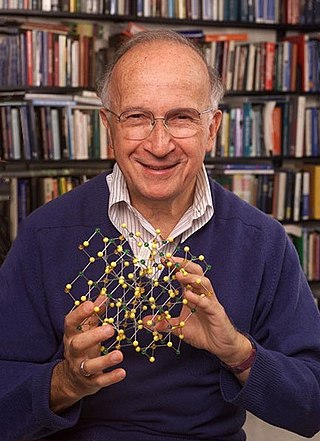
Roald Hoffmann is a Polish-American theoretical chemist who won the 1981 Nobel Prize in Chemistry. He has also published plays and poetry. He is the Frank H. T. Rhodes Professor of Humane Letters, emeritus, at Cornell University, in Ithaca, New York.

The Nobel Prize in Physics is a yearly award given by the Royal Swedish Academy of Sciences for those who have made the most outstanding contributions for humankind in the field of physics. It is one of the five Nobel Prizes established by the will of Alfred Nobel in 1895 and awarded since 1901, the others being the Nobel Prize in Chemistry, Nobel Prize in Literature, Nobel Peace Prize, and Nobel Prize in Physiology or Medicine. Physics is traditionally the first award presented in the Nobel Prize ceremony.
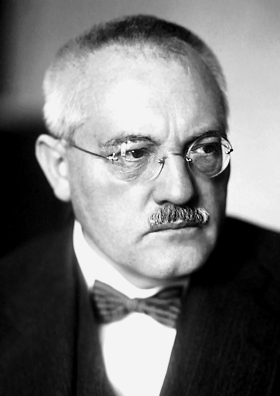
Carl Bosch was a German chemist and engineer and Nobel Laureate in Chemistry. He was a pioneer in the field of high-pressure industrial chemistry and founder of IG Farben, at one point the world's largest chemical company.
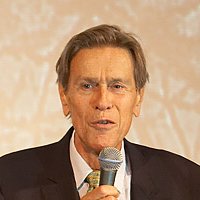
Pierre-Gilles de Gennes was a French physicist and the Nobel Prize laureate in physics in 1991.

The Max Planck Society for the Advancement of Science is a formally independent non-governmental and non-profit association of German research institutes. Founded in 1911 as the Kaiser Wilhelm Society, it was renamed to the Max Planck Society in 1948 in honor of its former president, theoretical physicist Max Planck. The society is funded by the federal and state governments of Germany.

George Andrew Olah was a Hungarian-American chemist. His research involved the generation and reactivity of carbocations via superacids. For this research, Olah was awarded a Nobel Prize in Chemistry in 1994 "for his contribution to carbocation chemistry." He was also awarded the Priestley Medal, the highest honor granted by the American Chemical Society and F.A. Cotton Medal for Excellence in Chemical Research of the American Chemical Society in 1996.

Johann Friedrich Wilhelm Adolf von Baeyer was a German chemist who synthesised indigo and developed a nomenclature for cyclic compounds. He was ennobled in the Kingdom of Bavaria in 1885 and was the 1905 recipient of the Nobel Prize in Chemistry.
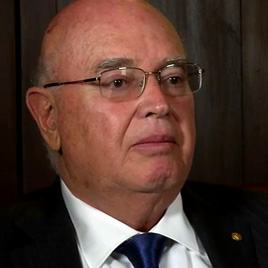
Gabor A. Somorjai is a professor of chemistry at the University of California, Berkeley, and is a leading researcher in the field of surface chemistry and catalysis, especially the catalytic effects of metal surfaces on gas-phase reactions. For his contributions to the field, Somorjai won the Wolf Prize in Chemistry in 1998, the Linus Pauling Award in 2000, the National Medal of Science in 2002, the Priestley Medal in 2008, the 2010 BBVA Foundation Frontiers of Knowledge Award in Basic Science and the NAS Award in Chemical Sciences in 2013. In April 2015, Somorjai was awarded the American Chemical Society's William H. Nichols Medal.
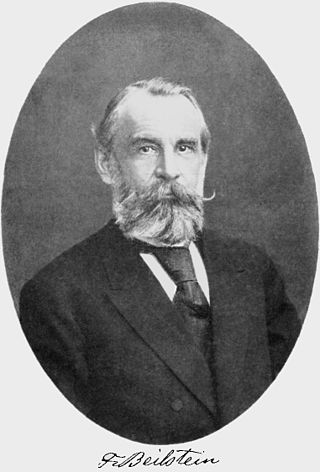
Friedrich Konrad Beilstein, was a Russian chemist and founder of the famous Handbuch der organischen Chemie. The first edition of this work, published in 1881, covered 1,500 compounds in 2,200 pages. This handbook is now known as the Beilstein database.
The Beilstein database is the largest database in the field of organic chemistry, in which compounds are uniquely identified by their Beilstein Registry Number. The database covers the scientific literature from 1771 to the present and contains experimentally validated information on millions of chemical reactions and substances from original scientific publications. The electronic database was created from Handbuch der Organischen Chemie, founded by Friedrich Konrad Beilstein in 1881, but has appeared online under a number of different names, including Crossfire Beilstein. Since 2009, the content has been maintained and distributed by Elsevier Information Systems in Frankfurt under the product name "Reaxys".
Jürgen Gmehling is a retired German professor of technical and industrial chemistry at the Carl von Ossietzky University of Oldenburg.

Duilio Arigoni was a Swiss chemist and Emeritus Professor at ETH Zurich. He worked on the biosynthetic pathways of many organic natural substances.

The Société Chimique de France (SCF) is a learned society and professional association founded in 1857 to represent the interests of French chemists in a variety of ways in local, national and international contexts. Until 2009 the organization was known as the Société Française de Chimie.

The German Chemical Society is a learned society and professional association founded in 1949 to represent the interests of German chemists in local, national and international contexts. GDCh "brings together people working in chemistry and the molecular sciences and supports their striving for positive, sustainable scientific advance – for the good of humankind and the environment, and a future worth living for."

The Otto Hahn Prize is awarded biennially jointly by the Society of German Chemists, the German Physical Society and the city of Frankfurt am Main for outstanding achievement in the field of chemistry, physics or applied engineering science. It was established in 2005 by the merger of the previous Otto Hahn Prize for Chemistry and Physics and the Otto Hahn Prize of the City of Frankfurt am Main. The award is presented in the St. Paul's Church, Frankfurt am Main.
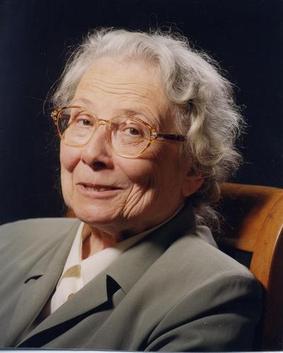
Margot Becke-Goehring was a Professor of Inorganic Chemistry at the University of Heidelberg and she was the first female rector of a university in West Germany - the Heidelberg University. She was also the director of the Gmelin Institute of Inorganic Chemistry of the Max Planck Society that edited the Gmelins Handbuch der anorganischen Chemie. She studied Chemistry in Halle (Saale) and Munich, and she finished her doctorate and habilitation at the University of Halle. For her research on the chemistry of main-group elements, she was awarded Alfred Stock Memorial Prize. One of her most notable contributions to inorganic chemistry was her work on the synthesis and structure of poly(sulfur nitride), which was later discovered to be the first non-metallic superconductor. For her success in editing the Gmelins Handbuch der anorganischen Chemie, she received the Gmelin-Beilstein memorial coin.
The Polanyi Medal is a biennial award of the Royal Society of Chemistry for outstanding contributions to the field of gas kinetics. The medal is presented at the International Symposium on Gas Kinetics after a plenary lecture given by the prize winner.
Walter Leitner is a German chemist, the director of the Max Planck Institute for Chemical Energy Conversion heading the department "Molecular Catalysis" as well as a university lecturer at the RWTH Aachen University, where he holds the position of chair for technical chemistry and petrochemistry.
Olga García Mancheño is an organic chemistry professor at the University of Münster in Germany. García Mancheño directs an organic chemistry research group at University of Münster that focuses on development of new catalytic methods with the goal of developing sustainable synthetic routes to accomplish carbon-hydrogen functionalization, organic chemical rearrangements, and photocatalyzed chemical reactions.
References
- ↑ German Chemical Society Prizes: Archived 2020-11-27 at the Wayback Machine
- ↑ Gmelin-Beilstein Medal: