Aramaic is a Northwest Semitic language that originated in the ancient region of Syria and quickly spread to Mesopotamia, the southern Levant, southeastern Anatolia, Eastern Arabia and the Sinai Peninsula, where it has been continually written and spoken in different varieties for over three thousand years.
The Moabite language, also known as the Moabite dialect, is an extinct sub-language or dialect of the Canaanite languages, themselves a branch of Northwest Semitic languages, formerly spoken in the region described in the Bible as Moab in the early 1st millennium BC.
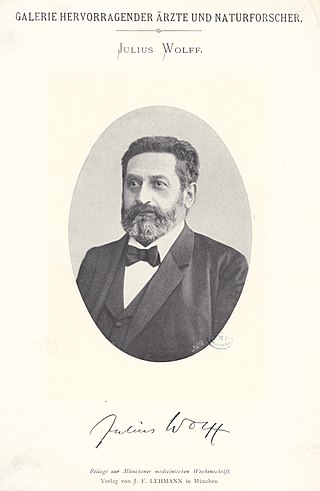
Julius Wolff was a German surgeon.

Tell Halaf is an archaeological site in the Al Hasakah governorate of northeastern Syria, a few kilometers from the city of Ras al-Ayn near the Syria–Turkey border. The site, which dates to the sixth millennium BCE, was the first to be excavated from a Neolithic culture, later called the Halaf culture, characterized by glazed pottery painted with geometric and animal designs.

The Philistine language is the extinct language of the Philistines. Very little is known about the language, of which a handful of words survived as cultural loanwords in Biblical Hebrew, describing specifically Philistine institutions, like the seranim, the "lords" of the Philistine five cities ("pentapolis"), or the 'argáz receptacle, which occurs in 1 Samuel 6 and nowhere else, or the title padî.
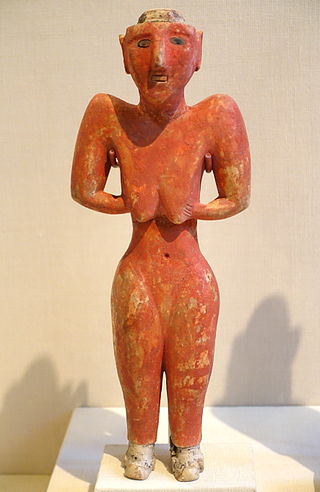
Tell Fekheriye is an ancient site in the Khabur river basin in al-Hasakah Governorate of northern Syria. It is securely identified as the site of Sikkan, attested since c. 2000 BC. While under an Assyrian governor c. 1000 BC it was called Sikani. Sikkan was part of the Syro-Hittite state of Bit Bahiani in the early 1st millennium BC. In the area, several mounds, called tells, can be found in close proximity: Tell Fekheriye, Ras al-Ayn, and 2.5 kilometers east of Tell Halaf, site of the Aramean and Neo-Assyrian city of Guzana. During the excavation, the Tell Fekheriye bilingual inscription was discovered at the site, which provides the source of information about Hadad-yith'i.
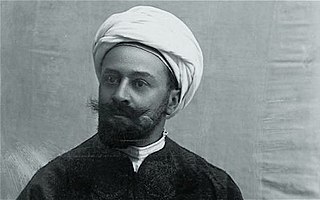
Baron Max von Oppenheim was a German lawyer, diplomat, ancient historian, pan-Islamist and archaeologist. He was a member of the Oppenheim banking dynasty. Abandoning his career in diplomacy, he discovered the site of Tell Halaf in 1899 and conducted excavations there in 1911–13 and again in 1927–29. Bringing many of his finds to Berlin, he exhibited them in a private museum in 1931. This was destroyed by Allied bombing in World War II; however, most of the findings were recently restored and have been exhibited again at Berlin and Bonn.
Alfred Karl Gabriel Jeremias was a German pastor, Assyriologist and an expert on the religions of the ancient Near East.

The Suteans were a nomadic Semitic people who lived throughout the Levant, Canaan and Mesopotamia, specifically in the region of Suhum, during the Old Babylonian period. They were famous in Semitic epic poetry for being fierce nomadic warriors, and like the ʿApiru, traditionally worked as mercenaries. Unlike Amorites, the Suteans were not governed by a king. They may have been part of the Ahlamu. Hypotheses regarding their identity variously identify them as Arameans, proto-Arabs or a unique Semitic people.
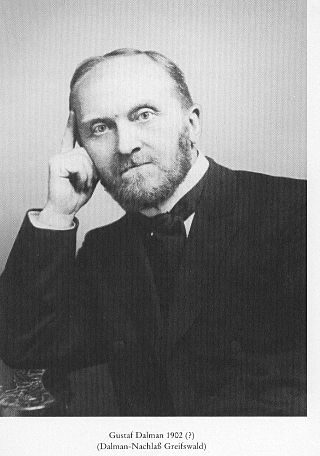
Gustaf Hermann Dalman was a German Lutheran theologian and orientalist. He did extensive field work in Palestine before the First World War, collecting inscriptions, poetry, and proverbs. He also collected physical articles illustrative of the life of the Arab farmers and herders of the country, including rock and plant samples, house and farm tools, small archaeological finds, and ceramics. He pioneered the study of biblical and early post-biblical Aramaic, publishing an authoritative grammar (1894) and dictionary (1901), as well as other works. His collection of 15,000 historic photographs and 5,000 books, including rare 16th century prints, and maps formed the basis of the Gustaf Dalman Institute at the Ernst Moritz Arndt University, Greifswald, which commemorates and continues his work.
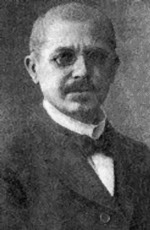
Friedrich Zacharias Schwally was a German Orientalist with professorships at Strasbourg, Gießen and Königsberg. He held the degrees of PhD, Lic. Theol., Dr. Habil., and the Imperial honour of the Order of the Red Eagle, Class IV. He was one of the first significant academics in the field of Quranic studies.
Friedrich Wilhelm Adolf Würzbach was a Nietzsche scholar, Nazi sympathiser and convinced propagandist. He was born in Berlin in the summer of 1886 to a Polish-Jewish mother and German-Protestant father, and died in 1961 in Munich.

The Canaanite and Aramaic inscriptions, also known as Northwest Semitic inscriptions, are the primary extra-Biblical source for understanding of the society and history of the ancient Phoenicians, Hebrews and Arameans. Semitic inscriptions may occur on stone slabs, pottery ostraca, ornaments, and range from simple names to full texts. The older inscriptions form a Canaanite–Aramaic dialect continuum, exemplified by writings which scholars have struggled to fit into either category, such as the Stele of Zakkur and the Deir Alla Inscription.

Friedrich Luft was a German feuilletonist and theater critic.
Mandaic lead rolls, sometimes also known as Mandaic amulets or sheets, which are related to Palestinian and Syrian metal amulets, are a specific term for a writing medium containing incantations in the Mandaic script incised onto lead sheets with a pin. Some Mandaic incantations are found on gold and silver sheets. They are rolled up and then inserted into a metal capsule with loops on it to be worn around the neck on a string or necklace.
The Aramaic Uruk incantation acquired 1913 by the Louvre, Paris and stored there under AO 6489 is a unique Aramaic text written in Late Babylonian cuneiform syllable signs and dates to the Seleucid Empire ca. 150 BCE. The finding site is the reš-sanctuary in the ancient city of Uruk (Warka), therefore the label “Uruk”. Particular about this incantation text is that it contains a magical historiola which is divided up into two nearly repetitive successive parts, a text genre that finds its continuation in the Aramaic magical text corpus of late antiquity from Iraq and Iran, most prominently in incantation bowls and Mandaic lead rolls.

The Sardis bilingual inscription is a 4th-century BCE bilingual Lydian-Aramaic funerary inscription discovered in 1912, during the investigation by the American Society for the Excavation of Sardis. It was found in Sardis, in Manisa, Turkey.

The Cherchell Neopunic inscriptions are two Neopunic inscriptions on marble discovered in 1875 and 1882 in Cherchell in French Algeria. They are currently in the Louvre, known as AO 1028 and AO 5294.

Julius Euting was a German Orientalist.

The County of Steinfurt, originally the Lordship of Steinfurt, was a historic territory of the Holy Roman Empire in the Munsterland. It existed from roughly 1100 until 1806.
