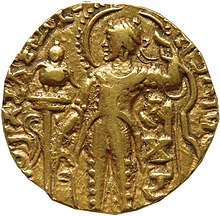
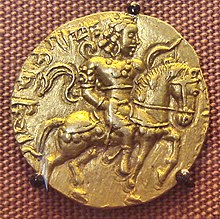
The Gupta Empire was an ancient Indian empire on the Indian subcontinent which existed from the mid 3rd century CE to mid 6th century CE. It was the seventh ruling dynasty of Magadha. At its zenith, from approximately 319 to 467 CE, it covered much of the Indian subcontinent. This period has been considered as the Golden Age of India by historians, although this characterisation has been disputed by some other historians. The ruling dynasty of the empire was founded by Gupta and the most notable rulers of the dynasty were Chandragupta I, Samudragupta, Chandragupta II, Kumaragupta I and Skandagupta.

Chandragupta II, also known by his title Vikramaditya, as well as Chandragupta Vikramaditya, was the third ruler of the Gupta Empire in India. Modern scholars generally identify him with King Chandra of the Delhi iron pillar inscription.

Chandragupta I was a monarch of the Gupta Empire, who ruled in northern and central India. His title Mahārājadhirāja suggests that he was the first suzerain ruler of the dynasty. It is not certain how he turned his small ancestral kingdom into an empire, although a widely accepted theory among modern historians is that his marriage to the Licchavi princess Kumaradevi helped him extend his political power. Their son Samudragupta further expanded the Gupta empire.
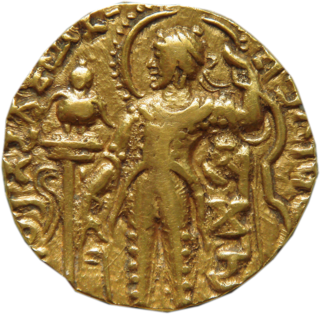
Samudragupta (Gupta script: Sa-mu-dra-gu-pta, was the second emperor of the Gupta Empire of ancient India, and is regarded among the greatest rulers of India. As a son of the Gupta emperor Chandragupta I and the Licchavi princess Kumaradevi, he greatly expanded his dynasty's political and military power.

Kumaragupta I was an King of Kings of the Gupta Empire of Ancient India. A son of the Gupta kingChandragupta II and Queen Dhruvadevi. He seems to have maintained control of his inherited territory, which extended from Gujarat in the west to Bengal region in the east.
Gupta was the founder of the Gupta dynasty of northern India. He is identified with king Che-li-ki-to, who, according to the 7th-century Chinese Buddhist monk Yijing, built a temple near Mi-li-kia-si-kia-po-no (Mṛgaśikhāvana) for Chinese pilgrims.

The Licchavis of Nepal was a kingdom which existed in the Kathmandu Valley, Nepal from approximately 450 CE to 750 CE. The Licchavi clan originated from a branch of the Licchavis of Vaishali who ruled in the territory of modern-day Bihar and who later conquered the Kathmandu Valley. The Licchavis were ruled by a maharaja, aided by a prime minister and other royal officials, but in practice local communities were controlled by caste councils.

Chandravarman was a king of the Pushkarana kingdom in the Bankura district of West Bengal. The kingdom was established shortly before the advent of the Gupta Empire, and was located to the west of the Samatata kingdom of eastern Bengal.

Kamarupa, an early state during the Classical period on the Indian subcontinent, was the first historical kingdom of Assam. The Kamrupa word first appeared in the Samudragupta Allahabad Edict before that there is no mention of existence of this word.
The Varman dynasty (350–650) was the first historical dynasty of the Kamarupa kingdom. It was established by Pushyavarman, a contemporary of Samudragupta. The earlier Varmans were subordinates of the Gupta Empire, but as the power of the Guptas waned, Mahendravarman (470–494) performed two horse sacrifices and the status of Kamarupa as an independent state remained unimpaired. As per the Apsad Inscription of Adityasen, Susthivarman was defeated by Mahasengupta on the bank of Lauhitya. The first of the three Kamarupa dynasties, the Varmans were followed by the Mlechchha and then the Pala dynasties.
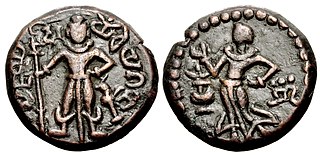
Yaudheya (Brahmi script: 𑀬𑁅𑀥𑁂𑀬) or Yoddheya Gana (Yoddheya Republic) was an ancient military ganasangha (republic) based in the Eastern region of the Sapta Sindhu. The word Yaudheya is a derivative of the word from yodha meaning warriors and according to Pāṇini, the suffix '-ya', was significant of warrior tribes, which is supported by their resistance to invading empires such as the Kushan Empire and the Indo-Scythians. Rudradaman I of the Western Satraps notes in his Junagadh rock inscription that the Yaudheyas were 'heroes among all Kshatriya' and 'were loath to surrender'. They were noted as having a republic form of government, unique from other Janapadas which instead maintained monarchies.
Ghatotkacha was a pre-imperial Gupta king of northern India. He was a son of the dynasty's founder Gupta, and the father of the dynasty's first emperor Chandragupta I.
The Malavas or Malwas were an ancient Indian tribe. They are believed to be the Mallian people (Malloi) who lived in the Punjab region at the time of Alexander's invasion in the 4th century BCE. Later, the Malavas migrated southwards to present-day Rajasthan, and ultimately to Madhya Pradesh and Gujarat. Their power gradually declined as a result of defeats against the Western Satraps, the Gupta emperor Samudragupta, and the Chalukya emperor Pulakeshin II.

Samataṭa was an ancient geopolitical division of Bengal in the eastern Indian subcontinent. The Greco-Roman account of Sounagoura is linked to the kingdom of Samatata. Its territory corresponded to much of present-day eastern Bangladesh and parts of the Rakhine State of Myanmar. The area covers the trans-Meghna part of the Bengal delta. It was a center of Buddhist civilisation before the resurgence of Hinduism, and Muslim conquest in the region.
There are conflicting theories regarding the original homeland and ancestry of the Gupta dynasty that ruled northern India between 4th and 6th centuries. Modern historians variously theorize that it originated in present-day Uttar Pradesh or Bengal, based on epigraphic, numismatic and literary evidence. The social group (varna) of the dynasty is also a matter of debate, with scholars variously placing them in Vaishya, Brahmana, or other categories.
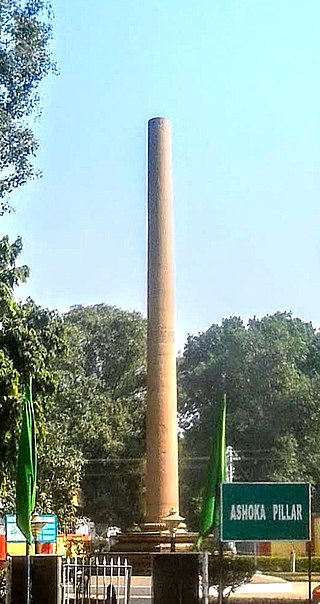
The Allahabad pillar is a stambha, containing one of the pillar edicts of Ashoka, erected by Ashoka, emperor of the Maurya dynasty, who reigned in the 3rd century BCE. While it is one of the few extant pillars that carry Ashokan edicts, it is particularly notable for containing later inscriptions attributed to the Gupta emperor Samudragupta. Also engraved on the stone are inscriptions by the Mughal emperor Jahangir, from the 17th century.

Davaka was a kingdom of ancient Indian subcontinent, located in current central region of Assam state. The references to it comes from the 4th century Allahabad pillar inscription of Samudragupta, where it is mentioned as one of five frontier kingdoms of the Gupta Empire.
The Sanakanikas were a tribe, who were subjugated by the powerful Gupta emperor Samudragupta along with other numerous tribes and clans. The Sanakanikas possibly lived in the neighbourhood of Bhilsa.

The Abhira dynasty was a dynasty that ruled over the northern Deccan, where it perhaps succeeded the Satavahana dynasty. From 203 to roughly 270 or 370, this dynasty formed a vast kingdom. The Abhiras had an extensive kingdom comprising modern-day Maharashtra, Gujarat and parts of southern Madhya Pradesh.

The Gupta-Saka Wars refers to the military conflict between the Gupta Empire, ruled by Chandragupta II, and the Western shatrapas, also known as the Shakas, during the 4th century CE.