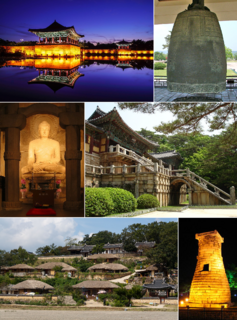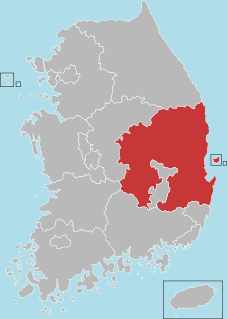
North Gyeongsang Province, also known as Gyeongbuk, is a province in eastern South Korea. The province was formed in 1896 from the northern half of the former Gyeongsang province, remained a province of Korea until the country's division in 1945, then became part of South Korea.
Gwangju is the sixth-largest city in South Korea. It is a designated metropolitan city under the direct control of the central government's Home Minister. The city was also the capital of South Jeolla Province until the provincial office moved to the southern village of Namak in Muan County in 2005.

Miryang, often spelled Milyang, is a city in Gyeongsangnam-do Province, South Korea. Neighboring cities include Changnyeong to the west, Cheongdo to the north, Ulsan to the east, and Yangsan, Gimhae, and Changwon to the south. The city bird is the Korean magpie, the city tree is the pine, and the city flower is the royal azalea.

Tongyeong is a coastal city in South Gyeongsang Province, South Korea. In 2010, it had an area of 238.81 km2 (92.21 sq mi) and a population of 139,869 people. It is divided into 1 eup (town), 6 myeon (township) and 11 dong (neighborhood). Chungmu city and Tongyeong county were reunited in 1995, creating Tongyeong City as it is known today. It consists of Goseong Peninsula, Hansan Island, Mireuk Island and other islets. It was formerly known as Chungmu, after the posthumous name of Admiral Yi Sun-sin. The name Tongyeong means "command post" and is itself associated with Admiral Yi, as it refers to his principal base that was located on nearby Hansan Island.
The Gukjagam, known at times as Gukhak or Seonggyungwan, was the highest educational institution of the Korean Goryeo dynasty. It was located at the capital, Gaegyeong, and provided advanced training in the Chinese classics. It was established in 992 during the reign of Seongjong. Its name has been changed to Songgyungam in 1298 and to Songgyungwam in 1308. Its current name is Koryo (/Goryeo) Songyungwam University/University of Light Industry. A similar institution, known as the Gukhak, had been established under Unified Silla, but it was not successful.

The Gyeongju National Museum is a museum in Gyeongju, North Gyeongsang Province, South Korea. Its holdings are largely devoted to relics of the Silla kingdom, of which Gyeongju was the capital.
The Gukhak, was the sole recorded institution of higher learning in the Silla period of medieval Korean history. It provided training in the Chinese classics. An earlier institution, the Taehak, had been founded in 372.

Beopju is a type of cheongju. The name literally means "law liquor", as it is made following a fixed procedure. On 1 November 1986, a variety called Gyodong-beopju was designated by the government of South Korea as Intangible Cultural Property.
Tourism in Gyeongju is a major industry and defining feature of Gyeongju, South Korea. Gyeongju is a major cultural site and tourist destination for South Koreans and foreigners with about 8 to 9 million visitors annually. A great deal of this is due to the city's status as a center of Silla heritage, derived from its former role as the capital of that ancient kingdom.
This article is about the history of Gyeongju. Gyeongju is a coastal city in the far southeastern corner of North Gyeongsang province in South Korea. It is the second largest city by area in the province after Andong, covering 1,324 km2 with a population of 269,343 people according to the 2008 census. The early history of Gyeongju is closely tied to that of the Silla kingdom, of which it was the capital for nearly one thousand years.
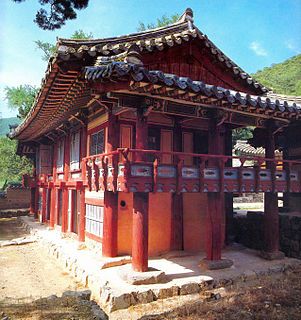
The Oksan Seowon is a seowon located at Oksan-ri, Angang-eup in the city of Gyeongju, North Gyeongsang Province, South Korea. Seowon is a type of local academy during the Joseon Dynasty (1392–1897). It was established by Yi Je-min, (李齊閔), the minister of Gyeongju and local Confucian scholars in 1572, the fifth year of King Seonjo's reign, to commemorate the scholarly achievement and virtue of Confucian scholar and politician Yi Eon-jeok (1491–1553).
The Seoak Seowon is a seowon located in the neighborhood of Seoak-dong, Gyeongju, North Gyeongsang Province, South Korea. Seowon was a type of local academy during the Joseon Dynasty (1392–1897). It was established by local Confucian scholars especially Yi Jeong in 1651, the second year of King Hyojong's reign, to commemorate the virtue and scholarly achievements of scholar Seol Chong, and Choe Chi-won and General Kim Yu-sin. The enshrined people played important roles in the unification of Three Kingdoms of Korea into the Silla kingdom.

The Byeongsan Seowon is a seowon located in Byeongsa-ri village of the Pungcheon-myeon township in the city of Andong, North Gyeongsang Province, South Korea. Seowon is a type of local academy during the Joseon Dynasty (1392–1897). It was first established as Jondeoksa (尊德祠) by local Confucian scholars especially Jeong Gyeong-se (鄭經世) in 1613, the fifth year of King Gwanghaegung's reign, to commemorate the scholarly achievement and virtue of the notable Confucian scholar and politician Ryu Seong-ryong. The predecessor of the seowon was Pungak Seodang (淵岳書堂) which was a school located in Pungsan to teach the Pungsan Ryu clan during the Goryeo period. Ryu Seong-ryong moved the seodang to the current place in 1572.

The Hwangseong Park is a park located in the neighborhood of Hwangseong-dong, Gyeongju, North Gyeongsang province, South Korea. Many of public sport facilities are located in the park with an area of 1,022,350㎡ including a luxuriant pine trees forest. The site is originally where Doksan was situated, an artificial forest established in regards to feng shui during the Silla period. The Doksan forest was used as a training place for hwarang warriors, and a recreation venue as well as a hunting place for the Silla Kings, especially the 26th ruler, King Jinpyeong's favorite place. Since 1975, Hwangseong Park has been designated as "city neighborhood park" and currently consists of multi-purposed Gyeongju Public Stadium, Football Park with 7 football fields and one futsal field, and one gymnasium, as well as Horimjang field for gukgung or Korean traditional archery and a ssireum wrestling ring. In addition, it contains a gateball field, an inline skating rink, jogging courses, and cycling roads. Among them, the construction of Gyeongju Public Stadium was completed in 1982. and can accommodate 20,000 audience.

Gwangajeong is an old hanok, or Korean traditional house located in Yangdong village, Gangdong-myeon, Gyeongju, South Korea. It was the house of Son Jung-don, a civil minister during the reign of King Seongjong of the Joseon Dynasty. It is designated as the 442 Treasure of South Korea. Sarangchae and anchae of the house are arranged in a rectangular shape looking to the west whereas a shrine is located facing to northeast. The hanok is regarded as a good example for studying houses built in the mid Joseon period.
Gyo-dong is a dong or neighborhood in the city of Gyeongju, North Gyeongsang province, South Korea. It is one of legal dong under its administrative dong, Wolseong-dong's jurisdiction. The name, Gyo-dong originates from the fact that the area has had a hyanggyo, government-managed Confucian academies during the Goryeo and Joseon dynasties. It belonged to Bunae-myeon, Gyeongju County (Gyeongju-gun) during the late period of the Joseon Dynasty. Gyo-dong was variously called Hyanggyotgol, Gyochon or Gyori at the times.
Daegu-Gyeongbuk or Taegu-Kyŏngbuk is the compound word of Daegu and Gyeongbuk, and indicates both administrative regions in South Korea. The region usually forms the similar political, economic, and cultural area. Daegu is an independent city from Gyeongsangbuk-do and has the same administrative status with its mother province. Both have their separate local governments reporting directly to the national government.
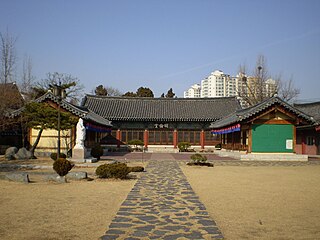
The Daegu Hyanggyo was founded in 1398 during the reign Joseon Dynasty King Taejo. During the Second Japanese Invasion in 1592 it was completely burned down. In 1599 the Daegu Hyanggyo was rebuilt near Dalseong Park but was relocated to the original 1398 site of Dalseong Park in 1605 and then back to the Gyodong area again. 1932 saw the hyanggyo again relocated to its present location in Namsandong, just south of downtown Daegu. In 1973 Hyanggyo at Daegu underwent a full restoration.