Related Research Articles

A cruise missile is an unmanned self-propelled guided vehicle that sustains flight through aerodynamic lift for most of its flight path and whose primary mission is to place an ordnance or special payload on a target. Cruise missiles are designed to deliver a large warhead over long distances with high precision. Modern cruise missiles are capable of traveling at high subsonic, supersonic, or hypersonic speeds, are self-navigating, and are able to fly on a non-ballistic, extremely low-altitude trajectory.
The BGM-109 TomahawkLand Attack Missile (TLAM) is an American long-range, all-weather, jet-powered, subsonic cruise missile that is primarily used by the United States Navy and Royal Navy in ship and submarine-based land-attack operations.

An anti-ship missile is a guided missile that is designed for use against ships and large boats. Most anti-ship missiles are of the sea-skimming variety, and many use a combination of inertial guidance and active radar homing. A large number of other anti-ship missiles use infrared homing to follow the heat that is emitted by a ship; it is also possible for anti-ship missiles to be guided by radio command all the way.

The Rajput-class guided-missile destroyers built for the Indian Navy are modified versions of Soviet Kashin-class destroyers. They are also known as Kashin-II class. The ships were built in the former Soviet Union after considerable Indian design modifications to the Kashin design. These included the replacement of the helicopter pad in the original design with a flight elevator, as well as major changes to the electronics and combat systems. Five units were built for export to India in the 1980s. All units are currently attached to the Eastern Naval Command.
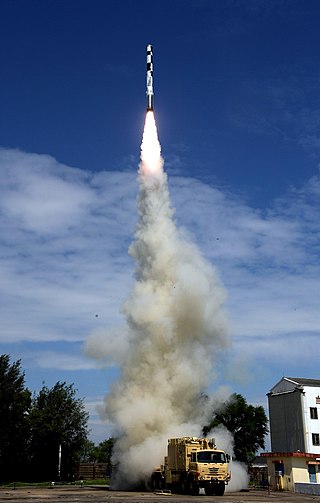
The BrahMos is a medium-range ramjet supersonic cruise missile that can be launched from submarines, ships, fighter aircraft or TEL. It is a joint venture between the Indian Defence Research and Development Organisation (DRDO) and the Russian Federation's NPO Mashinostroyeniya, who together have formed BrahMos Aerospace. The missile is based on P-800 Oniks. The name BrahMos is a portmanteau formed from the names of two rivers, the Brahmaputra of India and the Moskva of Russia.
The Islamic Republic of Iran Navy or Iranian Navy, officially abbreviated NEDAJA, is the naval warfare service branch of Iran's regular military, the Islamic Republic of Iran Army (Artesh). It is one of Iran's two maritime military branches, alongside the Navy of the Islamic Revolutionary Guard Corps (IRGC).
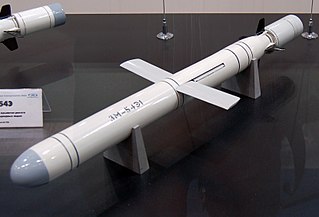
The Novator Kalibr, also referred to as 3M54-1 Kalibr, 3M14 Biryuza, is a family of Russian cruise missiles developed by NPO Novator (OKB-8). It first saw service in 1994. There are ship-launched, submarine-launched and air-launched versions of the missile, and variants for anti-ship, anti-submarine and land attack use. Some versions have a second propulsion stage that initiates a supersonic sprint in the terminal approach to the target, reducing the time that air defense systems have to react, while subsonic versions have greater range than the supersonic variants. The missile can carry a warhead weighing up to 500 kilograms (1,100 lb) of explosive or a thermonuclear warhead.

The RIM-174 Standard Extended Range Active Missile (ERAM), or Standard Missile 6 (SM-6), is a missile in current production for the United States Navy (USN). It was designed for extended-range anti-air warfare (ER-AAW) purposes, providing capability against fixed and rotary-wing aircraft, unmanned aerial vehicles, anti-ship cruise missiles in flight, both over sea and land, and terminal ballistic missile defense. It can also be used as a high-speed anti-ship missile. The missile uses the airframe of the earlier SM-2ER Block IV (RIM-156A) missile, adding the active radar homing seeker from the AIM-120C AMRAAM in place of the semi‑active seeker of the previous design. This will improve the capability of the Standard missile against highly agile targets and targets beyond the effective range of the launching vessels' target illumination radars. Initial operating capability was planned for 2013 and was achieved on 27 November 2013. The SM-6 is not meant to replace the SM-2 series of missiles but will serve alongside and provide extended range and increased firepower. It was approved for export in January 2017. An air-to-air variant of the SM-6, known as the AIM-174, is the first dedicated long-range air-to-air missile employed by the USN since the 2004 retirement of the AIM-54 Phoenix. SM-6 can also be fired from the U.S. Army's Typhon missile launcher as part of the Strategic Mid-range Fires System (SMRF).
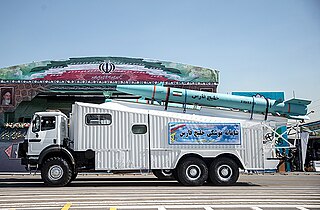
An anti-ship ballistic missile (ASBM) is a military ballistic missile system designed to hit a warship at sea.

The Harpoon is an all-weather, over-the-horizon, anti-ship missile manufactured by McDonnell Douglas. The AGM-84E Standoff Land Attack Missile (SLAM) and later AGM-84H/K SLAM-ER are cruise missile variants.

The YJ-83 is a Chinese subsonic anti-ship cruise missile. It is manufactured by the China Aerospace Science and Industry Corporation Third Academy.

The SSM-700K C-Star (Haeseong) is a ship-launched sea-skimming surface-to-surface anti-ship cruise missile developed by the South Korean Agency for Defense Development (ADD), LIG Nex1 and the Republic of Korea Navy in 2003. The missiles have deployed on KDX-II and KDX-III destroyers as of 2006, each carrying 8 and 16 of the missiles respectively, and on Ulsan-class frigates.
The FC/ASW, FMAN/FMC, FOSW or SPEAR 5 is a next generation missile programme launched by France and the United Kingdom in 2017 to succeed their jointly-developed Storm Shadow/SCALP as well as their respective Exocet and Harpoon anti-ship missiles. Equally funded by both countries, the project is led by European missile manufacturer MBDA and is a product of the close defence relationship set out between both nations by the Lancaster House treaties. In June 2023, it was announced Italy would join the programme and began allocating funding in November.

Zafar is an Iranian short-range, anti-ship and radar guided cruise missile. It has been designed to be carried inside a launch canister installed on a variety of light vessels and high-speed missile crafts.
The 3M22 Zircon, also spelled as Tsirkon is a Russian scramjet-powered, nuclear-capable hypersonic cruise missile. Produced by NPO Mashinostroyeniya for the Russian Navy, the missile utilizes the 3S-14 launch platforms on frigates and submarines. The missile has a reported top speed of Mach 9. The weapon was first used during Russia's invasion of Ukraine.
A loitering munition, also known as a suicide drone, kamikaze drone, or exploding drone, is a kind of aerial weapon with a built-in warhead that is typically designed to loiter around a target area until a target is located, then attack the target by crashing into it. Loitering munitions enable faster reaction times against hidden targets that emerge for short periods without placing high-value platforms near the target area and also allow more selective targeting as the attack can be changed mid-flight or aborted.

R-360 Neptune is a Ukrainian subsonic cruise missile with all-weather capabilities developed by the Luch Design Bureau in Kyiv as an anti-ship missile, with a later variant for land attack. Neptune's design is based on the Soviet Kh-35 subsonic anti-ship missile, with substantially improved range, targeting and electronics equipment. It has a range of over 200 kilometres.
Atmaca (Accipiter) is an all weather, long range, precision strike, anti-ship cruise missile, developed by Turkish missile manufacturer Roketsan. The Atmaca enters service with the Turkish Navy to gradually replace the country's existing inventory of Harpoon missiles.

The SkyKnight is an all-weather multi-target short-range air defence missile. It was developed by Halcon Systems and is the United Arab Emirates' first designed counter-rocket, artillery, and mortar (C-RAM) missile. SkyKnight is planned to be integrated into Rheinmetall Skynex air defence system. Skynex is a fully networked system of sensors and effectors linked via a tactical communications network to provide a mostly automated layered defence against various aerial threats. Up to four 6.1 m (20 ft)-long SkyKnight missile launcher units (MLU) with 60 rounds each can be controlled in a Skynex battery. An MLU can launch up to five missiles in one second and each can simultaneously fire 20 at one time to neutralize 80 incoming targets. The missiles are capable of intercepting manned and unmanned aircraft and helicopters at 10 km (6.2 mi), precision guided munitions (PGMs) and cruise missiles at 6 km (3.7 mi), and RAM projectiles at 4 km (2.5 mi). The Skynex system combines the SkyKnight with up to four Oerlikon Revolver Gun Mk3 35 mm revolver cannons to handle anything that penetrates through the missile defenses.
References
- ↑ "HALCON Unveils First Anti-Ship Cruise Missile at IDEX 2021". www.businesswire.com. 2021-02-22. Retrieved 2022-06-21.
- ↑ "HALCON from UAE has developed the HAS-250 first local-made anti-ship cruise missile". Navy Recognition. Retrieved 2022-06-21.