Hamilton is an inland city in the North Island of New Zealand. Located on the banks of the Waikato River, it is the seat and most populous city of the Waikato region. With a territorial population of 179,900, it is the country's fourth most-populous city. Encompassing a land area of about 110 km2 (42 sq mi), Hamilton is part of the wider Hamilton Urban Area, which also encompasses the nearby towns of Ngāruawāhia, Te Awamutu and Cambridge. In 2020, Hamilton was awarded the title of most beautiful large city in New Zealand.

Manukau City was a territorial authority district in Auckland, New Zealand, that was governed by the Manukau City Council. The area is also referred to as "South Auckland", although this term never possessed official recognition and does not encompass areas such as East Auckland, which was within the city boundary. It was a relatively young city, both in terms of legal status and large-scale settlement – though in June 2010, it was the third largest in New Zealand, and the fastest growing. In the same year, the entire Auckland Region was amalgamated under a single city authority, Auckland Council.
Territorial authorities are the second tier of local government in New Zealand, below regional councils. There are 67 territorial authorities: 13 city councils, 53 district councils and the Chatham Islands Council. District councils serve a combination of rural and urban communities, while city councils administer the larger urban areas. Five territorial authorities also perform the functions of a regional council and thus are unitary authorities. The Chatham Islands Council is a sui generis territorial authority that is similar to a unitary authority.
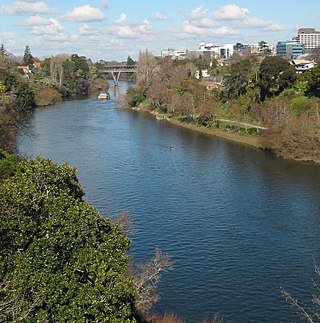
The Waikato River is the longest river in New Zealand, running for 425 kilometres (264 mi) through the North Island. It rises on the eastern slopes of Mount Ruapehu, joining the Tongariro River system and flowing through Lake Taupō, New Zealand's largest lake. It then drains Taupō at the lake's northeastern edge, creates the Huka Falls, and flows northwest through the Waikato Plains. It empties into the Tasman Sea south of Auckland, at Port Waikato. It gives its name to the Waikato region that surrounds the Waikato Plains. The present course of the river was largely formed about 17,000 years ago. Contributing factors were climate warming, forest being reestablished in the river headwaters and the deepening, rather than widening, of the existing river channel. The channel was gradually eroded as far up river as Piarere, leaving the old Hinuera channel through the Hinuera Gap high and dry. The remains of the old course are seen clearly at Hinuera, where the cliffs mark the ancient river edges. The Waikato's main tributary is the Waipā River, which converges with it at Ngāruawāhia.

South Auckland is one of the major geographical regions of Auckland, the largest city in New Zealand. The area is south of the Auckland isthmus, and on the eastern shores of the Manukau Harbour. The area has been populated by Tāmaki Māori since at least the 14th century, and has important archaeological sites, such as the Ōtuataua stonefield gardens at Ihumātao, and Māngere Mountain, a former pā site important to Waiohua tribes.

The Hunua Ranges is a mountain range and regional park to the southeast of Auckland city, in the Auckland and Waikato regions of New Zealand's North Island. The ranges cover some 250 square kilometres (97 sq mi) and rise to 688 metres (2255 ft) at Kohukohunui.

The North Island Main Trunk (NIMT) is the main railway line in the North Island of New Zealand, connecting the capital city Wellington with the country's largest city, Auckland. The line is 682 kilometres (424 mi) long, built to the New Zealand rail gauge of 1,067 mm and serves the large cities of Palmerston North and Hamilton.
The Waikato Connection was a short-lived express passenger train between Hamilton and Auckland in New Zealand's North Island. It consisted of a weekday single return service using diesel multiple unit railcars.
The Southern Line in Auckland, New Zealand is the name given to suburban train services that operate between Britomart Transport Centre in central Auckland and Pukekohe via Newmarket.

Papakura is a southern suburb of Auckland, in northern New Zealand. It is located on the shores of the Pahurehure Inlet, approximately 32 kilometres south of the Auckland CBD. It is under the authority of the Auckland Council.
The District Court of New Zealand is the primary court of first instance of New Zealand. There are 59 District Court locations throughout New Zealand. The court hears civil claims of up to $350,000 and most criminal cases. It is governed by the District Court Act 2016, which replaced the earlier District Courts Act 1947 as well as the District Court Rules which are periodically revised by the Rules Committee.

Auckland railway electrification occurred in phases as part of investment in a new infrastructure for Auckland's urban railway network. Electrification of the network had been proposed for several decades. Installation started in the late 2000s after funds were approved from a combination of regional and central government budgets.

The New Zealand British Rail Mark 2 carriages were built by British Rail Engineering Limited for British Rail in the early 1970s. From the mid-1990s, 150 were exported to New Zealand. After being rebuilt, refurbished and re-gauged, they entered service with a variety of operators on New Zealand's railway network. The carriages generally replaced older NZR 56-foot carriages, some of which had been in use for almost 70 years.
This article describes the current structure of the New Zealand Army. It includes the army's order of battle and the headquarters locations of major units.
Vickery v McLean [2006] NZAR 481 is a cited case in New Zealand regarding claims in defamation and the defence of free speech.
Autex Industries Ltd v Auckland City Council [2000] NZAR 324 is a cited case in New Zealand regarding the development of nuisance claims under Rylands v Fletcher.
Railway electrification in New Zealand consists of three separate electric systems, all on the North Island. Electrification was initially adopted by the New Zealand Railways for long tunnels; the Otira Tunnel, the Lyttelton Rail Tunnel and the two Tawa Tunnels of the Tawa Flat Deviation. Electrification of Wellington suburban services started with the Johnsonville Line and Kapiti Line out of Wellington from the 1930s. Auckland suburban services were electrified in 2014–2015. Electrification of long-distance services on the North Island Main Trunk (NIMT) dates from 1986. New long tunnels, for example the Rimutaka Tunnel and the Kaimai Tunnel, were operated by diesels, and the Otira and Lyttelton Tunnels have converted to diesel operation.

Te Huia is a passenger train service between Hamilton, Papakura, and Auckland in New Zealand. The service is a five-year trial with subsidies from the NZ Transport Agency and Waikato local authorities. The opening was delayed because of COVID-19 and the need to replace some rail track. A new starting date was announced, and the service began on 6 April 2021.
Watercare Services (Watercare) is an infrastructure asset management council-controlled organisation (CCO) that manages the drinking water and wastewater services of the Auckland Region of New Zealand. Watercare is registered with the New Zealand Companies Office as Watercare Services Limited, and is 100% owned by Auckland Council.