Related Research Articles

William the Conqueror, sometimes called William the Bastard, was the first Norman king of England, reigning from 1066 until his death. A descendant of Rollo, he was Duke of Normandy from 1035 onward. By 1060, following a long struggle, his hold on Normandy was secure. In 1066, following the death of Edward the Confessor, William invaded England, leading an army of Normans to victory over the Anglo-Saxon forces of Harold Godwinson at the Battle of Hastings, and suppressed subsequent English revolts in what has become known as the Norman Conquest. The rest of his life was marked by struggles to consolidate his hold over England and his continental lands, and by difficulties with his eldest son, Robert Curthose.

Harold Godwinson, also called Harold II, was the last crowned Anglo-Saxon English king. Harold reigned from 6 January 1066 until his death at the Battle of Hastings on 14 October 1066, the decisive battle of the Norman Conquest. Harold's death marked the end of Anglo-Saxon rule over England. He was succeeded by William the Conqueror.

Rollo, also known with his epithet, Rollo "the Walker", was a Viking who, as Count of Rouen, became the first ruler of Normandy, a region in today's northern France. He emerged as a leading warrior figure among the Norsemen who had secured a permanent foothold on Frankish soil in the valley of the lower Seine after the Siege of Chartres in 911. Charles the Simple, king of West Francia, in what is called the Treaty of Saint-Clair-sur-Epte, granted Rollo lands between the river Epte and the sea in exchange for Rollo agreeing to end his brigandage, swearing allegiance to him, religious conversion and a pledge to defend the Seine's estuary from other Viking raiders.

The Battle of Hastings was fought on 14 October 1066 between the Norman-French army of William, Duke of Normandy, and an English army under the Anglo-Saxon King Harold Godwinson, beginning the Norman Conquest of England. It took place approximately 7 mi (11 km) northwest of Hastings, close to the present-day town of Battle, East Sussex, and was a decisive Norman victory.

The Bayeux Tapestry is an embroidered cloth nearly 70 metres long and 50 centimetres tall that depicts the events leading up to the Norman Conquest of England in 1066, led by William, Duke of Normandy challenging Harold II, King of England, and culminating in the Battle of Hastings. It is thought to date to the 11th century, within a few years of the battle. Now widely accepted to have been made in England, perhaps as a gift for William, it tells the story from the point of view of the conquering Normans and for centuries has been preserved in Normandy.
Odo of Bayeux was Bishop of Bayeux in Normandy and was also made Earl of Kent in England following the Norman Conquest. He was the maternal half-brother of duke, and later king, William the Conqueror, and was, for a time, William's primary administrator in the Kingdom of England, although he was eventually tried for defrauding William's government. It is likely Odo commissioned the Bayeux Tapestry, a large tableau of the Norman Conquest, perhaps to present to his brother William. He later fell out with his brother over Odo's support for military adventures in Italy. William, on his deathbed, freed Odo. Odo died in Palermo Sicily on the way to crusade.

Bayeux is a commune in the Calvados department in Normandy in northwestern France.

Richard I, also known as Richard the Fearless, was the count of Rouen from 942 to 996. Dudo of Saint-Quentin, whom Richard commissioned to write the "De moribus et actis primorum Normanniae ducum", called him a dux. However, this use of the word may have been in the context of Richard's renowned leadership in war, and not as a reference to a title of nobility. Richard either introduced feudalism into Normandy or he greatly expanded it. By the end of his reign, the most important Norman landholders held their lands in feudal tenure.

Richard III was the duke of Normandy who reigned from August 1026 to his death. His brief reign opened with a revolt by his brother.

The House of Normandy was a noble family originating from the Duchy of Normandy. The House of Normandy's lineage began with the Scandinavian Rollo who founded the Duchy of Normandy in 911.
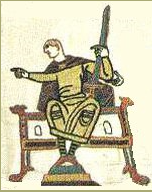
Guy I of Ponthieu was born sometime in the mid- to late 1020s and died 13 October 1100. He succeeded his brother Enguerrand II as Count of Ponthieu.
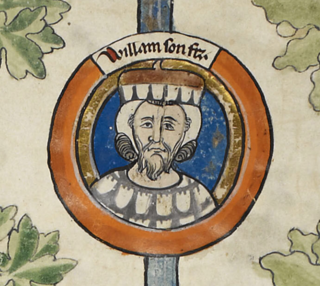
William Longsword was the second ruler of Normandy, from 927 until his assassination in 942.
Theobald I, called the Trickster, was Count of Blois, Tours, Chartres and Châteaudun, as well as Lord of Vierzon and Provins. He was a loyal and potent vassal of Hugh the Great, duke of the Franks.

Judith of Rennes was Duchess of Normandy from c. 1000 until her death.
Bernard the Dane is described by the tenth century ecclesiastical writer Dudo of Saint-Quentin as a 'warrior' of Rouen from 'Dacia', an ally and confidant of the first leaders of Normandy, political counsellor to Rollo's son William Longsword, and co-regent of the territory during the minority of his son and heir, Richard I of Normandy. In particular, Bernard is seen as being at the centre of events in the aftermath of the assassination of William Longsword.

The phrase more danico is a Medieval Latin legal expression which may be translated as "according to Danish custom", i.e. under Medieval Scandinavian customary law.
Sprota was an early 10th century woman of obscure origin who became wife 'in the Viking fashion' of William I, Duke of Normandy, by her becoming mother of his successor, Duke Richard I. After the death of William, she married a wealthy landowner, Esperleng, by him having another son, Norman nobleman Rodulf of Ivry.

Hugh III became Count of Maine on his father Hugh II's death, c. 991.
Hagrold, also known as Hagroldus, Harold, and Harald, was a powerful tenth-century Viking chieftain who ruled Bayeux. He was apparently a pagan from Scandinavia, and seems to have seized power in Normandy at about the time of the death of William, Count of Rouen. His career can be interpreted in the context of aiding the Normans against the intrusion of Frankish authority, or conversely in the context of taking advantage of the Normans.

Louis IV, called d'Outremer or Transmarinus, reigned as King of West Francia from 936 to 954. A member of the Carolingian dynasty, he was the only son of king Charles the Simple and his second wife Eadgifu of Wessex, daughter of King Edward the Elder of Wessex. His reign is mostly known thanks to the Annals of Flodoard and the later Historiae of Richerus.
References
- ↑ Flodoard, Annales, s.a. 943, p. 88.
- ↑ McNair, Fraser (2015). "The politics of being N orman in the reign of Richard the Fearless, Duke of Normandy (R. 942–996)". Early Medieval Europe. 23 (3): 308–328. doi: 10.1111/emed.12106 .
  | This French biographical article is a stub. You can help Wikipedia by expanding it. |
 | This French history–related article is a stub. You can help Wikipedia by expanding it. |