Related Research Articles

Erich Fritz Emil Mielke was a German communist official who served as head of the East German Ministry for State Security, better known as the Stasi, from 1957 until shortly after the fall of the Berlin Wall in 1989.
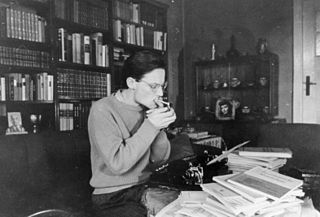
Wolfgang Harich was a philosopher and journalist in East Germany.
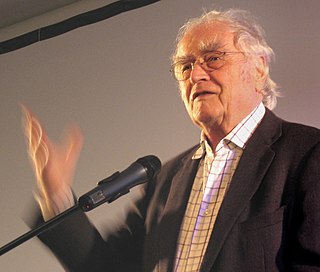
Martin Walser is a German writer.
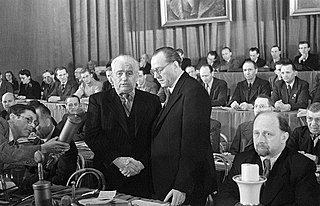
The Communist Party of Germany (KPD) and the Social Democratic Party of Germany (SPD) merged to form the Socialist Unity Party of Germany (SED) on 21 April 1946 in the territory of the Soviet occupation zone. It is considered a forced merger. In the course of the merger, about 5,000 Social Democrats who opposed it were detained and sent to labour camps and jails.
Carola Stern was the name under which Erika Assmus reinvented herself as a serious journalist and (subsequently) author and politically committed television presenter, after she was obliged to relocate at short notice from East Germany to West Germany in 1951.
Heinz Zöger was a German political journalist. Between 1968 and his death in 2000 he was married to Carola Stern.

Walter Janka was a German communist, political activist and writer who became a publisher.
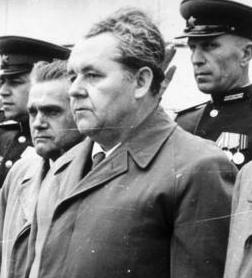
Paul Merker was an activist member of Germany's Communist Party who later became a politician and a top official of East Germany's ruling SED .

Ernst Melsheimer was a German lawyer.

Johann Burianek was a former Wehrmacht soldier and CIA-backed insurgent who planned and committed several attacks against the German Democratic Republic and a member of the "Struggle against Inhumanity" group .
Wolfgang Kaiser was a member of Rainer Hildebrandt's "Struggle against Inhumanty" group which campaigned against the one party dictatorship in the German Democratic Republic.

Rolf Schwanitz is a German national politician.
Hermann Weber was a German historian and political scientist. He has been described as "the man who knew everything about the German Democratic Republic".
Margarete "Grete" Fuchs-Keilson was a German politician and official in the Communist Party of Germany (KPD) and the Socialist Unity Party of Germany (SED).
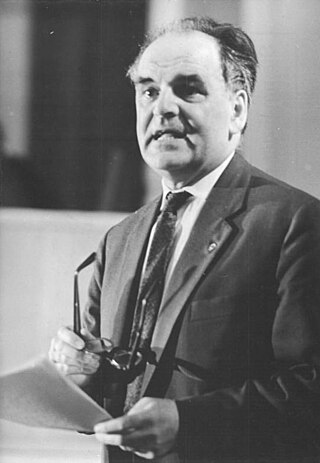
Ernst Engelberg was a German university professor and Marxist historian.

Karl Schirdewan was a German Communist activist who after World War II became a top East German politician.
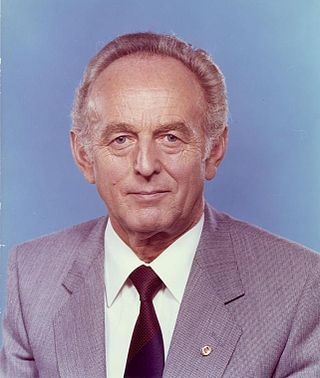
Gerhard Schürer was a leading politician in East Germany.

Ernst Lohagen was a German politician. He was a member both of the German parliament (Reichstag) before the Nazis took power in 1933 and of the East German equivalent assembly between 1946 and 1952, although under the Leninist power structure applied in East Germany it was his membership of the party Central Committee till 1952 that was of greater significance.
Bernhard Steinberger was a German engineer and economist. After 1945 he became an East German political dissident and / or victim, spending most of the period between 1949 and 1960 in prisons and labour camps. He had, by this time, already spent the war years accommodated in a succession of "emigrants' camps" in Switzerland, where he had arrived from Milan with his mother and sister in 1938 in order to escape the effects of newly introduced antisemitic legislation in Italy.
Ernst Jennrich worked as a gardener with an agricultural/horticultural cooperative in East Germany. He was a family man with four young sons. He did not smoke or drink: he could not even shoot straight. Overnight on 19/20 June 1953 police arrived to arrest him. He was able to look in on the room where his four children slept. Wolfgang, the eldest and Ernst, the second youngest, were awake. He was given time to reassure them that he had done nothing wrong before being taken away. Ernst Jennrich was executed at 4 in the morning on 17 March 1954. The party leadership had been badly unnerved by the short-lived popular revolt of June 1953. The authorities needed scapegoats following reports of police deaths. Jennrich was executed following a direct written instruction to the court from Hilde Benjamin, the Minister of Justice. On 20 August 1991 the original court verdict was overturned and Ernst Jennrich was (posthumously) rehabilitated by a decision of the district court (Bezirksgericht) in his home city of Magdeburg.
References
- ↑ "Kreis der Gleichgesinnten"
- ↑ Translation: Thomas Dunlap. "Documents - Culture: Appropriate Expressions in East Germany: Report of the Central Party Control Commission of the SED (Socialist Unity Party of German) on the Emergence and Goals of the "Harich Group" (March 26, 1957)". German History in Documents and Images (GHDI): Occupation and the Emergence of Two States (1945-1961). Retrieved 18 October 2014.
- ↑ "Nein, dafür hätte ich wohl kaum Interesse. Aber ich bin gern bereit, auf kulturellem Gebiet, in der Presse oder bei Studentenorganisationen mitzuwirken."
"No, I have very little interest in that. But I am more than ready to participate in the cultural sector, in the press, and with student organisations." - 1 2 Editor in chief: Rudolf Augstein (19 December 1956). "SOWJETZONE / HARICH". Der Spiegel (online). Retrieved 18 October 2014.
{{cite web}}:|author=has generic name (help) - 1 2 3 Editor in chief: Rudolf Augstein (4 June 1990). "A life-long lesson: from Wolfgang Harich's testimony at the Janka trial (Eine Lehre fürs ganze Leben: Aus Wolfgang Harichs Zeugenaussage für den Janka-Prozeß)". Der Spiegel (online). Retrieved 20 October 2014.
{{cite web}}:|author=has generic name (help) - ↑ "Zöger, Heinz: Chefredakteur der Wochenzeitung »Sonntag«". Bundesstiftung zur Aufarbeitung der SED-Diktatur: Biographische Datenbanken. Retrieved 18 October 2014.
- ↑ "Harich, Wolfgang: Philosoph, Publizist". Bundesstiftung zur Aufarbeitung der SED-Diktatur: Biographische Datenbanken. Retrieved 19 October 2014.
- 1 2 3 Karl Wilhelm Fricke (9 March 2007). "Anklage: Staatsverrat: Vor 50 Jahren: Der Harich-Prozess in Ostberlin". Deutschlandfunk, Köln. Retrieved 20 October 2014.
- ↑ "Ich glaube, ich habe im Laufe meines Plädoyers die Natur Harichs, den Menschen Harich, in all seiner Feigheit und Angst, in all seinem Ehrgeiz, in all seiner Anmaßung, in all seiner Überheblichkeit, in all seinem Karrierismus genügend geschildert. Er verdient eine schwere Strafe. Ein langjähriger Umerziehungsprozess ist bei Harich notwendig."
- ↑ "Mir ist es klar, dass der Staatssicherheit zu danken ist, dass sie also unseren Staat vor größerem Schaden bewahrt hat […] Ich wäre nämlich nicht mehr aufzuhalten gewesen. Ich war wie so ein durchgebranntes Pferd, das man nicht mehr durch Zurufe aufhält. Mit diesen Ideen im Kopf bin ich eben durchgegangen, und wenn sie mich nicht festgenommen hätten, dann wäre ich heute nicht reif für die zehn Jahre, die der Herr Generalstaatsanwalt beantragt hat, sondern für den Galgen. Und deshalb […] sage ich der Staatssicherheit also dafür meinen Dank."
- ↑ Ich erkläre […], dass es völlig ausgeschlossen ist, dass ich zu einem Hasser und zu einem Verräter an der Arbeiter-und-Bauern-Macht geworden bin oder jemals werden kann. Von meinen 43 Lebensjahren sind fast 30 Jahre […] mit der Arbeiterklasse, mit der kommunistischen Bewegung verbunden […] Es ist kein leeres Wort, dass ich mich lieber in Stücke reißen lasse, als dass ich Konzessionen machen würde und dem Kapitalismus jemals die Hand reichen würde.“