Harry Borrer Kirk (9 March 1859 – 1948) was a New Zealand school inspector, biologist and university professor.
He was born in Coventry, Warwickshire, England on 9 March 1859 to Thomas Kirk and Sarah Jane Mattocks, the family emigrated to New Zealand arriving in Auckland on 9 February 1863 and Wellington in 1874 when Thomas Kirk was appointed to Wellington College. Harry studied for University of New Zealand exams at home, gaining a BA in 1882 and a MA 1883, after which he joined the Department of Education first as a clerk and then as an inspector of native schools. As an inspector, he spend almost two decades travelling the country, collecting botanical specimens as he went. [1]
Coventry is a city and metropolitan borough in the West Midlands, England.
Thomas Kirk was an English-born botanist, teacher, public servant, writer and churchman who moved to New Zealand with his wife and four children in late 1862. The New Zealand government commissioned him in 1884 to compile a report on the indigenous forests of the country and appointed him as chief conservator of forests the following year. He published 130 papers in botany and plants including The Durability of New Zealand Timbers, The Forest Flora of New Zealand and Students' Flora of New Zealand.
Auckland is a city in the North Island of New Zealand. Auckland is the largest urban area in the country, with an urban population of around 1,628,900. It is located in the Auckland Region—the area governed by Auckland Council—which includes outlying rural areas and the islands of the Hauraki Gulf, resulting in a total population of 1,695,900. A diverse and multicultural city, Auckland is home to the largest Polynesian population in the world. The Māori-language name for Auckland is Tāmaki or Tāmaki-makau-rau, meaning "Tāmaki with a hundred lovers", in reference to the desirability of its fertile land at the hub of waterways in all directions.
As was typical at the time, Kirk saw Pākehā education as a force for 'elevating' Māori. [2] The 1880 Native Schools Code held that te reo Māori was only to be used to 'learn English more effectively' and Kirk stated in a report:
Pākehā is a Māori-language term for New Zealanders of European descent. The term has also recently come to refer inclusively either to fair-skinned persons, or to any non-Māori New Zealander. Papa'a has a similar meaning in Cook Islands Māori.
The Māori are the indigenous Polynesian people of New Zealand. Māori originated with settlers from eastern Polynesia, who arrived in New Zealand in several waves of canoe voyages some time between 1250 and 1300. Over several centuries in isolation, the Polynesian settlers developed a unique culture, with their own language, a rich mythology, and distinctive crafts and performing arts. Early Māori formed tribal groups based on eastern Polynesian social customs and organisation. Horticulture flourished using plants they introduced; later, a prominent warrior culture emerged.
I think the teacher should cease to use Maori in school when the necessary explanation can be made in English. It is quite likely that the children will readily understand instruction given in Maori and that they will make the greater progress in certain subjects, such as Writing and Arithmetic, but they will not trouble themselves to understand English if the teacher will speak Maori. It is to be borne in mind that English is not only an important subject in itself but that it is a 'key' subject to others.
— Harry Borrer Kirk, The Provision of Education Services to East Coast Maori. John Barrington, August 2007. quote taken from 'Inspection Report, Tikitiki, 15 March 1889.BAAA 1001/640c. ANZ-A. DB.'
In 1903 Kirk was appointed inaugural chair of biology to Victoria College (now Victoria University of Wellington) [3] and he largely devoted the rest of his life to building up the biology capabilities of the university. [1] [4] [5]
Victoria University of Wellington is a university in Wellington, New Zealand. It was established in 1897 by Act of Parliament, and was a constituent college of the University of New Zealand.
During the First World War he produced several innovations in military camps for to reduce fly contamination, [6] and he is said to have refused a Captain's commission. [7]
Kirk married Annie Lamont [1] (or La Monte [8] ) on 10 July 1885 in Dunedin. They had two children Ethelwin Gladys and Hilda Gyneth, Kirk lived with them after Annie's death in 1927. After he retired in 1944, he was cared for by his unmarried sister Cybele Ethel Kirk, [9] who had been active, along with their sister Lily May Kirk, [10] in the women's suffrage movement. [1] The family were active in the Baptist Union of New Zealand, [9] [10] with Harry being a listed as a Mortgagee in the Baptist Union Incorporation Act 1923 [11]

Cybele Ethel Kirk was a New Zealand temperance and welfare worker, suffragist, and teacher.
Women's suffrage in New Zealand was an important political issue in the late nineteenth century. In early colonial New Zealand, as in European societies, women were excluded from any involvement in politics. Public opinion began to change in the latter half of the nineteenth century, however, and after years of effort by women's suffrage campaigners, led by Kate Sheppard, New Zealand became the first self-governing colony in the world in which all women had the right to vote in parliamentary elections.
The Baptist Union of New Zealand is an association of Baptist churches in the country of New Zealand.
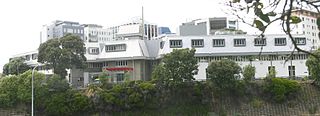
Two buildings on the Kelburn campus of Victoria University of Wellington are named after Kirk, called the Kirk Building and the Old Kirk Building [12]
The University of Otago is a collegiate university located in Dunedin, Otago, New Zealand. It scores highly for average research quality, and in 2006 was second in New Zealand only to the University of Auckland in the number of A-rated academic researchers it employs. In the past it has topped the New Zealand Performance Based Research Fund evaluation.
The Faculty of Education of Victoria University of Wellington was formed from the former School of Education of the University, and the former Wellington College of Education on 1 January 2005.
Public sector organisations in New Zealand comprise the state sector organisations plus those of local government.
Te Aho o Te Kura Pounamu or Te Kura is New Zealand's largest school with around 25,000 students enrolled each year, from early childhood to secondary level. It is headquartered in Portland Crescent in Thorndon, Wellington. In addition to its ordinary full-time students, Te Kura provides programmes to students at other state-owned schools where a subject is unavailable, and to adults. Te Kura is Ministry of Education funded.
In New Zealand, native schools were established to provide education for Māori. The first schools for Māori children were established by the Church Missionary Society (CMS) in the Bay of Islands after the arrival of the CMS in 1814. Bishop Pompallier arrived in 1838. Priests and brothers of the Marist order, established schools for the Māori throughout the country, including Hato Paora College (Feilding) and Hato Petera College (Auckland). St Joseph's Māori Girls' College (Taradale) was founded by the Sisters of Our Lady of the Missions.
Wellington High School is a co-educational secondary school in downtown Wellington, New Zealand. In 2005 the roll was approximately 1100 students. It was founded in the 1880s as the Wellington College of Design to provide a more appropriate education for the Dominion than the narrow academic training provided by the existing schools. It is the first co-educational secondary in New Zealand. It is one of only two schools in Wellington, and one of only a few New Zealand secondary schools that does not have a school uniform.
Wellington East Girls' College is a state single-sex girls' secondary school which sits directly above Mount Victoria Tunnel, Wellington, New Zealand. Serving Years 9 to 13, the school currently has 1079 students.
Te Whanganui-a-Tara is the Māori name for Wellington Harbour. The term is also sometimes used to refer to the city of Wellington, the capital city of New Zealand, which lies on the shores of the harbour. "Te Whanganui-a-Tara" translates as "the great harbour of Tara", which refers to the rangatira Tara, who Māori tradition says visited the area in the 12th century and decided to stay.
Karori is a suburb located at the western edge of the urban area of Wellington, New Zealand, 4 km from the city centre and is one of New Zealand's biggest suburbs having a population of over 14,000 at the time of the 2013 census.
Te Aute College is a school in the Hawke's Bay region of New Zealand. It opened in 1854 with twelve pupils under Samuel Williams, an Anglican missionary, and nephew and son-in-law of Bishop William Williams. It has a strong Māori character.
The Adam Art Gallery is a "purpose built" arts gallery located in the Kelburn Campus of Victoria University of Wellington in Wellington, New Zealand.
Shane William Cotton is a New Zealand painter whose work explores biculturalism, colonialism, cultural identity, Maori spirituality, and life and death.
Te Puni Kōkiri (TPK), the Ministry of Māori Development, is the public service department charged with advising the government on policies and issues affecting the Māori community; promoting Māori achievement in health, training and employment, education and economic development; and monitoring the provision of government services to Māori. The name means "a group moving forward together".

Hato Petera College was an integrated, co-educational college in Northcote Central, Auckland, New Zealand for students from Year 9 to Year 13. It existed for 90 years, opening on 3 June 1928 and closing on 31 August 2018. The school had a strong Catholic and Māori character. It was located on part of the land originally given by Sir George Grey, Governor of New Zealand, to Bishop Pompallier, the first Bishop of Auckland, in 1849 for education purposes.
Sir "Sidney" Hirini Moko Haerewa Mead, is a New Zealand anthropologist, historian, artist, teacher, writer and prominent Māori leader. Initially training as a teacher and artist, Mead taught in many schools in the East Coast and Bay of Plenty regions, and later served as principal of several schools. After earning his PhD in 1968, he taught anthropology in several universities abroad. He returned to New Zealand in 1977 and established the first Māori studies department in the country. Mead later became a prominent Māori advocate and leader, acting in negotiations on behalf of several tribes and sitting on numerous advisory boards. He has also written extensively on Māori culture. He is currently the chair of the council of Te Whare Wānanga o Awanuiārangi.
James Henry Pope (1837–1913) was a New Zealand teacher, school inspector, educationalist, amateur astronomer and writer. He was the first Inspector of Native schools in New Zealand in 1980. Pope was one of the founders of the Polynesian Society and was its President from 1899 to 1900. He was the father of the poet, cricketer and teacher Robert J. Pope
Hukarere Girls' College is a girls secondary boarding school in the Hawke's Bay region of New Zealand. It has a strong Māori character and follows the Anglican tradition. The School motto "Kia Ū Ki Te Pai" means "Cleave to that which is good" or "Abhor that which is evil".
The 1949 King's Birthday Honours in New Zealand, celebrating the official birthday of King George VI, were appointments made by the King on the advice of the New Zealand government to various orders and honours to reward and highlight good works by New Zealanders. They were announced on 9 June 1949.