
Bronze is an alloy consisting primarily of copper, commonly with about 12–12.5% tin and often with the addition of other metals and sometimes non-metals, such as phosphorus, or metalloids such as arsenic or silicon. These additions produce a range of alloys that may be harder than copper alone, or have other useful properties, such as strength, ductility, or machinability.

A metal is a material that, when freshly prepared, polished, or fractured, shows a lustrous appearance, and conducts electricity and heat relatively well. Metals are typically ductile and malleable. These properties are the result of the metallic bond between the atoms or molecules of the metal.

Smelting is a process of applying heat to an ore, to extract a base metal. It is a form of extractive metallurgy. It is used to extract many metals from their ores, including silver, iron, copper, and other base metals. Smelting uses heat and a chemical- reducing agent to decompose the ore, driving off other elements as gases or slag and leaving the metal base behind. The reducing agent is commonly a fossil fuel source of carbon, such as coke—or, in earlier times, charcoal. The oxygen in the ore binds to carbon at high temperatures as the chemical potential energy of the bonds in carbon dioxide is lower than the bonds in the ore.
Pewter is a malleable metal alloy consisting of tin (85–99%), antimony, copper (2%), bismuth, and sometimes silver. Copper and antimony act as hardeners, but lead may be used in lower grades of pewter, imparting a bluish tint. Pewter has a low melting point, around 170–230 °C (338–446 °F), depending on the exact mixture of metals. The word pewter is probably a variation of the word spelter, a term for zinc alloys.

Cookware and bakeware is food preparation equipment, such as cooking pots, pans, baking sheets etc. used in kitchens. Cookware is used on a stove or range cooktop, while bakeware is used in an oven. Some utensils are considered both cookware and bakeware.

Repoussé or repoussage is a metalworking technique in which a malleable metal is shaped by hammering from the reverse side to create a design in low relief. Chasing or embossing is a similar technique in which the piece is hammered on the front side, sinking the metal. The two techniques are often used in conjunction.

A coppersmith, also known as a brazier, is a person who makes artifacts from copper and brass. Brass is an alloy of copper and zinc. The term "redsmith" is used for a tinsmith that uses tinsmithing tools and techniques to make copper items.

Corrugated galvanised iron or steel, colloquially corrugated iron, wriggly tin, pailing, corrugated sheet metal and occasionally abbreviated CGI is a building material composed of sheets of hot-dip galvanised mild steel, cold-rolled to produce a linear ridged pattern in them. Although it is still popularly called "iron" in the UK, the material used is actually steel, and only the surviving vintage sheets may actually be made up of 100% iron. The corrugations increase the bending strength of the sheet in the direction perpendicular to the corrugations, but not parallel to them, because the steel must be stretched to bend perpendicular to the corrugations. Normally each sheet is manufactured longer in its strong direction.

The Gundestrup cauldron is a richly decorated silver vessel, thought to date from between 200 BC and 300 AD, or more narrowly between 150 BC and 1 BC. This places it within the late La Tène period or early Roman Iron Age. The cauldron is the largest known example of European Iron Age silver work. It was found dismantled, with the other pieces stacked inside the base, in 1891, in a peat bog near the hamlet of Gundestrup in the Aars parish of Himmerland, Denmark. It is now usually on display in the National Museum of Denmark in Copenhagen, with replicas at other museums; during 2015–16, it was in the UK on a travelling exhibition called The Celts.
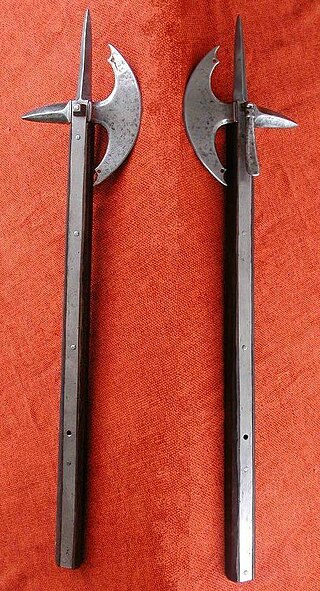
A battle axe is an axe specifically designed for combat. Battle axes were specialized versions of utility axes. Many were suitable for use in one hand, while others were larger and were deployed two-handed.
Plating is a surface covering in which a metal is deposited on a conductive surface. Plating has been done for hundreds of years; it is also critical for modern technology. Plating is used to decorate objects, for corrosion inhibition, to improve solderability, to harden, to improve wearability, to reduce friction, to improve paint adhesion, to alter conductivity, to improve IR reflectivity, for radiation shielding, and for other purposes. Jewelry typically uses plating to give a silver or gold finish.
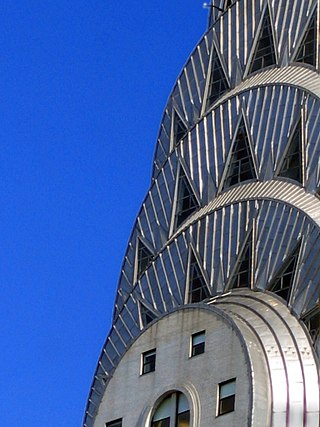
Sheet metal is metal formed into thin, flat pieces, usually by an industrial process. Sheet metal is one of the fundamental forms used in metalworking, and it can be cut and bent into a variety of shapes.
Tinplate consists of sheets of steel coated with a thin layer of tin to impede rusting. Before the advent of cheap milled steel, the backing metal was wrought iron. While once more widely used, the primary use of tinplate now is the manufacture of tin cans.

A tinsmith is a person who makes and repairs things made of tin or other light metals. The profession may sometimes also be known as a tinner, tinker, tinman, or tinplate worker; whitesmith may also refer to this profession, though the same word may also refer to an unrelated specialty of iron-smithing. By extension it can also refer to the person who deals in tinware, or tin plate. Tinsmith was a common occupation in pre-industrial times.

Tinning is the process of thinly coating sheets of wrought iron or steel with tin, and the resulting product is known as tinplate. The term is also widely used for the different process of coating a metal with solder before soldering.

A tin ceiling is an architectural element, consisting of a ceiling finished with plates of tin with designs pressed into them, that was very popular in Victorian buildings in North America in the late 19th and early 20th century. They were also popular in Australia where they were commonly known as pressed metal ceilings or Wunderlich ceilings. They were also used in South Africa.

Frederick Gottlieb Niedringhaus was a German-born American businessman and politician. He served as a U.S. Representative from Missouri.

Metals used for architectural purposes include lead, for water pipes, roofing, and windows; tin, formed into tinplate; zinc, copper and aluminium, in a range of applications including roofing and decoration; and iron, which has structural and other uses in the form of cast iron or wrought iron, or made into steel. Metal alloys used in building include bronze ; brass ; monel metal and nickel silver, mainly consisting of nickel and copper; and stainless steel, with important components of nickel and chromium.
There are many types of shears used to shear or cut sheet metal.
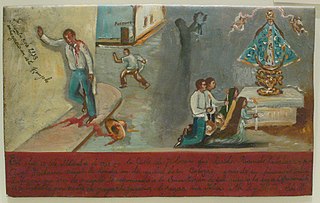
Votive paintings in Mexico go by several names in Spanish such as “ex voto,” “retablo” or “lámina,” which refer to their purpose, place often found, or material from which they are traditionally made respectively. The painting of religious images to give thanks for a miracle or favour received in this country is part of a long tradition of such in the world. The offering of such items has more immediate precedence in both the Mesoamerican and European lines of Mexican culture, but the form that most votive paintings take from the colonial period to the present was brought to Mexico by the Spanish. As in Europe, votive paintings began as static images of saints or other religious figures which were then donated to a church. Later, narrative images, telling the personal story of a miracle or favor received appeared. These paintings were first produced by the wealthy and often on canvas; however, as sheets of tin became affordable, lower classes began to have these painted on this medium. The narrative version on metal sheets is now the traditional and representative form of votive paintings, although modern works can be executed on paper or any other medium.

