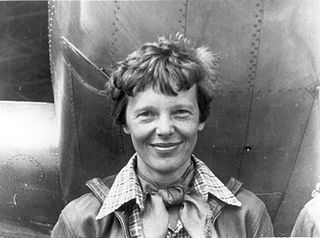
Amelia Mary Earhart was an American aviation pioneer. On July 2, 1937, Earhart disappeared over the Pacific Ocean while attempting to become the first female pilot to circumnavigate the world. During her life, Earhart embraced celebrity culture and women's rights, and since her disappearance, she has become a cultural icon. Earhart was the first female aviator to fly solo across the Atlantic Ocean and she set many other records; she was one of the first aviators to promote commercial air travel, wrote best-selling books about her flying experiences, and was instrumental in the formation of The Ninety-Nines, an organization for female pilots.

Bessie Coleman was an early American civil aviator. She was the first African-American woman and first Native American to hold a pilot license, and is the earliest known Black person to earn an international pilot's license. She earned her license from the Fédération Aéronautique Internationale on June 15, 1921.

Iris Louise McPhetridge Thaden was an American aviation pioneer, holder of numerous aviation records, and the first woman to win the Bendix trophy, alongside Blanche Noyes. She was inducted into the Arkansas Aviation Historical Society's Hall of Fame in 1980.

Frederick Joseph Noonan was an American flight navigator, sea captain and aviation pioneer, who first charted many commercial airline routes across the Pacific Ocean during the 1930s. As the flight navigator for famed aviator Amelia Earhart in their pioneering attempt at circumnavigating the globe, they disappeared somewhere over the central Pacific Ocean on July 2, 1937.
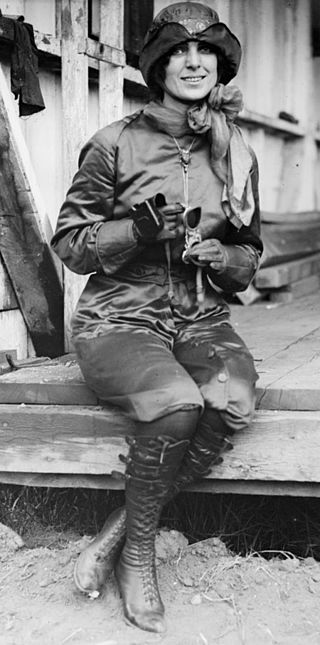
Harriet Quimby was an American pioneering aviator, journalist, and film screenwriter. In 1911, she became the first woman in the United States to receive a pilot's license and in 1912 the first woman to fly across the English Channel. Although Quimby died at the age of 37 in a flying accident, she strongly influenced the role of women in aviation.

Katherine Stinson was an American aviation pioneer who, in 1912, became the fourth woman in the United States to earn the FAI pilot certificate. She set flying records for aerobatic maneuvers, distance, and endurance. She was the first female pilot employed by the U.S. Postal Service and the first civilian pilot to fly the mail in Canada. She was also one of the first pilots to ever fly at night and the first female pilot to fly in Canada and Japan.

Julia Clark was the third woman to receive a pilot's license from the Aero Club of America, and the first American woman to die while piloting an airplane. She earned her pilot's license on May 19, 1912 and died less than one month later.

Mary Anita "Neta" Snook Southern was a pioneer aviator who achieved a long list of firsts. She was the first woman aviator in Iowa, first woman student accepted at the Curtiss Flying School in Virginia, first woman aviator to run her own aviation business and first woman to run a commercial airfield. Yet "Snooky", as her friends called her, was fated to be remembered for her relationship to Amelia Earhart. Her autobiography I Taught Amelia to Fly captures the essence of her fame and she is linked to Earhart, as her first instructor.
Janet Christine Dietrich was an American pilot and one of the Mercury 13 who underwent the same NASA testing in the early 1960s as the Mercury 7 astronauts.
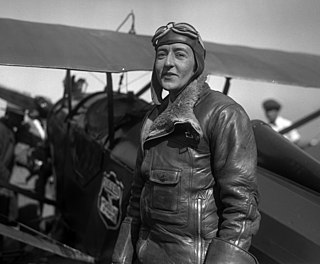
Evelyn "Bobbi" Trout was an early American aviator and endurance flying record holder. Trout began her aviation career at the age of 16; however, her first solo flight and solo certificate was not until April 30, 1928. In the spring of 1928, Trout’s mother bought her an International K-6 biplane. Trout received her pilot's identification card from the United States Department of Commerce on September 1, 1928. She was the second woman to break the non-refueling endurance record for women when she flew 12 hours straight from California in 1929. The record was previously held by Viola Gentry and was the first record where Fédération Aéronautique Internationale (FAI) rules of endurance were revised stating endurance records had to be broken by a full hour. Trout also participated in the Women's Air Derby of 1929, which was dubbed the Powder Puff Derby. In 2001, she was recognized as the only living participant in the first Women's Air Derby of 1929. Evelyn got her nickname "Bobbi" when she copied the hairstyle of 1928 actress Irene Castle, which was a short "bob" haircut.

Weldon Bagster Cooke was a pioneer aviator.

Katherine Sui Fun Cheung was a Chinese aviator. She received one of the first private licenses issued to a Chinese woman and was the first Chinese woman to obtain an international flying license. She became a United States citizen after attaining her licensure.

Geneve Lucy Angela Shaffer was an American realtor, lecturer and writer. In 1909 she was touted by the San Francisco Call as "the first woman in the world to sail in a flying machine".

Lydia Vissarionovna Zvereva was a Russian aviation pioneer who is credited with being the first woman in Russia to earn a pilot's license. Although she only lived to the age of 25, Zvereva is recognized for her feats as a female aviator. She competed in air shows in Eastern Europe, and later, with her husband Vladimir Victorovich Slusarenko, Zvereva operated an aircraft manufacturing factory in Riga.

Edna Emma Bissner Christofferson was an American aviator, markswoman, and radiographer. She was the wife of pioneering aviator Silas Christofferson.

Tom Tak Gunn (1890–1925) was the first Chinese-American pilot in the United States graduating from the Curtiss School of Aviation class of 1911 and earned pilot's license no. 131 on June 19, 1912. He popularized passenger flight in Hawaii and became the head of the Chinese air force.

Silas G. Christofferson was an American aviator. He was the brother of Harry Christofferson, a fellow Early Bird, and the husband of aviator and X-ray technician Edna Christofferson.
Maxine Dunlap Bennett, was an American aviator. She was the first licensed woman glider pilot and first woman glider club president in the United States. She flew her record-setting glider rating qualification flight over the sand dunes of Ocean Beach, San Francisco, California, on April 28, 1929, for a distance of 990 ft (300 m) and a flight duration of 50 seconds, exceeding the then-required minimum of 30 seconds, to obtain her Glider flying certificate.
Ivan Rhuele "Van" Gates was an American aviator and entrepreneur. While a member of the San Francisco Police Department, he is credited with being the first to transport a prisoner by air. He founded or co-founded the barnstorming Gates Flying Circus, which attained much success and fame in the 1920s. Later, he and designer Charles Healy Day established the Gates-Day Aircraft Company, subsequently renamed the New Standard Aircraft Company, to design and manufacture airplanes.
Margaret "Monte" Bartlett Thornton was a pilot, editor, and poet. In 1928 she flew as a passenger in an airmail biplane from New York to Oakland, using the trip to promote the work of airmail pilots. She flew across the continent a second time in April 1928, breaking the transcontinental air mail passenger record. In 1928 she began flying lessons and earned her pilot's license. When a heart condition prevented her from flying, she became a promoter of aviation alongside Amelia Earhart. Thornton was also a published poet.


