Related Research Articles

Pond Inlet is a small, predominantly Inuit community in the Qikiqtaaluk Region of Nunavut, Canada, located on northern Baffin Island. To the Inuit the name of the place "is and always has been Mittimatalik." The Scottish explorer Sir John Ross had named an arm of the sea that separates Bylot Island from Baffin Island as Pond's Bay, and the hamlet now shares that name. On 29 August 1921, the Hudson's Bay Company opened its trading post near the Inuit camp and named it Pond Inlet, marking the expansion of its trading empire into the High Arctic.

Rankin Inlet is an Inuit hamlet on the Kudlulik Peninsula in Nunavut, Canada. It is the largest hamlet and second-largest settlement in Nunavut, after the territorial capital, Iqaluit. On the northwestern Hudson Bay, between Chesterfield Inlet and Arviat, it is the regional centre for the Kivalliq Region.

The Kivalliq Region is an administrative region of Nunavut, Canada. It consists of the portion of the mainland to the west of Hudson Bay together with Southampton Island and Coats Island. The regional centre is Rankin Inlet. The population was 10,413 in the 2016 Census, an increase of 16.3% from the 2011 Census.

Arviat is a predominantly Inuit hamlet located on the western shore of Hudson Bay in the Kivalliq Region of Nunavut, Canada. Arviat is derived from the Inuktitut word arviq meaning "Bowhead whale". Earlier in history, its name was Tikirajualaaq, and Ittaliurvik,.
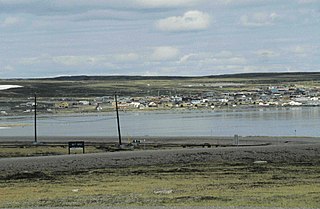
Baker Lake is a hamlet in the Kivalliq Region, in Nunavut on mainland Canada. Located 320 km (200 mi) inland from Hudson Bay, it is near the nation's geographical centre, and is notable for being Nunavut's sole inland community. The hamlet is located at the mouth of the Thelon River on the shore of Baker Lake. The community was given its English name in 1761 from Captain William Christopher who named it after Sir William Baker, the 11th Governor of the Hudson's Bay Company.
The Indigenous peoples in Northern Canada consist of the First Nations, Métis, and Inuit located in Canada's three territories: Northwest Territories, Nunavut, and Yukon.

Whale Cove, is a hamlet located 74 km (46 mi) south southwest of Rankin Inlet, 145 km (90 mi) northeast of Arviat, in the Kivalliq Region, Nunavut, Canada, on the western shore of Hudson Bay.

Ennadai Lake is a lake in the Kivalliq Region, Nunavut, Canada. It is 84 km (52 mi) long, and 4.8 to 22.5 km wide. It is drained to the north by the Kazan River. A 615 km (382 mi) section of the Kazan River from the outlet of Ennadai Lake to Baker Lake, was designated as a part of the Canadian Heritage Rivers System in 1990.
Richard Harrington, was a Canadian photographer. He is best known for his photographs taken in the Canadian Arctic between 1948 and 1953, including his iconic shot of the 1950 Canadian caribou famine and his 1949 photograph of Helen Konek.
Disc numbers, or ujamiit or ujamik in the Inuit language, were used by the Government of Canada in lieu of surnames for Inuit and were similar to dog tags.
The Ahiarmiut ᐃᓴᓪᒥᐅᑦ [ihalmiˈut] or Ihalmiut or are a group of inland Inuit who lived along the banks of the Kazan River, Ennadai Lake, and Little Dubawnt Lake, as well as north of Thlewiaza River, in northern Canada's Keewatin Region of the Northwest Territories, now the Kivalliq Region of present-day Nunavut.
Arctic Co-operatives Limited is a cooperative federation owned and controlled by 32 community-based cooperative business enterprises located in Nunavut, Northwest Territories, Yukon and northern Manitoba, Canada. Arctic Co-ops coordinates resources, consolidates the purchasing power and provides operational and technical support to the community-based co-operatives to enable them to provide a wide range of services to their local member-owners. Arctic Co-ops operates in both English and Inuktitut and provides patronage dividends to the local members.

Caribou Inuit, barren-ground caribou hunters, are Inuit who live west of Hudson Bay in Kivalliq Region, Nunavut, between 61° and 65° N and 90° and 102° W in Northern Canada. They were originally named "Caribou Eskimo" by the Danish Fifth Thule Expedition of 1921–1924 led by Knud Rasmussen. Caribou Inuit are the southernmost subgroup of the Central Inuit.

Historically Inuit cuisine, which is taken here to include Greenlandic cuisine, Yup'ik cuisine and Aleut cuisine, consisted of a diet of animal source foods that were fished, hunted, and gathered locally.
Padlei is a former community in the Kivalliq Region of Nunavut, Canada. It is located on the mainland on the north shore of Kinga (Kingarvalik) Lake at the juncture of the Maguse River. Whale Cove is to the east, while the Henik Lakes are to the southwest.
Ennadai is a former populated place in the Kivalliq Region, Nunavut, Canada. Located on a peninsula that juts into northeastern Ennadai Lake it faces an unnamed island. It is 400 km (250 mi) northwest of Churchill, Manitoba and 1,050 km (650 mi) west of Arviat. Ennadai and the surrounding area has been the traditional home of the Ahiarmiut (Ihalmiut), a Caribou Inuit band.

Inuit Nunangat is the homeland of the Inuit in Canada. This Arctic homeland consists of four northern Canadian regions called the Inuvialuit Settlement Region, the territory Nunavut (ᓄᓇᕗᑦ), Nunavik (ᓄᓇᕕᒃ) in northern Québec, and Nunatsiavut of Newfoundland and Labrador.
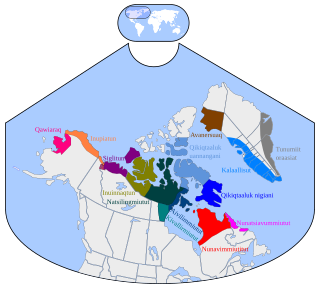
Kivalliq, also known as Kivallirmiutut, Caribou Eskimo, or formerly as Keewatin, is a dialect of Eastern Canadian Inuktitut which is spoken along the northwestern shores of Hudson Bay in Nunavut.
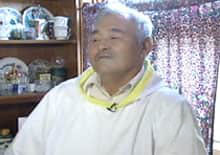
Simonie Michael was a Canadian politician from the eastern Northwest Territories who was the first Inuk elected to a legislature in Canada. Before becoming involved in politics, Michael worked as a carpenter and business owner, and was one of very few translators between Inuktitut and English. He became a prominent member of the Inuit co-operative housing movement and a community activist in Iqaluit, and was appointed to a series of governing bodies, including the precursor to the Iqaluit City Council.

The UtkuhiksalingmiutUkukhalingmiut, Utkukhalingmiut —the people of the place where there is soapstone—is one of 48 groups of Inuit in what is now Nunavut, Canada. Their traditional land was around Chantrey Inlet (Tariunnuaq) area, near the estuary of the Back River in, what was then called, the Keewatin District of the Northwest Territories. The Utkuhiksalingmiut followed the traditional hunter-nomadic life moving from fishing the camp near the mouth of the Back River on Chantrey Inlet to their caribou hunting camp in the Garry Lake area, living in winter snow houses (igloos) and caribou skin tents in the summer. They subsisted mainly on trout, whitefish, and barren-ground caribou.
References
- 1 2 3 4 5 Brockman, Alex (6 May 2019). "'It's amazing to me': Meet the Inuk elder in this photo shared around the world". CBC.
- ↑ Helen Konek , National Gallery of Canada
- 1 2 3 4 5 6 7 8 Gerald Kuehl, Portraits of the Far North (volume 2), ISBN 9781989282328, 2022
- ↑ Atiqput: Inuit Oral History and Project Naming. (2022). United Kingdom: McGill-Queen's University Press. p59
- 1 2 Payne, Carol. (2013). The Official Picture: The National Film Board of Canada's Still Photography Division and the Image of Canada, 1941-1971. Canada: McGill-Queen's University Press. p183
- ↑ Jordan Konek, Tweet of 27 Oct 2019.
- ↑ Laugrand, F. B., Oosten, J. G. (2014). Inuit Shamanism and Christianity: Transitions and Transformations in the Twentieth Century. United States: McGill-Queen's University Press.

