
In general, kung fu or kungfu refers to the Chinese martial arts also called quanfa. In China, it refers to any study, learning, or practice that requires patience, energy, and time to complete. In its original meaning, kung fu can refer to any discipline or skill achieved through hard work and practice, not necessarily martial arts. The literal equivalent of "Chinese martial art" in Mandarin would be 中國武術 zhōngguó wǔshù.
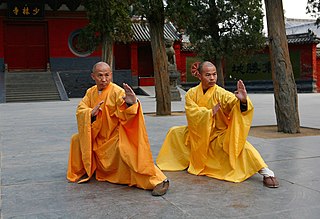
Neijia is the collective name for the internal Chinese martial arts. It relates to those martial arts occupied with spiritual, mental or qi-related aspects, as opposed to an "external" approach focused on physiological aspects. The distinction dates to the 17th century, but its modern application is due to publications by Sun Lutang, dating to the period of 1915 to 1928. Neijin is developed by using neigong or "internal changes", contrasted with waigong or "external exercises".

Tai chi is an ancient Chinese martial art. Initially developed for combat and self-defense, it has evolved into a sport and form of exercise. Tai chi is a gentle, low-impact form of exercise in which practitioners perform a series of deliberate, flowing motions while focusing on deep, slow breaths. Often referred to as "meditation in motion," tai chi aims to concentrate and balance the body's qi, providing benefits to mental and physical health.

Shaolin kung fu, also called Shaolin Wushu, or Shaolin quan, is one of the oldest, largest, and most famous styles of wushu, or kung fu of Chan Buddhism. It combines Chan philosophy and martial arts. It was developed in the Shaolin Temple in Henan province, Greater China during its 1500-year history. Popular sayings in Chinese folklore related to this practice include "All martial arts under heaven originated from Shaolin" and "Shaolin kung fu is the best under heaven," indicating the influence of Shaolin kung fu among martial arts. The name Shaolin is also used as a brand for the so-called external styles of kung fu. Many styles in southern and northern China use the name Shaolin.
Chinese martial arts, commonly referred to with umbrella terms kung fu, kuoshu or wushu, are multiple fighting styles that have developed over the centuries in Greater China. These fighting styles are often classified according to common traits, identified as "families" of martial arts. Examples of such traits include Shaolinquan (少林拳) physical exercises involving All Other Animals (五形) mimicry or training methods inspired by Old Chinese philosophies, religions and legends. Styles that focus on qi manipulation are called internal, while others that concentrate on improving muscle and cardiovascular fitness are called external. Geographical associations, as in northern and southern, is another popular classification method.
Bow-sim Mark is a Chinese martial arts grandmaster who lives in Newton, Massachusetts, US. She is the mother of martial arts film star, Donnie Yen.

Wushu, or kung fu, is a competitive Chinese martial art. It integrates concepts and forms from various traditional and modern Chinese martial arts, including Shaolin kung fu, tai chi, and Wudangquan. "Wushu" is the Chinese term for "martial arts", reflecting the art's goal as a compilation and standardization of various styles.
Scott M. Rodell is a martial artist, author, and teacher of Yang-style taijiquan. He is the founding director of Great River Taoist Center, a non-profit organization based in Washington, D.C.
Stephan Berwick is an American author, martial artist, and actor known for his scholarly research on traditional Chinese martial arts – particularly Chen-style taijiquan, and roles in early Yuen Wo-ping Hong Kong Action films.

Sam Masich is a tai chi instructor, performing songwriter and filmmaker residing in Vancouver, British Columbia, Canada and Berlin, Germany.

Chang Dsu Yao was a teacher of the martial arts Meihuaquan and tai chi.
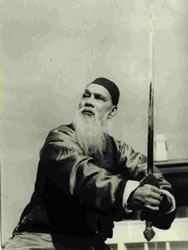
Wang Ziping was a Chinese Muslim practitioner of Chinese Martial Arts and traditional medicine from Cangzhou, Cangxian county, Mengcun, Hebei Province. He served as the leader of the Shaolin kung fu division of the Martial Arts Institute in 1928 and was also the vice chairman of the Chinese Wushu Association. Wang was known for his mastery of Chaquan, Huaquan, Leopard kung fu, Bajiquan, and tai chi. He was also a master of Wushu.
Wang Jurong was a Chinese-Muslim martial artist and Wushu professor in the Shanghai Institute of Physical Education.

Chen Xiaowang is an Australian-Chinese tai chi teacher, who was born and raised in Chen Family Village, Wen County, Henan province, and is the 19th generation lineage holder of Chen-style tai chi. His grandfather was the tai chi grandmaster Chen Fake.

Doc-Fai Wong is a master of tai chi and the Hung Sing branch of Choy Li Fut kung fu. He was born in 1948 in the Guangdong province of China, specifically, the Wangshan village in the Doumen District of Zhuhai. In April 1960, he and his mother immigrated to San Francisco, California to be reunited with his father. He arrived as a third-generation citizen of the United States of America since both his grandfather and father were already citizens. He sought out his first kung fu teacher - Lau Bun (劉彬), the founder of the first Hung Sing Kwoon of Choy Li Fut in America, after encountering taunting and bullying due to language and ethnic difficulties after his arrival. When Lau Bun died in 1967, he started teaching and opened his first school when he was 19 years old.
Wudangquan is a class of Chinese martial arts. In contemporary China, Chinese martial arts styles are generally classified into two major groups: Wudang (Wutang), named after the Wudang Mountains; and Shaolin, named after the Shaolin Monastery. Whereas Shaolin includes many martial art styles, Wudangquan includes only a few arts that use the focused mind to control the body. This typically encompasses tai chi, xingyiquan and baguazhang, but must also include bajiquan and Wudang Sword. Although the name Wudang simply distinguishes the skills, theories and applications of the internal arts from those of the Shaolin styles, it misleadingly suggests these arts originated at the Wudang Mountains. The name Wudang comes from a popular Chinese legend that incorrectly purports the genesis of tai chi and Wudang Sword by an immortal, Taoist hermit named Zhang Sanfeng who lived in the monasteries of Wudang Mountain. Wudang quan is often used synonymously with Neijia, but Neijia is a broader term that also encompasses Aikido and Qigong, which are not Wudang quan.
Philip Sahagun is a martial arts champion in both forms and fighting. With a background in American Kenpo, Kickboxing, Wushu and Shaolin Kung Fu, Philip is a 7-time National Weapons Champion and a 3-Time International Martial Arts Council Grand Champion. Philip has been a semi-finalist on America's Got Talent, as well as a contestant on two of China's top-rated reality competitions, Kung Fu Star and Jackie Chan's Disciple. In 2008 & 2009 He toured as a martial arts ‘Ninja’ performer for Tina Turner's 50th Anniversary World Tour. He has taught martial arts extensively and represented America twice at the World Traditional Wushu Festival in China where he won both gold and silver medals for the U.S. Team. In 2010 he founded the group "Kung Fu Heroes" an international martial arts team whose mission is to unite individuals seeking to become "Heroes" and positive role models in local and worldwide communities in December 2014, Philip Sahagun moved to Las Vegas to begin a new artistic journey under the guidance of Cirque Du Soleil's artistic directors Ria Martins and Pierre Parisien which eventually led to the creation of multiple martial arts inspired sequences for Zumanity.
Chan Kowk-wai was born on 3 April 1936, in Taishan in the province of Guangdong, China. He introduced traditional Shaolin kung fu to Brazil through the China-Brazil Kung Fu Academy. His disciples have spread as far as the USA, Canada, Spain, Argentina and the Czech Republic.
The United States of America Wushu Kungfu Federation (USAWKF) is the governing body of wushu-kungfu in the United States. The USAWKF manages and selects the members of the US Wushu Team to compete in various international competitions including the World Wushu Championships, World Junior Wushu Championships, World Kungfu Championships, and the World Taijiquan Championships. The USAWKF also develops regional and national activities relating to Wushu, and has had great influence on how wushu taolu and sanda events are run in the United States. The USAWKF is a member of the Pan-American Wushu Federation (PAWF) and the International Wushu Federation (IWUF).

Hsu, Chi, commonly known as Adam Hsu is a martial artist and essayist known for his expertise in various forms of Chinese martial arts. Hsu was born in mainland China in 1941 and later moved to Taiwan, where he has operated for most of his life.


