Related Research Articles
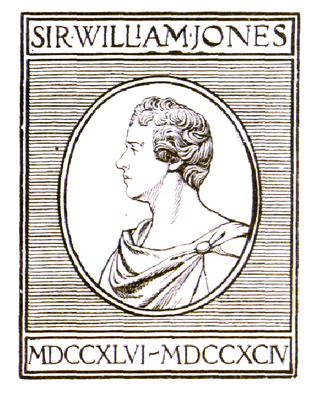
The Asiatic Society is a government of India organisation founded during the Company rule in India to enhance and further the cause of "Oriental research", in this case, research into India and the surrounding regions. It was founded by the philologist William Jones on 15 January 1784 in a meeting presided over by Justice Robert Chambers in Calcutta, the then-capital of the Presidency of Fort William.

James Prinsep FRS was an English scholar, orientalist and antiquary. He was the founding editor of the Journal of the Asiatic Society of Bengal and is best remembered for deciphering the Kharosthi and Brahmi scripts of ancient India. He studied, documented and illustrated many aspects of numismatics, metallurgy, meteorology apart from pursuing his career in India as an assay master at the mint in Benares.

The Bengal Presidency, officially the Presidency of Fort William and later Bengal Province, was a subdivision of the British Empire in India. At the height of its territorial jurisdiction, it covered large parts of what is now South Asia and Southeast Asia. Bengal proper covered the ethno-linguistic region of Bengal. Calcutta, the city which grew around Fort William, was the capital of the Bengal Presidency. For many years, the Governor of Bengal was concurrently the Viceroy of India and Calcutta was the de facto capital of India until 1911.

Ishwar Chandra Vidyasagar CIE, born Ishwar Chandra Bandyopadhyay, was an Indian educator and social reformer of the nineteenth century. His efforts to simplify and modernise Bengali prose were significant. He also rationalised and simplified the Bengali alphabet and type, which had remained unchanged since Charles Wilkins and Panchanan Karmakar had cut the first (wooden) Bengali type in 1780.

Faridpur District is a district in south-central Bangladesh. It is a part of the Dhaka Division. It is bounded by the Padma River to its northeast. The district was named after Farīd-ud-Dīn Masʿūd, a 13th century Sufi saint. A separate district was created by severing Dhaka district in 1786 and was called Dacca Jelalpur. A municipality was established in 1869. Historically, the town was known as Fatehabad. It was also called Haveli Mahal Fatehabad.

Sir Brajendra Nath Seal was a Bengali Indian humanist philosopher. He served as the second vice chancellor of Mysore University.
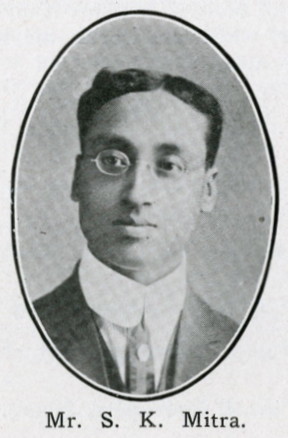
Sisir Kumar Mitra MBE, FNI, FASB, FIAS, FRS was an Indian physicist.
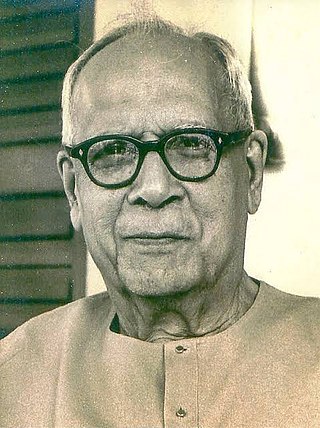
Ramesh Chandra Majumdar was a historian and professor of Indian history. Majumdar is a noted historian of modern India. He was a former Sheriff of Kolkata.
Lawrence Samuel Durrell was a British engineer, best remembered as the father of novelist Lawrence Durrell and naturalist and writer Gerald Durrell.
Alfred William Begbie was a British civil servant in India.

Ubaidullah Al Ubaidi Suhrawardy was a Bengali Islamic scholar, educationist and writer from Midnapore.

James Atkinson was a surgeon, artist and Persian scholar — "a Renaissance man among Anglo-Indians" First arriving in India in 1802, he was later appointed Assistant to the Assay Master at the Calcutta Mint ten years later; and also was editor of the Calcutta Gazette. Closely associated with the English colonial authorities and their community in India, he would meet Lord Minto and Lord Bentick, the latter of whom he had a notorious disagreement with. He was also known for his journals while in Afghanistan in the 1840s.
Colonel Nicholas Gassaway was a colonial military and political leader and justice in early Maryland. He is the progenitor of the some five and a half thousand Americans who bear the family name in the 2000 census.

Sir Muhammad Azizul Haque, KCSI, CIE, also known as Muhammad Azizul Huq or Mohammad Azizul Huque, was a Bengali lawyer, writer and public servant. He studied at Presidency College and University Law College in Calcutta. He worked to better the condition of Muslim people, primarily in the rural farmlands. This led him to work with Sher-e-Bangla A.K. Fazlul Haque, Sir Abdulla Suhrawardy, Sir Salimullah and Muhammad Ali Jinnah. He remained friends with many throughout his life.
James William Grant FRSE FRAS, 3rd Laird of Wester Elchies (1788–1865) was a Scottish astronomer and landowner. On 23 July 1844 he was the first person to observe and record the existence of the star Antares B.
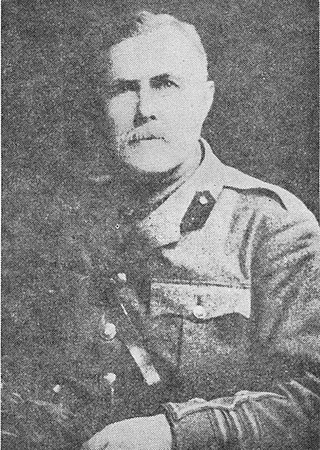
Dirom Grey Crawford was an Indian-born British physician and officer of the Indian Medical Service (IMS). He rose to the rank of lieutenant colonel before retiring in 1911 and returning to serve on hospital ships during the First World War when he was mentioned in dispatches. He wrote a history of the IMS as well as the roll of its members which included biographical details of 6,156 of its officers.

Major-General Sir Peter Melvill Melvill was a British military commander in the Bombay Army who was military and naval secretary to the Governor of Bombay.
Majd ad-Dīn al-Madanī, also known as Madan Shāhjahānpūrī, was an 18th-century Indian Muslim theologian. He served as the first principal of the Calcutta Madrasa, the first Alia Madrasa of Bengal.
Major-general Sir James Rutherford Lumley KCB (1773–1846) was an English soldier of the Bengal Army in British India.
References
- 1 2 3 4 Hayavadana Rao, C. (Ed.) (1915) The Indian biographical dictionary 1915. Madras: Pillar & Co. pp. 359-360.
- ↑ India Births and Baptisms, 1786-1947. familysearch.org Retrieved 29 December 2016.
- ↑ "Marriages", The Times , 5 June 1895, p. 1.
- 1 2 3 4 The Cobbold Family History Trust Retrieved 29 December 2016.
- ↑ India Births and Baptisms, 1786-1947. familysearch.org Retrieved 29 December 2016.
- ↑ England Births and Christenings, 1538-1975. familysearch.org Retrieved 29 December 2016.
- ↑ India Births and Baptisms, 1786-1947. familysearch.org Retrieved 29 December 2016.
- ↑ India Births and Baptisms, 1786-1947. familysearch.org Retrieved 29 December 2016.
- ↑ India Births and Baptisms, 1786-1947. familysearch.org Retrieved 29 December 2016.
- ↑ India Births and Baptisms, 1786-1947. familysearch.org Retrieved 29 December 2016.
- ↑ England Births and Christenings, 1538-1975. familysearch.org Retrieved 29 December 2016.
