
Python is a high-level, general-purpose programming language. Its design philosophy emphasizes code readability with the use of significant indentation.

MediaWiki is free and open-source wiki software originally developed by Magnus Manske for use on Wikipedia on January 25, 2002, and further improved by Lee Daniel Crocker, after which it has been coordinated by the Wikimedia Foundation. It powers several wiki hosting websites across the Internet, as well as most websites hosted by the Foundation including Wikipedia, Wiktionary, Wikimedia Commons, Wikiquote, Meta-Wiki and Wikidata, which define a large part of the set requirements for the software.
Trac is an open-source, web-based project management and bug tracking system. It has been adopted by a variety of organizations for use as a bug tracking system for both free and open-source software and proprietary projects and products. Trac integrates with major version control systems including Subversion and Git. Trac is used, among others, by the Internet Research Task Force, Django, FFmpeg, jQuery UI, WebKit, 0 A.D., and WordPress.

Git is a distributed version control system that tracks changes in any set of computer files, usually used for coordinating work among programmers who are collaboratively developing source code during software development. Its goals include speed, data integrity, and support for distributed, non-linear workflows.

Mantis Bug Tracker is a free and open source, web-based bug tracking system. The most common use of MantisBT is to track software defects. However, MantisBT is often configured by users to serve as a more generic issue tracking system and project management tool.

Django is a free and open-source, Python-based web framework that runs on a web server. It follows the model–template–views (MTV) architectural pattern. It is maintained by the Django Software Foundation (DSF), an independent organization established in the US as a 501(c)(3) non-profit.
A source-code-hosting facility is a file archive and web hosting facility for source code of software, documentation, web pages, and other works, accessible either publicly or privately. They are often used by open-source software projects and other multi-developer projects to maintain revision and version history, or version control. Many repositories provide a bug tracking system, and offer release management, mailing lists, and wiki-based project documentation. Software authors generally retain their copyright when software is posted to a code hosting facilities.

Mercurial is a distributed revision control tool for software developers. It is supported on Microsoft Windows, Linux, and other Unix-like systems, such as FreeBSD and macOS.
Notable issue tracking systems, including bug tracking systems, help desk and service desk issue tracking systems, as well as asset management systems, include the following. The comparison includes client-server application, distributed and hosted systems.
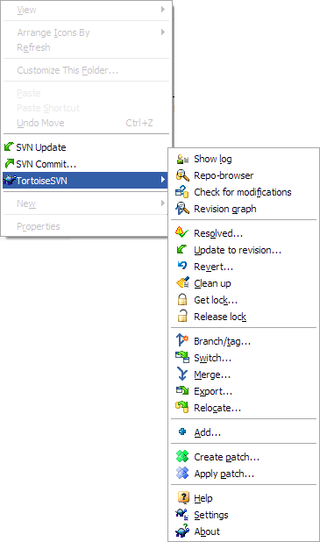
TortoiseSVN is a Subversion client, implemented as a Microsoft Windows shell extension, that helps programmers manage different versions of the source code for their programs. It is free software released under the GNU General Public License.
In software development, version control is a class of systems responsible for managing changes to computer programs or other collections of information such that revisions have a logical and consistent organization. The following tables include general and technical information on notable version control and software configuration management (SCM) software. For SCM software not suitable for source code, see Comparison of open-source configuration management software.

GNU Bazaar is a distributed and client–server revision control system sponsored by Canonical.
IronRuby is an implementation of the Ruby programming language targeting Microsoft .NET Framework. It is implemented on top of the Dynamic Language Runtime (DLR), a library running on top of the Common Language Infrastructure that provides dynamic typing and dynamic method dispatch, among other things, for dynamic languages.
Jira is a proprietary product developed by Atlassian that allows bug tracking, issue tracking and agile project management. Jira is used by a large number of clients & users globally for project, time, requirements, task, bug, change, code, test, release, sprint management.
Bitbucket is a Git-based source code repository hosting service owned by Atlassian. Bitbucket offers both commercial plans and free accounts with an unlimited number of private repositories.

TortoiseHg is a GUI front-end for Mercurial that runs on Microsoft Windows, Mac OS X, and Linux.

Cloud9 IDE is an Online IDE, published as open source from version 2.0, until version 3.0. It supports multiple programming languages, including C, C++, PHP, Ruby, Perl, Python, JavaScript with Node.js, and Go.

The Chromium Embedded Framework (CEF) is an open-source software framework for embedding a Chromium web browser within another application. This enables developers to add web browsing functionality to their application, as well as the ability to use HTML, CSS, and JavaScript to create the application's user interface.

RhodeCode is an open source self-hosted platform for behind-the-firewall source code management. It provides centralized control over Git, Mercurial, and Subversion repositories within an organization, with common authentication and permission management. RhodeCode allows forking, pull requests, and code reviews via a web interface.

The KDE Gear is a set of applications and supporting libraries that are developed by the KDE community, primarily used on Linux-based operating systems but mostly multiplatform, and released on a common release schedule.

