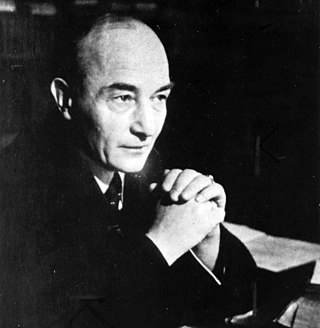
Robert Musil was an Austrian philosophical writer. His unfinished novel, The Man Without Qualities, is generally considered to be one of the most important and influential modernist novels.

Hugo Laurenz August Hofmann von Hofmannsthal was an Austrian novelist, librettist, poet, dramatist, narrator, and essayist.
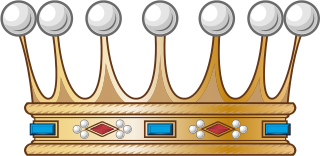
Freiherr, Freifrau and Freiin are designations used as titles of nobility in the German-speaking areas of the Holy Roman Empire and in its various successor states, including Austria, Prussia, Bavaria, Liechtenstein, Luxembourg, etc. Traditionally, it denotes the titled rank within the nobility above Ritter (knight) and Edler and below Graf. The title superseded the earlier medieval form, Edelherr.
In early modern Europe, particularly in Germany, a court Jew or court factor was a Jewish banker who handled the finances of, or lent money to, royalty and nobility. In return for their services, court Jews gained social privileges, including, in some cases, being granted noble status.

The Austrian nobility is a status group that was officially abolished in 1919 after the fall of Austria-Hungary. Austria's system of nobility was very similar to that of Germany, as both countries were previously part of the Holy Roman Empire (962–1806).
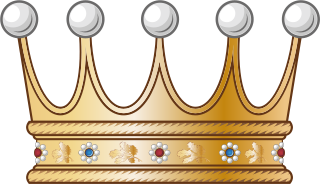
Edler was until 1919 the lowest rank of nobility in Austria-Hungary and Germany, just beneath a Ritter, but above untitled nobles, who used only the nobiliary particle von before their surname. It was mostly given to civil servants and military officers, as well as those upon whom the lower rank of an Order had been conferred. The noun Edler comes from the adjective edel ("noble"), and translated literally means "noble [person]". In accordance with the rules of German grammar, the word can also appear as Edle, Edlem, or Edlen depending on case, gender, and number.
Löw is a surname of German or Yiddish origin. Another romanization of the Yiddish name לייב is Leib. It may refer to:
The German nobility and royalty were status groups of the medieval society in Central Europe, which enjoyed certain privileges relative to other people under the laws and customs in the German-speaking area, until the beginning of the 20th century. Historically, German entities that recognized or conferred nobility included the Holy Roman Empire (962–1806), the German Confederation (1814–1866) and the German Empire (1871–1918). Chancellor Otto von Bismarck in the German Empire had a policy of expanding his political base by ennobling nouveau riche industrialists and businessmen who had no noble ancestors. The nobility flourished during the dramatic industrialization and urbanization of Germany after 1850. Landowners modernized their estates, and oriented their business to an international market. Many younger sons were positioned in the rapidly growing national and regional civil service bureaucracies, as well as in the officer corps of the military. They acquired not only the technical skills but the necessary education in high prestige German universities that facilitated their success. Many became political leaders of new reform organizations such as agrarian leagues, and pressure groups. The Roman Catholic nobility played a major role in forming the new Centre Party in resistance to Bismarck's anti-Catholic Kulturkampf, while Protestant nobles were similarly active in the Conservative Party.

Isaak Löw Hofmann, Edler von Hofmannsthal was an Austrian merchant.

Prostiboř is a municipality and village in Tachov District in the Plzeň Region of the Czech Republic. It has about 300 inhabitants.

The House of Leyen-Hohengeroldseck is an ancient German noble family of princely and historically sovereign rank. As a former ruling and mediatized family, it belongs to the Hochadel.

Ava Alice Muriel Astor was an American heiress, socialite, and member of the Astor family. She was the daughter of John Jacob Astor IV and Ava Lowle Willing, and sister of Vincent Astor and half-sister of John Jacob Astor VI.

Augustin Emil Hofmann von Hofmannsthal was an Austrian industrialist.
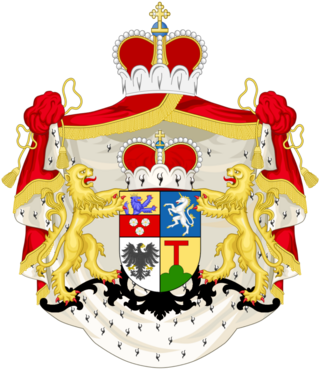
The Henckel von Donnersmarck family is an Austro-German noble family that originated in the former region of Spiš in Upper Hungary. The founder of the family was Henckel de Quintoforo in the 14th century. The original seat of the family was in Donnersmarck, which was then within the Kingdom of Hungary but is now part of Slovakia. The family was ennobled in 1607 by Rudolf II, Holy Roman Emperor. Members of the family were granted other noble titles and privileges in 1636 by Ferdinand II, Holy Roman Emperor, in 1651 by Ferdinand Charles, Archduke of Austria, in 1661 by Leopold I, Holy Roman Emperor, and in 1901 by Wilhelm II, German Emperor. In 1531, the family moved to Silesia. They were expelled from Silesia, along with other German families, in 1945 by the Soviet Army and settled in Germany and Austria.
Isaac transliterated from Yitzhak, Yitzchok was one of the three patriarchs in the Hebrew Bible, whose story is told in the book of Genesis.
Hofmann is a German surname. Notable people with the surname include:

Raimund von Hofmannsthal was an Austrian-born author and representative of an American newsreel firm in London.

Schloss Prielau or Prielau Castle is a former prince-bishop's hunting lodge on the shore of Lake Zell in the municipality of Maishofen in the district of Zell am See in Salzburg, Austria. The castle, which is used as a hotel, is under German Foundation for Monument Conservation.

