Peter Kalifornsky was a writer and ethnographer of the Dena'ina Athabaskan of Kenai, Alaska.

The Seward Highway is a highway in the U.S. state of Alaska that extends 125 miles (201 km) from Seward to Anchorage. It was completed in 1951 and runs through the scenic Kenai Peninsula, Chugach National Forest, Turnagain Arm, and Kenai Mountains. The Seward Highway is numbered Alaska Route 9 (AK-9) for the first 37 miles (60 km) from Seward to the Sterling Highway and AK-1 for the remaining distance to Anchorage. At the junction with the Sterling Highway, AK-1 turns west towards Sterling and Homer. About eight miles (13 km) of the Seward Highway leading into Anchorage is built to freeway standards. In Anchorage, the Seward Highway terminates at an intersection with 5th Avenue, which AK-1 is routed to, and which then leads to the Glenn Highway freeway.

Wien Air Alaska (IATA: WC) was a United States airline that was the result of a merger of Northern Consolidated Airlines(NCA) and Wien Alaska Airways (WE). It initially used the name Wien Consolidated Airlines (WC) following the merger in July 17, 1968. In August 1, 1973, Wien Consolidated became Wien Air Alaska. The company was famous for being the first airline in Alaska, and one of the first in the United States. It ceased operations on 23 November 1984, at which point it was operating as Wien Airlines.

A. J. Dimond High School (DHS) is a public four-year high school in Anchorage, Alaska, and is a part of the Anchorage School District. It has been accredited by the Northwest Commission on Colleges and Universities. Dimond serves students in the Sand Lake, Kincaid, and Bayshore areas of suburban Anchorage, and had an enrollment of 1,709 as of November 25, 2016.
Alan S. Boraas is a professor of anthropology at Kenai Peninsula College in Alaska. He is known for his research into the culture, history, and archaeology of the peoples of the Cook Inlet area of Alaska, and in particular has worked closely with the Dena'ina people of the Kenai Peninsula. He is an adopted honorary member of the Kenaitze Indian Tribe, and is helping the tribe develop a program to teach the Dena'ina language.
Alvin Eli Amason is a Sugpiaq Alaskan painter and sculptor. He was raised in Kodiak and is of Alutiiq ancestry. He received his Master of Fine Arts from Arizona State University and taught for several years at Navajo Community College. For seventeen years, he taught at the University of Alaska Fairbanks and was the head of the Alaska Native Art studies program there. After retiring, he was asked to join the Department of Art at the University of Alaska, Anchorage and develop an Alaska Native Art curriculum.

The Municipality of Anchorage is the largest city in the U.S. state of Alaska by population. With a population of 291,247 at the 2020 census, it contains nearly 40 percent of the state's population, and has more people than all of Northern Canada and Greenland combined. The Anchorage metropolitan area, which includes Anchorage and the neighboring Matanuska-Susitna Borough, had a population of 398,328 in 2020, accounting for more than half the state's population. At 1,706 sq mi (4,420 km2) of land area, the city is the fourth-largest by area in the United States and larger than the smallest state, Rhode Island, which has 1,212 sq mi (3,140 km2).
William Alex Stolt served as mayor of Anchorage, Alaska from 1941 to 1944.

In Anchorage, Alaska, Sand Lake is the area surrounding Sand Lake, a stocked lake in the southwest part of the city. It is south of the Ted Stevens International Airport and Lake Spenard. The lake itself has a surface area of 78 acres (320,000 m2). It is one of the few big-city lakes in the world with common and Pacific loon populations. Its shores are mostly privately owned, but a small park to the northeast allows public access. Kayakers, fishermen, picnickers and birdwatchers frequent the area.
The Alutiiq language is a close relative to the Central Alaskan Yup'ik language spoken in the western and southwestern Alaska, but is considered a distinct language. It has two major dialects:

The Mat-Su Miners are a college summer baseball club in the Alaska Baseball League (ABL). The Miners are based in Palmer, Alaska, and their name refers to the Matanuska-Susitna Borough where Palmer is located. The team was founded in 1976 and play their home games at Hermon Brothers Field.
Kesler Edward "Kes" Woodward is an American artist, art historian and curator. Known for his colorful paintings of northern landscapes, he was awarded the first Alaska Governor's Award for Lifetime Achievement in the Arts in 2004. Woodward has also written extensively on the Art of the circumpolar North and has curated exhibitions which have toured Alaska, California, Oregon, Washington, and Georgia.

Harold B. Foss (1910-1988) was an American architect from Juneau, Alaska.

N. Lester Troast (1899–1958) was an American architect from Sitka and Juneau, Alaska, who was one of the first professional architects to practice in Alaska.

Manley & Mayer was an American architectural firm in Alaska, and was the leading firm in Anchorage for several decades.
Hogarth Kingeekuk Sr. Memorial School or Savoonga School is a K-12 school in Savoonga, Alaska. It is a part of the Bering Strait School District.

On November 30, 2018, at 8:29 a.m. AKST (17:29 UTC), a magnitude 7.1 earthquake hit Anchorage in South Central Alaska. The earthquake's epicenter was near Point Mackenzie, about 10 miles (16 km) north of Anchorage, and occurred at a depth of 29 miles (47 km). It was followed six minutes later by a magnitude 5.7 aftershock centered 2.5 miles (4.0 km) north-northwest of the municipality. The earthquake could be felt as far away as Fairbanks.
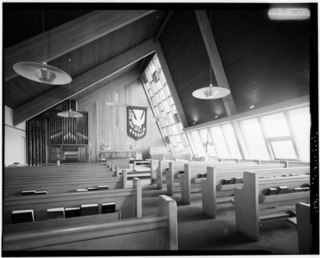
Edwin Butler Crittenden (1915-2015) was an American architect practicing in Anchorage, Alaska. Referred to later in life as the "dean of Alaska architecture", he was the most notable Alaskan architect of the 20th century.


