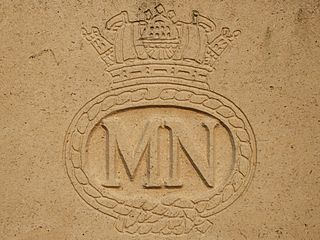
The British Merchant Navy is the collective name given to British civilian ships and their associated crews, including officers and ratings. In the UK, it is simply referred to as the Merchant Navy or MN. Merchant Navy vessels fly the Red Ensign and the ships and crew are regulated by the Maritime and Coastguard Agency (MCA), a specialist agency of the UK Department of Transport. British merchant ships are registered under the UK or Red Ensign group ship registries. British Merchant Navy deck officers and ratings are certificated and trained according to STCW Convention and the syllabus of the Merchant Navy Training Board in maritime colleges and other training institutes around the UK.

A permanent account number (PAN) is a ten-character alphanumeric identifier Foundational ID, issued in the form of a laminated "PAN card", by the Indian Income Tax Department, to any person who applies for it or to whom the department allots the number without an application. It can also be obtained in the form of a PDF file known as e-PAN from the website of the Indian Income Tax Department.
International Convention on Standards of Training, Certification and Watchkeeping for Seafarers (STCW) sets minimum qualification standards for masters, officers and watch personnel on seagoing merchant ships and large yachts. STCW was adopted in 1978 by the International Maritime Organization (IMO) conference in London, and entered into force in 1984. The Convention was significantly amended in 1995 and 2010 entered into force on 1 January 2012.

The National Maritime College of Ireland is a public maritime college located in Ringaskiddy, County Cork, Ireland. It is a constituent college of the Munster Technological University. Founded in 2004, it is situated on former Department of Defence land aside the Haulbowline naval base, the headquarters of the Irish Naval Service. It is the first dedicated maritime college of its kind in the State, and was built under the Irish Government's Public-Private Partnership scheme, involving the Munster Technological University, the Naval Service and a number of other partners.
The Central Institute of Fisheries Nautical and Engineering Training (or CIFNET) formerly known as the Central Institute of Fisheries Operatives, is a marine studies centre located at Kochi, India. Maintained by the Department of Fisheries and Animal Husbandry and Dairying of the Government of India, the institute was set up to aid research and development in the field.
The flag state of a merchant vessel is the jurisdiction under whose laws the vessel is registered or licensed, and is deemed the nationality of the vessel. A merchant vessel must be registered and can only be registered in one jurisdiction, but may change the jurisdiction in which it is registered. The flag state has the authority and responsibility to enforce regulations over vessels registered under its flag, including those relating to inspection, certification, and issuance of safety and pollution prevention documents. As a ship operates under the laws of its flag state, these laws are applicable if the ship is involved in an admiralty case.

The Indian passport is a passport issued by the Ministry of External Affairs of the Republic of India to Indian citizens for the purpose of international travel. It enables the bearer to travel internationally and serves as proof of Indian citizenship as per the Passports Act (1967). The Passport Seva unit of the Consular, Passport & Visa (CPV) Division of the Ministry of External Affairs functions as the issuing authority and is responsible for issuing Indian passports on application to all eligible Indian citizens. Indian passports are issued at 93 passport offices located across India and at 197 Indian diplomatic missions abroad.
Tolani Maritime Institute also known as TMI is a maritime college in Induri, Pune, Maharashtra, India which was established in 1998. It has about 1,500 students in its campus based and distance learning programmes.

A Certificate of Origin or Declaration of Origin is a document widely used in international trade transactions which attests that the product listed therein has met certain criteria to be considered as originating in a particular country. A certificate of origin / declaration of origin is generally prepared and completed by the exporter or the manufacturer, and may be subject to official certification by an authorized third party. It is often submitted to a customs authority of the importing country to justify the product's eligibility for entry and/or its entitlement to preferential treatment. Guidelines for issuance of Certificates of Origin by chambers of commerce globally are issued by the International Chamber of Commerce.
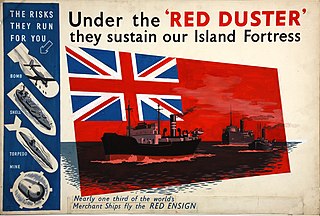
A merchant navy or merchant marine is the fleet of merchant vessels that are registered in a specific country. On merchant vessels, seafarers of various ranks and sometimes members of maritime trade unions are required by the International Convention on Standards of Training, Certification and Watchkeeping for Seafarers (STCW) to carry Merchant Mariner's Documents.

The Merchant Mariner Credential (MMC) is a credential issued by the United States Coast Guard in accordance with guidelines of the International Convention on Standards of Training, Certification and Watchkeeping for Seafarers (STCW) to United States seafarers in order to show evidence of a mariner's qualifications. It is the standard documentation required for all crew members of U.S. ships for all vessels required to operate with a licensed Master or Operator, regardless of size. The MMC replaced the Merchant Mariner's Document, merchant mariner license, Certificate of Registry, and STCW Certificate.
A Continuous Certificate of Discharge or Continuous Discharge Certificate (C.D.C.) is a seafarer's identity document issued by his country. This document certifies that the person holding this is a seaman as per The International Convention on Standards of Training, Certification and Watch keeping for Seafarers (STCW), 1978, as amended 2010. Every seafarer must carry this document while on board, which is also an official and legal record of his sea experience. The master of the vessel signs the document each time a seaman is signed off from the vessel certifying his experience on board.

Sashastra Seema Bal is a border guarding force of India deployed along its borders with Nepal and Bhutan. It is one of the seven Central Armed Police Forces under the administrative control of the Ministry of Home Affairs (MHA).
A master mariner is a licensed mariner who holds the highest grade of seafarer qualification; namely, an unlimited master's license. Such a license is labelled unlimited because it has no limits on the tonnage, power, or geographic location of the vessel that the holder of the license is allowed to serve upon. A master mariner would therefore be allowed to serve as the master of a merchant ship of any size, of any type, operating anywhere in the world, and it reflects the highest level of professional qualification amongst mariners and deck officers.
Vessel safety surveys are inspections of the structure and equipment of a vessel to assess the condition of the surveyed items and check that they comply with legal or classification society requirements for insurance and registration. They may occur at any time when there is reason to suspect that the condition has changed significantly since the previous survey, and the first survey is generally during construction or before first registration. The criteria for acceptance are defined by the licensing or registration authority for a variety of equipment vital to the safe operation of the vessel, such as safety equipment, lifting equipment, hull structure, static stability, ground tackle, propulsion machinery, auxiliary machinery, etc. The SOLAS Convention, specifies safety equipment for commercial vessels operating internationally.
The Government Shipping Office is an agency in the Government of Pakistan that registers and manages sailors in the Pakistan Merchant Navy. The Government Shipping Office was first established in 1923 under the Merchant Shipping Act. It was a subordinate office of the then-Ministry of Communications, now reorganised as the Ministry of Ports and Shipping, under the administrative control of Ports and Shipping Wing, Karachi.
Mercantile Marine Department, Pakistan is an attached department of Ports and Shipping Wing, Karachi under the Ministry of Ports and Shipping, Government of Pakistan. The department was established in 1930 under the Merchant Shipping Act, 1923, which was repealed and replaced with Merchant Shipping Ordinance No. L II of 2001 in 2001. The department is headed by the Principal Officer who is also Registrar of Ships and Superintendent of Light Houses in Pakistan.

Seaman Service Book (SSB) is a continuous record of a seaman’s service. This document certifies that the person holding is a seaman as per the International Convention on Standards of Training, Certification and Watch keeping for Seafarers (STCW), 1978, as amended from time to time. Seaman Book is one of the compulsory document for applying crew transit visas. The record of employment on board of a merchant ship (sea service) is recorded in a Seaman Service Book. Different countries issue to their seafarers the similar service book with different names i.e. Seaman Record Book, Seaman Discharge Book etc.

Euro Tech Maritime Academy is an educational institute in India dedicated to maritime education and training. It is situated on the outskirts of the city of Kochi. It is affiliated to the Indian Maritime University and approved by Directorate General Of Shipping the government of India. The institution offers extensive education and training in pre-sea and post-sea training for candidates ranging from cadets to officers.

Coimbatore Marine College is a college for maritime education and training in Coimbatore, Tamil Nadu, India, founded in 2001. The college offers education and training in pre-sea and post-sea training for candidates from cadets through masters of ships. The institute is recognised by the Directorate General of Shipping (DGS), Government of India, and is affiliated to Indian Maritime University.

