
Thiruvananthapuram, formerly known as Trivandrum, is the capital of the Indian state of Kerala. It is the most populous city in Kerala with a population of 957,730 as of 2011. The encompassing urban agglomeration population is around 1.68 million. Located on the west coast of India near the extreme south of the mainland, Thiruvananthapuram is a major information technology hub in Kerala and contributes 55% of the state's software exports as of 2016. Referred to by Mahatma Gandhi as the "Evergreen city of India", the city is characterised by its undulating terrain of low coastal hills.
Kannur University is a multi-campus public university established in 1996 to provide development of higher education in Kasaragod, Kannur, Wayanad districts of Kerala, India. It serves the region of North Malabar. It was established after the passing of Act No. 22 of 1996 of the Kerala Legislative Assembly. A university by the name of "Malabar University" had come into existence even earlier by the passing of an ordinance by the Governor of Kerala, on 9 November 1995.
The National Centre for Earth Science Studies(NCESS) is an autonomous research centre to promote scientific and technological research and development studies in the earth sciences. NCESS pursues problems related to land, sea and atmosphere. It was instituted by the government of Kerala in 1978, at Thiruvananthapuram, Kerala. CESS was the earliest institute in the country to embrace the concept of Earth System Science (ESS). CESS contributions over the years have enhanced knowledge of the geological evolution of south India, the complexity of coastal processes and natural hazards, as well as in proposing mitigatory measures to deal with natural hazards.
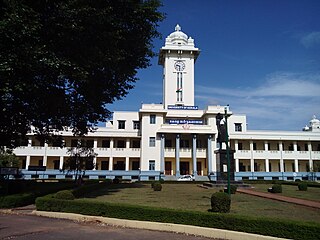
The importance and antiquity of education in Kerala are underscored by the state's ranking as among the most literate in the country. The educational transformation of Kerala was triggered by the efforts of the Church Mission Society missionaries, who were the pioneers that promoted mass education in Kerala, in the early decades of the 19th century. The local dynastic precursors of modern-day Kerala—primarily the Travancore Royal Family, the Nair Service Society, Sree Narayana Dharma Paripalana Yogam and Muslim Educational Society (MES)—also made significant contribution to the progress on education in Kerala. Local schools were known by the general word kalaris, some of which taught martial arts, but other village schools run by Ezhuthachans were for imparting general education. Christian missionaries and British rule brought the modern school education system to Kerala. Ezhuthu palli was the name used in earlier times. The word was derived from the schools run by the Buddhist monasteries. For centuries villages used to setup an ezhuthupally or ashan pallikoodam with one or two teachers. Students used to go this school from nearby areas and learn languages, literature, mathematics, grammar etc. After completing this students may continue study about specific subjects such as ayurveda, astrology, accounting etc. Censuses during 1800 shows that Travancore, Cochin, Kannur areas have many such schools. Even name list of ashans were used to be published along with the census.
Federal Institute of Science And Technology (FISAT) is a private engineering college and business school in Mookkannoor, Kerala, India, run by the Federal Bank Officers' Association Educational Society (FBOAES), established in 2002. It is an initiative of the Federal Bank Officers' Association (FBOA), the organisation representing the officers of the Federal Bank. FISAT is accredited by NBA and NAAC.

Perinad is a village in Kollam district in the state of Kerala, India. As of 2001 India census, Perinad had a population of 32,864 with 16,032 males and 16,832 females.

College of Engineering, Attingal, commonly known as CEAL was established by the Institute of Human Resources Development in 2004, undertaken by Government of Kerala. The college is situated in Attingal and affiliated to KTU and is approved by All India Council for Technical Education.

Kunnamangalam is a growing census town located about 14 km east of Kozhikode (Calicut) city on the Calicut - Bangalore National Highway. Nearby places are Koduvally, Mukkam, Chathamangalam, and Kattangal. India's premier educational institutions like Indian Institute of Management, Kozhikode (IIMK), National Institute of Technology Calicut, National Institute of Electronics & Information Technology, Indian Institute of Spices Research, and Kerala School of Mathematics, Kozhikode are located here. Kunnamangalam is developing as a suburb of Kozhikode, Kunnamangalam is the east side entry of Calicut city.
Kerala State Council for Science, Technology and Environment (KSCSTE) is an autonomous body constituted by the Government of Kerala in November 2002 to encourage and promote science and technology-related activities in Kerala State. Prior to the establishment of KSCSTE, the body responsible for carrying out similar work was the State Committee for Science, Technology and Environment (STEC) established in 1972. KSCSTE was formed by restructuring STEC in concurrence with the Science Policy of Government of India.

Albertian Institute of Management (AIM) is in the city of Kochi, in state of Kerala, India. It is the management department of St. Albert's College (Autonomous), owned and managed by the Archdiocese of Verapoly.
Civil Defence Training Institute is a disaster management institute situated in the City of Thrissur in Kerala state of India. The institute is set up for giving training in disaster management for officials and civilians across Kerala. The institute is set up in eight acres of land and will have lecture halls, hostels and library facilities.
J. Hareendran Nair is an Indian Ayurveda practitioner and entrepreneur from Kerala. He is the founder of Pankajakasthuri Herbals, This is a business group that contributed to the promotion and popularising of Ayurveda and ayurvedic products across the country. The Government of India, in 2012, honoured him with Padma Shri for his services to the cause of Ayurveda.

The Bishop Jerome Institute or BJI or BJGI is an institution situated in Kollam city of Kerala, India. It is one among the AICTE approved engineering and management colleges situated inside the city limit of Kollam.
V. Ramachandran (1931–2015) was an Indian civil servant, management expert and the chief secretary of the state of Kerala. He was a member of the Kerala State Planning Board and held the vice-chair of the United Nations Committee on Right to Development from 1980 to 1984. He also served several United Nations agencies such as UNESCAP, UNCHS, United Nations Economic and Social Council (UNESC), and UNDP as a consultant, and was the chairman of the Centre for Management Development, Thiruvanathapuram at the time of his death in 2015. The Government of India awarded him the third highest civilian honour of the Padma Bhushan, in 2008, for his contributions to Indian civil service.
Narayana Balakrishnan Nair (1927–2010) was a marine biologist, ecologist and the founder president of Kerala Science Congress. He was known for his advocacy of trawling ban during monsoon seasons which was later accepted and imposed by the Government of Kerala. A Jawaharlal Nehru fellow, Nair was an elected fellow of all the major Indian science academies as well as the Zoological Society of London. The Council of Scientific and Industrial Research, the apex agency of the Government of India for scientific research, awarded him the Shanti Swarup Bhatnagar Prize for Science and Technology, one of the highest Indian science awards, in 1971, for his contributions to biological sciences. He received the fourth highest Indian civilian honor of the Padma Shri in 1984.


