External links
 | This biography of a member of a European royal house is a stub. You can help Wikipedia by expanding it. |
| Iraklii Danylovich | |
|---|---|
| Born | c. 1223 |
| Died | before 1240 |
| House | Romanovichi |
| Father | Daniel of Galicia |
| Mother | Anna Mstislavna of Novgorod |
Iraklii Danylovich (c. 1223, - before 1240) was a Ruthenian prince.
Iraklii had seven known siblings, they were:
Brothers
Sisters
| | This biography of a member of a European royal house is a stub. You can help Wikipedia by expanding it. |

Bolesław the Pious was a Duke of Greater Poland during 1239–1247, Duke of Kalisz during 1247–1249, Duke of Gniezno during 1249–1250, Duke of Gniezno-Kalisz during 1253–1257, Duke of the whole of Greater Poland and Poznań during 1257–1273, in 1261 ruler over Ląd, regent of the Duchies of Mazovia, Płock and Czersk during 1262–1264, ruler over Bydgoszcz during 1268–1273, Duke of Inowrocław during 1271–1273, and Duke of Gniezno-Kalisz from 1273 until his death.

The Principality or, from 1253, Kingdom of Galicia–Volhynia, historically known as the Kingdom of Ruthenia, was a medieval state in Eastern Europe which existed from 1199 to 1349. Its territory was predominantly located in modern-day Ukraine, with parts in Belarus, Poland, Moldova, and Lithuania. Along with Novgorod and Vladimir-Suzdal, it was one of the three most important powers to emerge from the collapse of Kievan Rus'. The main language was Old East Slavic, the predecessor of the modern East Slavic languages, and the official religion was Eastern Orthodoxy.

Yuri I of Galicia was a King of Ruthenia, Prince of Volhynia. His full title was Yuri I, King of Ruthenia, Grand Prince of Kyiv, Volodymyr, Halych, Lutsk, Dorohochyn.
Yaroslav II Vsevolodovich, also transliterated as Iaroslav, was Grand Prince of Vladimir from 1238 to 1246. He helped to restore his country and capital after the Mongol invasion.
Ingvar Yaroslavich was Prince of Dorogobuzh, Prince of Lutsk (1180–1220), Grand Prince of Kiev, and Prince of Vladimir-Volynsk (1207). He was son of Yaroslav Izyaslavich, great-grandson of Vladimir II Monomakh.
Daniel Romanovich, known as Daniel of Galicia, was Prince of Galicia, Volhynia, Grand Prince of Kiev (1240), and King of Ruthenia (1253–1264).

Shvarn or Shvarno was the prince of Kholm from 1264 to 1269, and Grand Duke of Lithuania from 1267 to 1269. An influential leader, he became involved in internal struggles of power within the neighboring Grand Duchy of Lithuania.
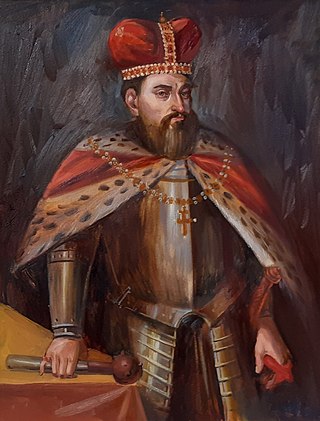
Vaišvilkas or Vaišelga was Grand Duke of Lithuania from 1264 until his death in 1267. He was a son of Mindaugas, the first and only Christian King of Lithuania.
Leo I of Galicia was a king of Ruthenia, prince (Kniaz) of Belz (1245–1264), Peremyshl, Halych (1264–1269), and grand prince of Kiev.

Edmund of Almain was the second Earl of Cornwall of the fourth creation from 1272. He joined the Ninth Crusade in 1271, but never made it to the Holy Land. He was the regent of the Kingdom of England from 1286 to 1289 and the High Sheriff of Cornwall from 1289 to 1300.
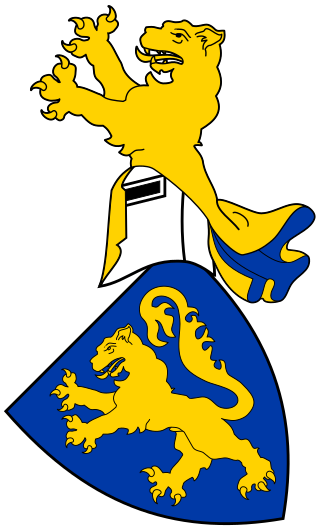
Csák was the name of a gens in the Kingdom of Hungary.
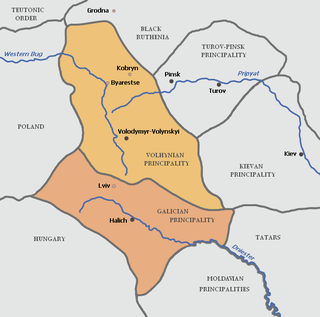
The Principality of Volhynia was a western Kievan Rus' principality founded by the Rurikid prince Vsevolod in 987 centered in the region of Volhynia, straddling the borders of modern-day Ukraine, Belarus, and Poland. From 1069 to 1118, it belonged to Izyaslavichi who primarily ruled from Turov. After losing Turov to Monomakhovichi in 1105, the descendants of Iziaslav Yaroslavovich for a few years continued to rule in Volhynia. From 1154 to 1199, the Principality was referred to as the Principality of Volodymyr when the Principality of Lutsk (1154–1228) was separated.
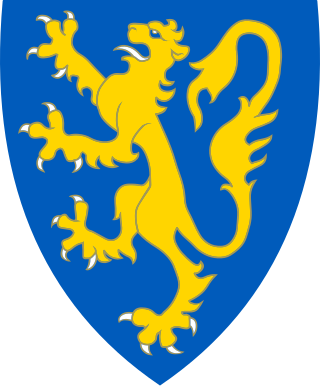
King of Ruthenia, King of Rus', King of Galicia and Lodomeria, Lord and Heir of Ruthenian Lands was a title of princes of Galicia and Volhynia, granted by the Pope.
Maria of Galicia was a princess of Galicia-Volhynia and a member of the Rurik Dynasty. She was sister to Leo II of Halych and Andrew of Halych, daughter of Yuri I of Galicia and his second wife, Euphemia of Kuyavia. She assisted her son king Boleslaus George II of Halych in ruling Galicia.
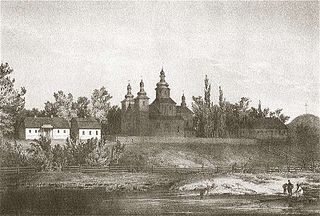
Lavriv is a small village in Sambir Raion (district), Lviv Oblast (province) of Ukraine. It belongs to Staryi Sambir urban hromada, one of the hromadas of Ukraine. The population of the village is just about 461 people, and local government is administered by Velykolinynska village council.

Leontii Viktorovich Voitovych was a Ukrainian scientist-historian who held a Doctor of Science degree. He was a research fellow of the department of Middle Ages history at the Krypiakevych Institute of Ukrainian Studies as well as an academic department director of history of Middle Ages and Byzantine studies in the University of Lviv.