
Jabal, Jabel, Jebel or Jibal may refer to:
Jabal, Jabel, Jebel or Jibal may refer to:
In Arabic, jabal or jebel (spelling variants of the same word) means 'mountain'.


Mount Sinai, also known as Jabal Musa, is a mountain on the Sinai Peninsula of Egypt. It is one of several locations claimed to be the biblical Mount Sinai, the place where, according to the Torah, Bible, and Quran, Moses received the Ten Commandments.
Jebel Akhdar or Djebel Akhdar may be:
Uri may refer to:

The Jebel Akhdar is a heavily forested, fertile upland area in northeastern Libya. It is located in the modern shabiyahs or districts of Derna, Jabal al Akhdar, and Marj.

Jebel Ali is a port town 35 kilometers (22 mi) south-west of Dubai. The Jebel Ali Port is located there. Al Maktoum International Airport has been constructed just outside the port area. Jebel Ali is connected to Dubai via the UAE Exchange, Danube and Energy stations on the Dubai Metro. Among the infrastructure projects built to support the port and town is the world's largest desalination plant, the Jebel Ali Desalination Plant, providing an ample supply of freshwater.

The Musandam Peninsula, locally known as Ruus Al Jibal, is a peninsula that forms the northeastern point of the Arabian Peninsula. It is located to the south of the Strait of Hormuz, between the Persian Gulf and the Gulf of Oman. It is inhabited by the Shihuh tribe and is mainly governed by Oman as the Musandam Governorate with certain parts governed by the United Arab Emirates, including Ras Al Khaimah and parts of Dibba.
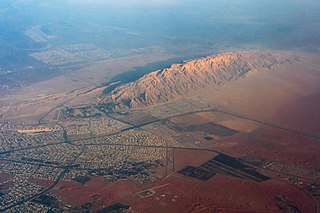
Jabal Hafeet is a mountain in the region of Tawam, on the border of the United Arab Emirates and Oman, which may be considered an outlier of the Hajar Mountains in Eastern Arabia. Due to its proximity to the main Hajar range, the mountain may be considered as being part of the Hajar range. To the north is the UAE city of Al Ain, in the Eastern Region of the Emirate of Abu Dhabi, and the adjacent Omani town of Al-Buraimi.
Big Box, Big box, or Big-box may refer to:
Tariq is an Arabic given name.
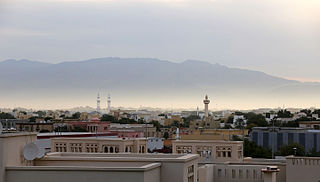
Jabal Al-Mebraḥ, also known by the name Jabal Yibir, is a 1,527 m (5,010 ft) tall mountain in the Emirate of Fujairah, the U.A.E.

Mount Sinai is the mountain at which the Ten Commandments were given to Moses by God, according to the Book of Exodus in the Hebrew Bible. In the Book of Deuteronomy, these events are described as having transpired at Mount Horeb. "Sinai" and "Horeb" are generally considered by scholars to refer to the same place.
Jebel Musa, Jabal Moussa or Gebel Musa may refer to:
Jabal is an Arabic surname or male given name, which means "mountain". Alternative spellings include Jabel, Jebal, and Jebel. With regard to persons, the name may refer to:
Attar or Attoor is an essential oil or perfume.

Jabel Mukaber is a predominantly Palestinian neighborhood in southern East Jerusalem. It is bordered by East Talpiot to the west, Abu Tor and Silwan to the north and Sur Baher to the south. Jabel Mukaber has a population of approximately 30,000 (2017).

The Coastal Mountain Range also called Jabal al-Ansariya, Jabal an-Nusayria or Jabal al-`Alawīyin is a mountain range in northwestern Syria running north–south, parallel to the coastal plain. The mountains have an average width of 32 kilometres (20 mi), and their average peak elevation is just over 1,200 metres (3,900 ft) with the highest peak, Nabi Yunis, reaching 1,562 metres (5,125 ft), east of Latakia. In the north the average height declines to 900 metres (3,000 ft), and to 600 metres (2,000 ft) in the south.
Nazarene may refer to:

Jebel Jassassiyeh is an area with early petroglyphs, residential ruins and pottery remnants in northeast Qatar. The carvings, in fossil sand dunes ("jebels"), include geometric shapes, animals and ship shapes. It is Qatar's most extensive rock art site with more than 900 carvings scattered over 580 numbered sites. They are similar to those found at the temple of Karnak in Luxor, Egypt. The area also has ruined dwellings and remains of pottery from the 15th century.

The glossary of Arabic toponyms gives translations of Arabic terms commonly found as components in Arabic toponyms. A significant number of them were put together during the PEF Survey of Palestine carried out in the second half of the 19th century.