Related Research Articles

This is a demography of the population of Kuwait.

Salmiya is an area in Hawalli Governorate in Kuwait.

Jabriya is in an area in Hawalli Governorate in Kuwait. It is a large, mainly residential area that borders Surra, Hawalli, Salmiya and Bayan.
The New English School, founded in 1969 by Tareq Rajab, is a co-educational British curriculum, English medium, private school in Jabriya, Kuwait, which caters for children between the ages of 3½ and 19.
Surra is a residential area located in the Capital Governorate in Kuwait City, Kuwait. It is located west of Jabriya and east of Qurtuba. It has six residential blocks and is considered home to about 35,366 persons. Its southern section is in Hawalli Governorate.
Duttapukur is a census town and a gram panchayat in the Barasat I CD block in the Barasat Sadar subdivision in the North 24 Parganas district in the Indian state of West Bengal. It is a part of Kolkata Urban Agglomeration.

The American International School of Kuwait is a private school located in Maidan Hawalli, Kuwait, offering education from grades K to 12. The school has been a member of IBO since 1993. The school's curriculum is based mostly on the US curriculum, however religion and Arabic classes are provided due to the Ministry of Education's requirement. The school has a review in the Good Schools Guide International, which states, "The school has a relaxed yet purposeful air to it throughout," adding, "Given that a majority of the students do not speak English as a first language, they do reasonably well."
Prostitution in Kuwait is illegal, but common. Most of the prostitutes are foreign nationals.

This page list topics related to Kuwait.

The first constituency of Kuwait is a legislative constituency in Kuwait. Like the other four constituencies in Kuwait, it elects exactly 10 members to the National Assembly via plurality vote. As of 2022, it currently represents twenty residential areas and has an electorate of 100,185. The Hawalli and Capital governates are divided between the first, second and third constituencies.
The third constituency of Kuwait is a legislative constituency in Kuwait. Like the other four constituencies in Kuwait, it elects exactly 10 members to the National Assembly via plurality vote. As of 2022, it currently represents fifteen residential areas and has an electorate of 138,364. The Hawalli and Capital governates are divided between the first, second and third constituencies.
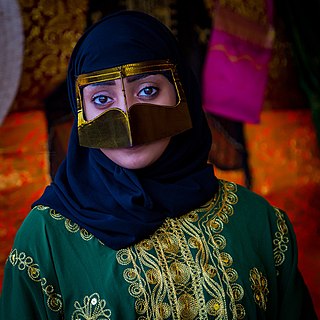
Battoulah, also called Gulf Burqah, is a metallic-looking fashion mask traditionally worn in southern Iran by Muslim Arab women. The mask is mainly worn in the Persian Gulf region, including Bahrain, Kuwait, United Arab Emirates, Oman, Iraq and Qatar. The mask usually indicates that the wearer is married. Historically, it was also used to fool enemies into thinking that the women they spied from a distance were actually men.
Maidan Hawally Is one of the blocks of Salmiya in Hawalli Governorate, Kuwait. The population of this block is 200,000. The district is also close to Hawally. The District is full of Mosques.
Shuwaikh Port is an urban industrial area within the Al Asimah Governorate in Kuwait City, Kuwait.
Hawally is an area in, and the namesake of, the Hawalli Governorate, located in the State of Kuwait.

Kuwait is divided into six governorates, and in each there are several areas. Areas are much less commonly called by other names such as districts or towns. However they are commonly known inside the English-speaking community in Kuwait as, and are officially translated as, areas. The Arabic word for area, Mintaqah, can mean both mean area and region. Areas are further subdivided into blocks, each of which is refereed by to a number. All blocks are divided into streets (شوارع). However, some areas may be further subdivided into جادات Jaddāt, which might be translated to avenue or lane.
Jehan Rajab was a Brazil-born Kuwaiti author of British origin. She stayed in Kuwait from 1959 before she wrote her book titled Invasion Kuwait: An English Woman's Tale which was an account of life in Kuwait during the Iraqi invasion of Kuwait from her own point of view and married Tareq Rajab in 1955 in England who was the 5th Kuwaiti to marry a western woman & the 1st Kuwaiti to go abroad to study Art and archeology. In accordance with Kuwait law, through her marriage she was able to gain Kuwaiti citizenship. She worked as the first director of the department of antiquities and museums of Kuwait. Jehan stayed in Jamaica, Portugal, and the Cape Varde Island during her childhood. She had 3 children including Dr. Ziad Rajab who is the current director of the New English School. She had a hard time settling in Kuwait due to the lack of facilities and found it harder to adjust to the cool winter than hot summers. She co-founded the Tareq Rajab Museum and The New English school with her husband in 1980 and 1969 respectively. Jehan also appeared in a documentary called Class of 1990. She died on 5 April 2015 at the age of 81. Her funeral took place in Jabriya.

The Tareq Rajab Museum is located in Kuwait and houses an extensive collection of artefacts accumulated over a fifty-year period commencing in the 1950s. The Museum is housed at two separate locations in Jabriya, Kuwait. The Tareq Rajab Museum, which was founded in 1980, and the Tareq Rajab Museum of Islamic Calligraphy in 2007. The Tareq Rajab Museum includes collections of manuscripts and miniatures, ceramics, metalwork, glass, arms and armour as well as textiles, costumes and jewellery. The museum's ceramics collection is very large and comprehensive, and includes objects from pre-Islamic times up to the early 20th century and from across the breadth of the Islamic world. The museum houses one of the foremost collections of silver jewellery as well as a fine collection of gold jewellery much of which dates from pre-Islamic times. There is a large collection of Qurans and manuscripts from all periods, with the earliest dating to the 7th century AD and from across the whole Islamic world. From important Qurans, to rare manuscripts such as the Al-Kindi book on optics and a folio from the Shahnameh of Shah Tahmasp, the range of works is comprehensive and representative of many styles and regions.
References
- ↑ "Tareq Rajab Museum" . Retrieved 7 June 2023.
- ↑ "Kuwait Elections 2016: Understanding the constituencies". Kuwait Times. Kuwait Times. Retrieved 7 June 2023.
 Areas of Hawalli Governorate Areas of Hawalli Governorate | |
|---|---|
| Areas | |
| South Surra Quarter | |
| Blocks and groups of blocks | |
| Beaches | |

 | This Kuwaiti location article is a stub. You can help Wikipedia by expanding it. |