Related Research Articles
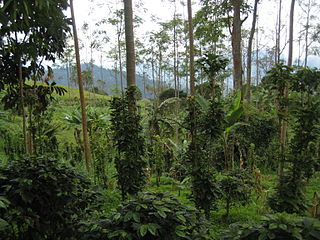
Sustainable agriculture is farming in sustainable ways meeting society's present food and textile needs, without compromising the ability for current or future generations to meet their needs. It can be based on an understanding of ecosystem services. There are many methods to increase the sustainability of agriculture. When developing agriculture within sustainable food systems, it is important to develop flexible business process and farming practices. Agriculture has an enormous environmental footprint, playing a significant role in causing climate change, water scarcity, water pollution, land degradation, deforestation and other processes; it is simultaneously causing environmental changes and being impacted by these changes. Sustainable agriculture consists of environment friendly methods of farming that allow the production of crops or livestock without damage to human or natural systems. It involves preventing adverse effects to soil, water, biodiversity, surrounding or downstream resources—as well as to those working or living on the farm or in neighboring areas. Elements of sustainable agriculture can include permaculture, agroforestry, mixed farming, multiple cropping, and crop rotation.
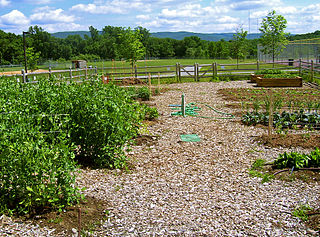
The following outline is provided as an overview of and topical guide to organic gardening and farming:

Community-supported agriculture or cropsharing is a system that connects producers and consumers within the food system closer by allowing the consumer to subscribe to the harvest of a certain farm or group of farms. It is an alternative socioeconomic model of agriculture and food distribution that allows the producer and consumer to share the risks of farming. The model is a subcategory of civic agriculture that has an overarching goal of strengthening a sense of community through local markets.

Urban agriculture,urban farming, or urban gardening is the practice of cultivating, processing, and distributing food in or around urban areas. It encompasses a complex and diverse mix of food production activities, including fisheries and forestry, in cities in both developed and developing countries. The term also applies to urban area activities of animal husbandry, aquaculture, beekeeping, and horticulture. These activities occur in peri-urban areas as well, although peri-urban agriculture may have different characteristics.

A market garden is the relatively small-scale production of fruits, vegetables and flowers as cash crops, frequently sold directly to consumers and restaurants. The diversity of crops grown on a small area of land, typically from under 0.40 hectares to some hectares, or sometimes in greenhouses, distinguishes it from other types of farming. A market garden is sometimes called a truck farm.

Established in 1994, the Cane River Creole National Historical Park serves to preserve the resources and cultural landscapes of the Cane River region in Natchitoches Parish, Louisiana. Located along the Cane River Lake, the park is approximately 63 acres and includes two French Creole cotton plantations, Oakland and Magnolia. Both plantations are complete in their historic settings, including landscapes, outbuildings, structures, furnishings, and artifacts; and they are the most intact French Creole cotton plantations in the United States. In total, 65 historic structures and over a million artifacts enhance the National Park Service mission as it strives to tell the story of the evolution of plantation agriculture through the perspective of the land owners, enslaved workers, overseers, skilled workers, and tenant farmers who resided along the Cane River for over two hundred years. This park is included as a site on the Louisiana African American Heritage Trail.

A smallholding or smallholder is a small farm operating under a small-scale agriculture model. Definitions vary widely for what constitutes a smallholder or small-scale farm, including factors such as size, food production technique or technology, involvement of family in labor and economic impact. Smallholdings are usually farms supporting a single family with a mixture of cash crops and subsistence farming. As a country becomes more affluent, smallholdings may not be self-sufficient, but may be valued for the rural lifestyle. As the sustainable food and local food movements grow in affluent countries, some of these smallholdings are gaining increased economic viability. There are an estimated 500 million smallholder farms in developing countries of the world alone, supporting almost two billion people.

Joel F. Salatin is an American farmer, lecturer, and author.

Magnolia Plantation is a former cotton plantation in Natchitoches Parish, Louisiana. The site was declared a National Historic Landmark in 2001, significant as one of the most intact 19th-century plantation complexes in the nation, as it is complete with a suite of slave cabins and numerous outbuildings and period technology. Included in the Cane River Creole National Historical Park, Magnolia Plantation is also a destination on the Louisiana African American Heritage Trail. It is one of two plantations in the park; the other is Oakland Plantation.
Development-supported agriculture is a nascent movement in real estate development that preserves and invests in agricultural land use. As farmland is lost due to the challenging economics of farming and the pressures of the real estate industry, DSA attempts to reconcile the need for development with the need to preserve agricultural land. The overall goal of DSA is to incubate small-scale organic farms that co-exist with residential land development, providing benefits to farmers, residents, the local community, and the environment.
Daron Joffe is a U.S. agribusiness and nonprofit executive who is prominent in the organic farming and biodynamic agriculture movements. He is the founder and president of Farmer D and author of award-winning book, Citizen Farmers - The Biodynamic Way to Grow Healthy Food, Build Thriving Communities and Give Back to the Earth.
Occupy the Farm is an ongoing social movement that started with the 2012 occupation of the Gill Tract in Albany, California, in protest of planned commercial development of public land and in support of preserving the land for the creation of an open center for urban agroecology and food sovereignty.

Urban agriculture in West Oakland involves the implementation of Urban agriculture in West Oakland, California.
Yonnette Fleming is an American urban farmer and community earth steward based in Bedford–Stuyvesant, Brooklyn. Fleming is part of the environmental movement, her work focusing on urban community gardens and black farmers.
Taqwa Community Farm is a half-acre park operated as a community garden in the Highbridge neighborhood of the Bronx, New York City.

Karen Washington is a political activist and community organizer fighting for food justice.

Leah Penniman is a farmer, educator, author, and food sovereignty activist. Penniman is Co-Founder, Co-Director and Program Manager of Soul Fire Farm, in Grafton, New York.
Keep Growing Detroit is an organization dedicated to food sovereignty and community engagement in the cities of Detroit, Hamtramck, and Highland Park. Founded in 2013, the program designs and implements initiatives that promote the practice of urban agriculture as a mode of food justice for underrepresented communities, particularly those who do not have access to healthy food options. The goals of Keep Growing Detroit are to educate and empower community members using urban agricultural practices. Programs such as the Garden Resource Program and Grown in Detroit served as catalysts, laying the foundation for Keep Growing Detroit.
Soul Fire Farm is a community farm in Grafton, New York, United States. The farm is Black, Indigenous, and People of Color (BIPOC)-centered and uses organic and ancestral farming techniques to combat racism and injustice in the food system. It is owned by Leah Penniman.
Annie Withey is an American farmer and entrepreneur. Withey developed Smartfood in 1984 and Annie's Homegrown in 1989, both with her husband at the time, Andrew Martin.
References
- 1 2 3 4 5 Rangus, Eric (2021-12-02). "Jamila Norman: Farm to Table to Television - Georgia Magazine". UGA Today. Retrieved 2023-02-09.
- 1 2 3 Kaufman, Joanne (2023-04-11). "An Urban Farmer and TV Host on Why She Recycles Almost Everything". The New York Times. ISSN 0362-4331 . Retrieved 2023-04-11.
- 1 2 3 4 Struble, Cristine (2021-07-09). "The Untold Truth Of Jamila Norman". Mashed. Retrieved 2023-04-04.
- 1 2 3 4 5 6 "Patchwork City Farms". Patchwork City Farms. Retrieved 2023-04-04.
- ↑ McCarthy, Zachary (2023-04-07). "Homegrown's Jamila Norman Details Farming Life And Garden Advice - Exclusive Interview". House Digest. Retrieved 2023-04-11.
- ↑ "Homegrown". magnolia.com. Retrieved 2023-04-11.
- 1 2 3 Burton, Nylah (2022-12-20). "Jamila Norman knows farming holds secrets of our past and future". Andscape. Retrieved 2023-04-04.
- ↑ Mishan, Ligaya (2021-02-19). "The Activists Working to Remake the Food System". The New York Times. ISSN 0362-4331 . Retrieved 2023-04-11.
- ↑ "Jamila Norman | OTA". ota.com. Retrieved 2023-04-11.
- ↑ "Jamila Norman, Vegetarian Recipes". UDAYA Yoga & Fitness. Retrieved 2023-04-11.
 | This article needs additional or more specific categories .(April 2023) |