Jazz meditation

Last updated

Jazz meditation refers to guided meditation practice that incorporates live instrumental jazz music. During a typical jazz meditation performance, a meditation guide or teacher is accompanied by one or more musicians, and musical improvisation is used as an anchor for mindfulness techniques such as visualization and breathing exercises. An audience of seated participants meditate in response to live music and the teacher's spoken instructions. [1]

Contents

History

Roots in Buddhism and jazz

Since the mid-20th Century, there has been an evolving relationship between jazz musicians and Buddhist meditative practices. From the emergence of the Beat Generation artists in the post World War II era United States, through the counter-culture 1960s and New Age and experimental aesthetics of the late 20th Century, musicians have found rich inspiration as well as discipline in many of the same concepts that are fundamental to Buddhist practices. [2]

Meditation concepts that have been integrated into jazz theory and performance include: being in the present moment; concentration; following the mind; following the breath; returning to the anchor concept of focus; placing priority on the action in the present, not in a theory. Particular Buddhist teachings such as esoteric ideas of non-verbal deep insight and communication, and the benefits of chanting (rhythmic repetition of sound) - have strong analogues in jazz performance. [3]

Several late 20th Century and contemporary jazz musicians have acknowledged drawing inspiration from meditation and Buddhist practices, including John Coltrane, John McLaughlin, Don Cherry, Wayne Shorter, Yusef Lateef, Sonny Rollins, and Herbie Hancock. [4] [5] [6]

"When [John Coltrane] created A Love Supreme. He had meditated that week. I almost didn't see him downstairs. And it was so quiet! There was no sound, no practice! He was up there meditating, and when he came down he said, "I have a whole new music!" He said, "There is a new recording that I will do, I have it all, everything." And it was so beautiful! He was like Moses coming down from the mountain. And when he recorded it, he knew everything, everything. He said this was the first time that he had all the music in his head at once to record." - Alice Coltrane [7]

Contemporary practice

Several academic institutions offer courses and degree programs linking contemplative practice with jazz, including the Berklee School of Music and the University of Michigan School of Music, Theatre & Dance. [8] [9] Verve Records' compilation album Jazz for Meditation was released in the UK in 2007. [10] Jazz meditation as a live music program originated at the Shinnyo Center for Meditation and Well-being in New York City [11] and at the Mass Bliss Arts and Awareness Festival in the Berkshires. [12] Since 2015, the Festival Jazz à Saint-Germain-des-Prés Paris has been proposing "Jazz & Meditation" sessions with a therapist specialized in MBSR (Mindfulness Based Stress Reduction), Elisabeth Petit-Lizop, and the Festival artistic director Frédéric Charbaut. [13]

See also

Related Research Articles

<span class="mw-page-title-main">Meditation</span> Practice of mindfulness

Meditation is a practice in which an individual uses a technique – such as mindfulness, or focusing the mind on a particular object, thought, or activity – to train attention and awareness, and achieve a mentally clear and emotionally calm and stable state.

<span class="mw-page-title-main">Herbie Hancock</span> American jazz pianist and composer (born 1940)

Herbert Jeffrey Hancock is an American jazz musician, bandleader, and composer. Hancock started his career with trumpeter Donald Byrd's group. He shortly thereafter joined the Miles Davis Quintet, where he helped to redefine the role of a jazz rhythm section and was one of the primary architects of the post-bop sound. In the 1970s, Hancock experimented with jazz fusion, funk, and electro styles, using a wide array of synthesizers and electronics. It was during this period that he released perhaps his best-known and most influential album, Head Hunters.

<span class="mw-page-title-main">John Coltrane</span> American jazz saxophonist (1926–1967)

John William Coltrane was an American jazz saxophonist, bandleader and composer. He is among the most influential and acclaimed figures in the history of jazz and 20th-century music.

Modal jazz is jazz that makes use of musical modes, often modulating among them to accompany the chords instead of relying on one tonal center used across the piece.
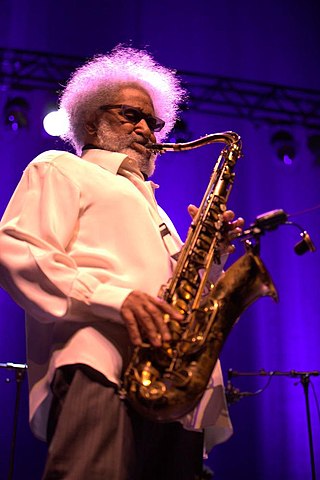
<span class="mw-page-title-main">Sonny Rollins</span> American jazz saxophonist and composer (b. 1930)

Walter Theodore "Sonny" Rollins is an American former jazz tenor saxophonist who is widely recognized as one of the most important and influential jazz musicians. In a seven-decade career, he has recorded over sixty albums as a leader. A number of his compositions, including "St. Thomas", "Oleo", "Doxy", and "Airegin", have become jazz standards. Rollins has been called "the greatest living improviser".

<span class="mw-page-title-main">Freddie Hubbard</span> American jazz trumpeter (1938–2008)

Frederick Dewayne Hubbard was an American jazz trumpeter.
He played bebop, hard bop, and post-bop styles from the early 1960s onwards. His unmistakable and influential tone contributed to new perspectives for modern jazz and bebop.
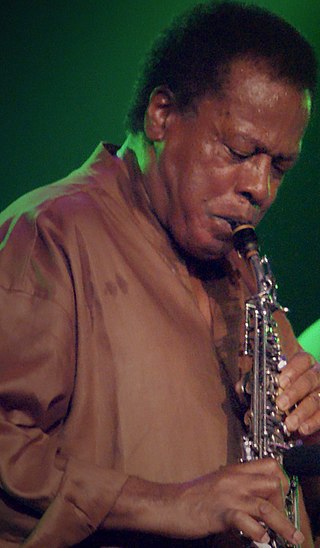
<span class="mw-page-title-main">Wayne Shorter</span> American jazz saxophonist and composer (1933–2023)

Wayne Shorter was an American jazz saxophonist, composer and bandleader. Shorter came to mainstream prominence in 1959 upon joining Art Blakey's Jazz Messengers, for whom he eventually became the primary composer. In 1964 he joined Miles Davis' Second Great Quintet, and then co-founded the jazz fusion band Weather Report in 1970. He recorded more than 20 albums as a bandleader.

<span class="mw-page-title-main">Mahasi Sayadaw</span> Burmese Theravada Buddhist monk (1904–1982)

Mahāsī Sayādaw U Sobhana was a Burmese Theravada Buddhist monk and meditation master who had a significant impact on the teaching of vipassanā (insight) meditation in the West and throughout Asia.
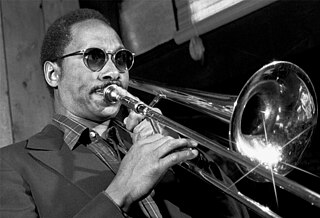
<span class="mw-page-title-main">Julian Priester</span> American jazz trombonist

Julian Priester is an American jazz trombonist and occasional euphoniumist. He is sometimes credited "Julian Priester Pepo Mtoto". He has played with Sun Ra, Max Roach, Duke Ellington, John Coltrane, and Herbie Hancock.

<i>Transition</i> (John Coltrane album) 1970 studio album by John Coltrane

Transition is an album of music by jazz saxophonist John Coltrane, recorded in 1965 but released posthumously only in 1970. As its title indicates, Transition was a bridge between classic quartet recordings like A Love Supreme and the more experimental works of Coltrane's last years.
<span class="mw-page-title-main">Monterey Jazz Festival</span> Annual music festival in California since 1958

The Monterey Jazz Festival is an annual music festival that takes place in Monterey, California, United States. It debuted on October 3, 1958, championed by Dave Brubeck and co-founded by jazz and popular music critic Ralph J. Gleason and jazz disc jockey Jimmy Lyons.

<span class="mw-page-title-main">Effects of meditation</span> Surveys & evaluates various meditative practices & evidence of neurophysiological benefits

The psychological and physiological effects of meditation have been studied. In recent years, studies of meditation have increasingly involved the use of modern instruments, such as fMRI and EEG, which are able to observe brain physiology and neural activity in living subjects, either during the act of meditation itself or before and after meditation. Correlations can thus be established between meditative practices and brain structure or function.
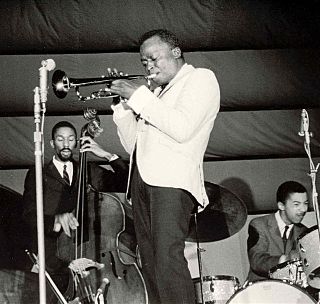
<span class="mw-page-title-main">Miles Davis Quintet</span> Jazz band led by Miles Davis

The Miles Davis Quintet was an American jazz band from 1955 to early 1969 led by Miles Davis. The quintet underwent frequent personnel changes toward its metamorphosis into a different ensemble in 1969. Most references pertain to two distinct and relatively stable bands: the First Great Quintet from 1955 to 1959, and the Second Great Quintet from late 1964 to early 1969, Davis being the only constant throughout.

<span class="mw-page-title-main">Dhyana in Buddhism</span> Training of the mind through meditation

In the oldest texts of Buddhism, dhyāna or jhāna is a component of the training of the mind (bhavana), commonly translated as meditation, to withdraw the mind from the automatic responses to sense-impressions, "burn up" the defilements, and leading to a "state of perfect equanimity and awareness (upekkhā-sati-parisuddhi)." Dhyāna may have been the core practice of pre-sectarian Buddhism, in combination with several related practices which together lead to perfected mindfulness and detachment.

<i>Live at the 1963 Monterey Jazz Festival</i> 2007 live album by Miles Davis

Live at the 1963 Monterey Jazz Festival is a live album by Miles Davis recorded on September 20, 1963 and released July 31, 2007. Davis searched for new musicians for his quintet, after splitting with saxophonist John Coltrane in 1960. The new quintet consists of saxophonist George Coleman, pianist Herbie Hancock, bassist Ron Carter and drummer Tony Williams. It was recorded at the Monterey Jazz Festival in the early fall of 1963.

Mark Samuel Soskin is an American jazz pianist based in New York City.

Buddhānusmṛti, meaning "Buddha-mindfulness", is a common Buddhist practice in all Buddhist traditions which involves meditating on the virtues of the Buddha, mainly Gautama Buddha as the meditation or contemplation subject. Later Mahayana sects like Pureland Buddhism focused on Amida Buddha instead, mainly to pray for rebirth in the Western Pure Land.

<span class="mw-page-title-main">Mindful Yoga</span> Buddhist-style mindfulness practice with yoga as exercise

Mindful Yoga or Mindfulness Yoga combines Buddhist-style mindfulness practice with yoga as exercise to provide a means of exercise that is also meditative and useful for reducing stress. Buddhism and Hinduism have since ancient times shared many aspects of philosophy and practice including mindfulness, understanding the suffering caused by an erroneous view of reality, and using concentrated and meditative states to address such suffering.

References

  1. Lenkin, Elysha (March 23, 2015). "Live Jazz As An Anchor For Meditation". YogaCity NYC. Retrieved 29 March 2016.
  2. Vernon Frazer. "Extending the age of Spontaneity to a New Era : Post-Beat Poets in America" (PDF). Vernonfrazer.net. Archived from the original (PDF) on 11 April 2016. Retrieved 2016-04-01.
  3. Garfinkel, Perry (2007). Buddha Or Bust: In Search of Truth, Meaning, Happiness, and the Man Who ... - Perry Garfinkel - Google Books. Harmony/Rodale. ISBN   9781400082186 . Retrieved 2016-03-31.
  4. "Miles Davis, Buddhism, and Jazz featured in Hancock's First Lecture as Norton Professor | News | The Harvard Crimson". Thecrimson.com. 2014-02-04. Retrieved 2016-03-31.
  5. "Herbie Hancock on his Buddhist practice". Tricycle. Archived from the original on 2015-05-03. Retrieved 2016-03-31.
  6. Jones, Josh (2015-10-08). "Sonny Rollins Describes How 50 Years of Practicing Yoga Made Him a Better Musician". Open Culture. Retrieved 2016-03-31.
  7. "Alice Coltrane quote: It was so interesting, when [John Coltrane] created A Love". Azquotes.com. Retrieved 2016-03-31.
  8. "Yoga, Meditation and Kirtan | Berklee College of Music". Berklee.edu. Retrieved 2016-03-31.
  9. "U-M School of Music, Theatre & Dance - Department of Jazz & Contemporary Improvisation - Degree Programs". Music.umich.edu. Retrieved 2016-03-31.
  10. Alice Coltrane. "Various Artists - Jazz for Meditation (Jazz Club) - Amazon.com Music". Amazon. Retrieved 2016-03-31.
  11. "YogaCity NYC" . Retrieved 31 March 2016.
  12. "Spiritual Healing and Arts Festival in the Berkshires". The New York Times. 21 June 2015. Retrieved 31 March 2016.
  13. "Jazz & Meditation". festivaljazzsaintgermainparis.com. Retrieved 8 February 2017.