Life
Lucas was born in Rouen at an uncertain date, 1636 or 1646. Having migrated to the Netherlands about 1667, he became a citizen of Amsterdam in 1670. He published a number of books, but was declared bankrupt in 1680. [1]
Without personal acquaintance with Spinoza, who died in 1677, Lucas met members of his circle through Jan Rieuwertsz, Spinoza's publisher. The 1719 biography, La vie de Monsieur Benoit de Spinosa is generally attributed to him, following Charles Levier. Internal evidence shows it was a production of the period immediately after Spinoza's death. It is hagiographical in tone and publicizes Spinozism. Pierre Bayle drew on it, in manuscript, access being provided by Jan Rieuwertsz junior. The other work published with it, L'Esprit de Monsieur Benoit de Spinosa, is now attributed to Jan Vroesen (1672–1725). [1] [2]
Lucas also was involved in production of clandestine journals in French, directed against Louis XIV. [1]

Anatole France was a French poet, journalist, and novelist with several best-sellers. Ironic and skeptical, he was considered in his day the ideal French man of letters. He was a member of the Académie française, and won the 1921 Nobel Prize in Literature "in recognition of his brilliant literary achievements, characterized as they are by a nobility of style, a profound human sympathy, grace, and a true Gallic temperament".

Baruch (de) Spinoza was a Dutch philosopher of Portuguese Sephardic Jewish origin. One of the foremost exponents of 17th-century Rationalism and one of the early and seminal thinkers of the Enlightenment and modern biblical criticism including modern conceptions of the self and the universe, he came to be considered "one of the most important philosophers—and certainly the most radical—of the early modern period." Inspired by the groundbreaking ideas of René Descartes, Spinoza became a leading philosophical figure of the Dutch Golden Age. Spinoza's given name, which means "Blessed", varies among different languages. In Hebrew, his full name is written ברוך שפינוזה. "In most of the documents and records contemporary with Spinoza's years within the Jewish community, his name is given as 'Bento'". In his works in Latin, he used the name Benedictus de Spinoza.
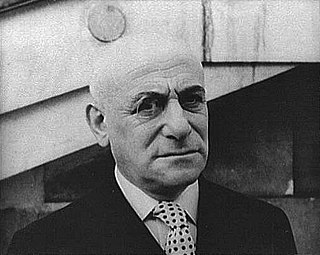
Max Jacob was a French poet, painter, writer, and critic.

The Battle of Stromboli, also known as the Second Battle of Stromboli or the Battle of Alicuri, took place on 8 January, 1676, during the Franco-Dutch War. The battle occurred between a French fleet of 20 ships under Abraham Duquesne and a combined fleet of 19 allied ships under Lieutenant-Admiral-General Michiel de Ruyter. It lasted eight hours and ended inconclusively. The fleets fought again several months later at the Battle of Augusta in April.

The Battle of Augusta, also known as the Battle of Agosta and the Battle of Etna, took place on 22 April 1676 during the Franco-Dutch War and was fought between a French fleet of 29 men-of-war, five frigates and eight fireships under Abraham Duquesne, and a Dutch-Spanish fleet of at least 28 warships besides several frigates and five fireships with a Spanish admiral in overall command and Dutch Lieutenant-Admiral-General Michiel de Ruyter commanding the squadron most involved in the fighting.

Henri Bosco was a French writer. He was nominated for the Nobel Prize in Literature four times.

The Treatise of the Three Impostors was a long-rumored book denying all three Abrahamic religions: Christianity, Judaism, and Islam, with the "impostors" of the title being Jesus, Moses, and Muhammad. Hearsay concerning such a book surfaces by the 13th century and circulates through the 17th century. Authorship of the hoax book was variously ascribed to Jewish and Muslim writers. Fabrications of the text eventually begin clandestine circulation, with a notable French underground edition Traité sur les trois imposteurs first appearing in 1719.
Jonathan Irvine Israel is a British writer and academic specialising in Dutch history, the Age of Enlightenment and European Jews. Israel was appointed as Andrew W. Mellon Professor in the School of Historical Studies at the Institute for Advanced Study, Princeton, New Jersey, in January 2001. He was previously Professor of Dutch History and Institutions at the University College London.
Henri de Boulainvilliers was a French nobleman, writer and historian. He was educated at the College of Juilly; he served in the army until 1697.

Cornelis de Wael was a Flemish painter, engraver and merchant who was primarily active in Genoa in Italy. He is known for his genre paintings, battle scenes, history paintings and still lifes. Through his art work, support for Flemish painters working in Italy and role as an art dealer, he played an important role in the artistic exchange between Italy and Flanders in the first half of the 17th century. His work also had an influence on local painters such as Alessandro Magnasco, particularly through his scenes of despair and irony.

Petrus Serrarius was a millenarian theologian, writer, and also a wealthy merchant, who established himself in Amsterdam in 1630, and was active there until his death. He was born "into a well-to-do Walloon merchant family by name of Serrurier in London." He has been called "the dean of the dissident Millenarian theologians in Amsterdam".

Thierry Sandre was a French writer, poet, essayist. He won the Prix Goncourt in 1924 for Le Chèvrefeuille.
Noel Aubert de Versé was a French advocate of religious toleration, whose own religious position oscillated between Unitarian Protestantism and an Oratorian-influenced Catholicism.

Gilbert Melki is a French actor.

Lodewijk Meyer was a Dutch physician, classical scholar, translator, lexicographer, and playwright. He was an Enlightenment radical who was one of the more prominent members of the circle around the philosopher Benedictus de Spinoza.
Michel le Vassor (1648?–1718) was a French Oratorian priest and author, who became a Protestant in exile in England. He is known for theological, historical and political works.
The Gazette van Gent was a twice-weekly newspaper originally published in Ghent from 1723 to 1809 under the title Gazette van Ghendt. The publisher switched to French in 1809, first under the title Gazette de Gand and from 1811 as Journal du département de l'Escaut. Dutch-language publication resumed in 1814, initially under the title Gazette van Gend, and continued until 1940, with a hiatus during the First World War.

Jan van Haelbeck or Jan van Haelbeeck was a Flemish engraver. He was mainly active in Paris in the first 30 years of the 17th century and helped introduce copper engraving as a technique in French printing. He worked on various publication projects on religious and worldly subjects and portraits.

Franciscus van der Steen was a Flemish painter and engraver who was active in Vienna. He is now mainly known for his reproductive prints after master paintings and various publications containing portraits of prominent persons. No known paintings are currently attributed to him.
Johannes Bouwmeester was a Dutch physician, philosopher and a founding member of the literary society Nil volentibus arduum. He enrolled at Leiden University in 1651 and in 1658 graduated there in medicine. He was a close friend of Lodewijk Meyer, co-founder of Nil volentibus arduum, and acquainted with the philosophers Benedictus de Spinoza and Adriaen Koerbagh. His father, Claes Bouwmeester, was tailor by trade and several family members were builders of musical instruments.

