The European Coal and Steel Community (ECSC) was a European organization created after World War II to integrate Europe's coal and steel industries into a single common market based on the principle of supranationalism. It was formally established in 1951 by the Treaty of Paris, signed by Belgium, France, Italy, Luxembourg, the Netherlands, and West Germany. The organization's subsequent enlargement of both members and duties ultimately led to the creation of the European Union.

The Treaty of Rome, or EEC Treaty, brought about the creation of the European Economic Community (EEC), the best known of the European Communities (EC). The treaty was signed on 25 March 1957 by Belgium, France, Italy, Luxembourg, the Netherlands and West Germany, and it came into force on 1 January 1958. Originally the "Treaty establishing the European Economic Community", and now continuing under the name "Treaty on the Functioning of the European Union", it remains one of the two most important treaties in what is now the European Union (EU).

Walter Hallstein was a German academic, diplomat and statesman who was the first president of the Commission of the European Economic Community and one of the founding fathers of the European Union.
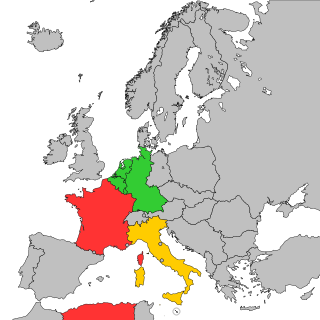
The Treaty establishing the European Defence Community, also known as the Treaty of Paris, is an unratified treaty signed on 27 May 1952 by the six 'inner' countries of European integration: the Benelux countries, France, Italy, and West Germany. The treaty would have created a European Defence Community (EDC), with a unified defence force acting as an autonomous European pillar within the North Atlantic Treaty Organization (NATO). The ratification process was completed in the Benelux countries and West Germany, but stranded after the treaty was rejected in the French National Assembly. Instead, the London and Paris Conferences provided for West Germany's accession to NATO and the Western European Union (WEU), the latter of which was a transformed version of the pre-existing Western Union. The historian Odd Arne Westad calls the plan "far too complex to work in practice".
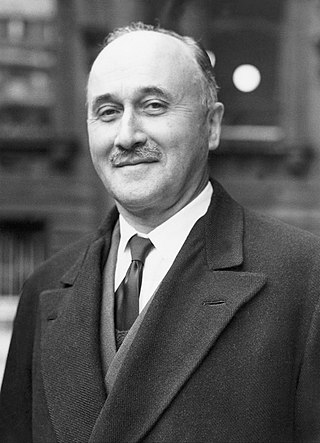
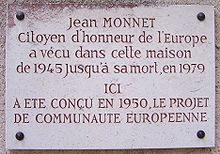
Jean Omer Marie Gabriel Monnet was a French civil servant, entrepreneur, diplomat, financier, administrator, and political visionary. An influential supporter of European unity, he is considered one of the founding fathers of the European Union.
The Charlemagne Prize is a prize awarded for work done in the service of European unification. It has been awarded since 1950 by the German city of Aachen. It commemorates Charlemagne, ruler of the Frankish Empire and founder of what became the Holy Roman Empire, who was the first to unify Western Europe following the Fall of the Western Roman Empire. Traditionally the award is given to the recipient on Ascension Day in a ceremony in the Aachen Town Hall. In April 2008, the organisers of the Charlemagne Prize and the European Parliament jointly created a new European Charlemagne Youth Prize, which recognises contributions by young people towards the process of European integration. Patrons of the foundation are King Philippe of Belgium, King Felipe VI of Spain, and Henri, the Grand Duke of Luxembourg.

Jean-Baptiste Nicolas Robert Schuman was a Luxembourg-born French statesman. Schuman was a Christian democrat political thinker and activist. Twice Prime Minister of France, a reformist Minister of Finance and a Foreign Minister, he was instrumental in building postwar European and trans-Atlantic institutions and was one of the founders of the European Communities, the Council of Europe and NATO. The 1964–1965 academic year at the College of Europe was named in his honour. In 2021, Schuman was declared venerable by Pope Francis in recognition of his acting on Christian principles.
A supranational union is a type of international organization that is empowered to directly exercise some of the powers and functions otherwise reserved to states. A supranational organization involves a greater transfer of or limitation of state sovereignty than other kinds of international organizations.

The Hague Congress or the Congress of Europe was a conference that was held in The Hague from 7–11 May 1948 with 750 delegates participating from around Europe as well as observers from Canada and the United States of America.
The Schuman Declaration, or Schuman Plan, was a proposal to place French and West German production of coal and steel under a single authority that later became the European Coal and Steel Community, made by the French foreign minister, Robert Schuman, on 9 May 1950, the day after the fifth anniversary of the end of World War II. The alliance would later be opened to other European countries. The ultimate goal was to pacify relations, especially between France and West Germany, through gradual political integration to be achieved by creating common interests. Schuman said that "[t]he coming together of the countries of Europe requires the elimination of the age-old opposition of France and Germany ... the solidarity in production thus established will make it plain that any war between France and Germany becomes not merely unthinkable, but materially impossible."
Faced with the challenge of reconstruction after World War II, France implemented the Modernization and Re-equipment Plan, which was designed to spur economic recovery. This plan is commonly known as the “Monnet Plan” after Jean Monnet, the chief advocate and first head of the General Planning Commission.
The year 1948 marked the beginning of the institutionalised modern European integration. With the start of the Cold War, the Treaty of Brussels was signed in 1948 establishing the Western Union (WU) as the first organisation. In the same year, the International Authority for the Ruhr and the Organization for European Economic Co-operation, the predecessor of the OECD, were also founded, followed in 1949 by the Council of Europe, and in 1951 by the European Coal and Steel Community, with the ensuing moves to create further communities leading to the Treaty of Rome (1957).
The founding fathers of the European Union are men who are considered to be major contributors to European unity and the development of what is now the European Union. The number and list of the founding fathers of the EU varies depending on the source. In a publication from 2013 the European Union listed 11 men. All but one were from the Inner Six of the European Union.

The International Authority for the Ruhr (IAR) was an international body established in 1949 by the Western Allies to regulate the coal and steel industries of the Ruhr area in West Germany. Its seat was in Düsseldorf.

The Jean Monnet Foundation for Europe is a public-utility and independent institution, created in 1978 by Jean Monnet and Henri Rieben, and dedicated to the conservation of Monnet's archives. Based in Lausanne since its creation, the foundation is located since 1981 at the Ferme de Dorigny, on the campus of the University of Lausanne. The foundation's activities range from the organization of events to the conservation and the enhancement of its collection of archives and documents.
The Europe Declaration, also known as the Charter of the Community, was a joint statement issued by the Foreign Ministers of West Germany, France, Italy, the Netherlands, Belgium, and Luxembourg in 1951. The Declaration was issued at the signing of the Treaty of Paris, which created the European Coal and Steel Community (ECSC) based on the Schuman Plan, on 18 April 1951.

The Wilfried Martens Centre for European Studies, also known as the Martens Centre and previously as the Centre for European Studies, is a think tank and political foundation of the European People's Party (EPP). The Martens Centre links together a large network of political foundations across the European Union, which all hold centre-right positions and seek to advance those points of view in Europe and beyond. The president of the Martens Centre is former Slovak prime minister Mikuláš Dzurinda.
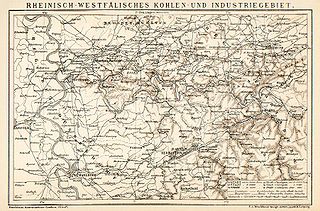
The Ruhr Question was a political topos put on the agenda by the Allies of World War I and the Allies of World War II in the negotiations following each respective war, concerning how to deal with the economic and technological potential of the area where the Rhine and Ruhr intersect. France was heavily in favor of monitoring this region, due to the perception that the economic and technological potential of the region had allowed the German Reich to threaten and occupy France during the Franco-Prussian War, World War I, and World War II. The Ruhr question was intimately associated with the Saar Statute and the German Question. There was also a close relationship between the Ruhr Question and the Allied occupation of the Rhineland (1919-1930), the Occupation of the Ruhr, the founding of the state of North Rhine-Westphalia (1946), the International Authority for the Ruhr (1949-1952), the Schuman Declaration (1950), and the founding of the European Coal and Steel Community (1951). The political treatment of the Ruhr question is known as Ruhrpolitik in German. When one looks at the Rhineland as a whole or the attempted establishment of the Rhenish Republic in 1923, the terms Rhein- und Ruhrfrage or Rhein-Ruhr-Frage are used in German.

The Jean Monnet 2 building is a future office complex for the European Commission under construction on Boulevard Konrad Adenauer in the European district of the Luxembourg City quarter of Kirchberg, Luxembourg. The complex is to be composed of a welcome pavilion and two office buildings to be completed in two phases respectively; an 8 storey 180 metre (m) long block and a 24 storey tower, connected at the basement and second storey levels. The first phase was expected to be completed by late February 2023, and the second phase by late February 2024. This timetable has been pushed back due to the global COVID-19 pandemic. The first Jean Monnet building, opened in 1975, was demolished between 2016 and 2019, after exceeding its lifespan, and following the discovery of airborne traces of asbestos. The construction site combines some of the plot of the previous building with an adjacent former open air car park. Upon completion, the Jean Monnet 2 building will enable the European Commission to consolidate the majority of its Luxembourg-based staff on one site. Like its predecessor, the building's namesake is European Union (EU) founding father Jean Monnet.

The Action Committee for the United States of Europe, colloquially referred to as the Monnet Committee, was a collective initiative spearheaded by Jean Monnet from 1955 to 1975 that aimed at accelerating European integration through informal dialogue among key political and trade unions leaders. It was a civil society endeavor that lied outside of any formal policymaking process, but involved the direct participation of organizations that collectively wielded overwhelming decision-making power within its geographical scope, namely the participating countries of the European Coal and Steel Community and from 1958 of the European Communities.