Related Research Articles
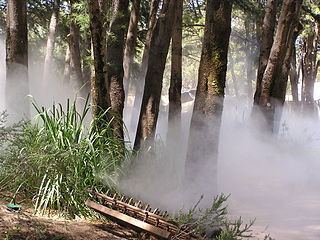
Gas sculpture is a concept introduced by Joan Miró to make sculptures out of gaseous materials. The idea of a gas sculpture also appeared in the book Gog, by Giovanni Papini (1881–1956).

Joan Jonas is an American visual artist and a pioneer of video and performance art, "a central figure in the performance art movement of the late 1960s". Jonas' projects and experiments were influential in the creation of video performance art as a medium. Her influences also extended to conceptual art, theatre, performance art and other visual media. She lives and works in New York and Nova Scotia, Canada.
Tony Oursler is an American multimedia and installation artist married to Jacqueline Humphries. He completed a Bachelor of Fine Arts at the California Institute for the Arts, Valencia, California, in 1979. His art covers a range of mediums, working with video, sculpture, installation, performance, and painting. He lives and works in New York City.

Stan VanDerBeek was an American independent animator, experimental filmmaker, and art theoretician known for his collage works and his early use the digital computer as a creative medium. His Movie Drome theater was a grain silo dome or geodesic dome where he showed 16mm films mixed with 35mm slides, video and digital animations.
The MIT Program in Art, Culture and Technology (ACT) has its origins in the Center for Advanced Visual Studies (CAVS) at the Massachusetts Institute of Technology (MIT), an arts and research center founded in 1967 by artist and teacher György Kepes. In 2009, CAVS merged with the MIT Visual Arts Program, to become the MIT Program in Art, Culture and Technology (ACT). The Program is part of the MIT School of Architecture and Planning.

Otto Piene was a German-American artist specializing in kinetic and technology-based art, often working collaboratively. He lived and worked in Düsseldorf, Germany; Cambridge, Massachusetts; and Groton, Massachusetts.

Raven Chacon is a Diné composer, musician and artist. Born in Fort Defiance, Arizona within the Navajo Nation, Chacon became the first Native American to win a Pulitzer Prize for Music, for his Voiceless Mass in 2022.

György Kepes was a Hungarian-born painter, photographer, designer, educator, and art theorist. After immigrating to the U.S. in 1937, he taught design at the New Bauhaus in Chicago. In 1967 he founded the Center for Advanced Visual Studies at the Massachusetts Institute of Technology (MIT) where he taught until his retirement in 1974.
Christopher Janney is an American composer, artist, and architect known for his work on the interrelation of architecture and music. Sometimes he attempts to make architecture more like music as in his sound sculptures titled "Urban Musical Instruments", of which "Soundstair" and "Sonic Forest" are examples. Other times, he develops performance projects which make music more like architecture as in his "Physical Music" series which includes "HeartBeat," a piece danced by Mikhail Baryshnikov. Much of Janney's permanent work has sought to create "permanent participatory soundworks for public spaces," including installations for airports in Dallas, Boston, Miami and Sacramento, Atlanta and the New York City Subway.

Günther Uecker is a German painter, sculptor, op artist and installation artist.

The MIT School of Architecture and Planning is one of the five schools of the Massachusetts Institute of Technology in Cambridge, Massachusetts. Founded in 1865 by William Robert Ware, the school offered the first architecture curriculum in the United States and was the first architecture program established within a university. MIT's Department of Architecture has consistently ranked among the top architecture/built environment schools in the world.

Shawn Brixey is an artist, educator, researcher, and inventor.

Dieter Jung is a German artist working in the field of holography, painting and installation art. He lives and works in Berlin.

Zero was an artist group founded in the late 1950s in Düsseldorf by Heinz Mack and Otto Piene. Piene described it as "a zone of silence and of pure possibilities for a new beginning". In 1961 Günther Uecker joined the initial founders. ZERO became an international movement, with artists from Germany, the Netherlands, Belgium, France, Switzerland, and Italy.
Aldo Tambellini was an Italian-American artist. He pioneered electronic intermedia, and was a painter, sculptor, and poet. He died at age 90, in November 2020.
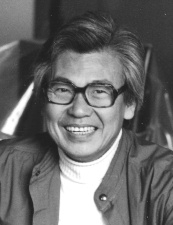
Wen-Ying Tsai was a Chinese-American pioneer cybernetic sculptor and kinetic artist best known for creating sculptures using electric motors, stainless steel rods, stroboscopic light, and audio feedback control. As one of the first Chinese-born artists to achieve international recognition in the 1960s, Tsai was an inspiration to generations of Chinese artists around the world.

Judith Barry is an American multimedia artist, writer and educator. Art critics regard her as a pioneer in performance art, video, electronic media and installation art who has contributed significantly to feminist theories of subjectivity and the exploration of public constructions of gender and identity. Her work draws on a diverse background, which includes studies in critical theory and cinema, dance, and training in architecture, design and computer graphics. Rather than employ a signature style, Barry combines multiple disciplines and mediums in immersive, research-based works whose common methodology calls into question technologies of representation and the spatial languages of film, urbanism and the art experience. Critic Kate Linker wrote, "Barry has examined the effects and ideological functions of images in and on society. Her installations and writings … have charted the transformation of representation by different 'machines' of image production, from the spatial ensembles of theater to computer and electronic technologies."
Nancy Goldring is an American artist. Her art practice combines graphic, photographic, and projected material, presented as a non-narrative series of images that she calls "foto-projections." Goldring currently lives and works in New York City, and is a professor emerita, Montclair State University.

Heimo Zobernig is an Austrian artist who works in a variety of media from painting and sculpture to site specific installation and design.
Richard Kriesche is an Austrian artist. He is considered one of the most productive and influential contemporary artists in Austria.
References
- ↑ Carlock, Marty (August 12, 1983). "Joan Brigham's palette of steam, mist and fog". The Boston Globe . p. 42. Retrieved September 8, 2023– via Newspapers.com.
- ↑ "Art in motion". The Boston Globe . December 22, 2010. pp. G11. Retrieved September 8, 2023– via Newspapers.com.
- ↑ "Light and steam become art for lecturer at local museum". The Brattleboro Reformer . July 16, 1986. p. 13. Retrieved September 8, 2023.
- ↑ "Joan Brigham". Emerson College. August 31, 2023. Retrieved September 1, 2023.
- ↑ "Joan Brigham". act.mit.edu. Retrieved September 1, 2023.
- ↑ "Stan VanDerBeek and Joan Brigham: Steam Screens". whitney.org. Retrieved September 1, 2023.
- ↑ Piene, Otto (1980). Centerbeam. Cambridge, MA: Otto Piene, Elizabeth Goldring. p. 23.
- ↑ "Centerbeam. A Performative Sculpture by CAVS | May 24, 2017 - 00:00 to October 1, 2017 - 00:00 | ZKM". zkm.de. Retrieved September 1, 2023.
- ↑ Schneckenburger, Manfred (1980). Ein Aquädukt ins 21. Jahrhundert. Cambridge, MA: Otto Piene, Elizabeth Goldring. p. 30.
- ↑ "Public Art On The Mall: Centerbeam & Icarus – greg.org". September 6, 2009. Retrieved September 1, 2023.
- ↑ "Tanner Fountain | TCLF". www.tclf.org. Retrieved September 1, 2023.
