Related Research Articles
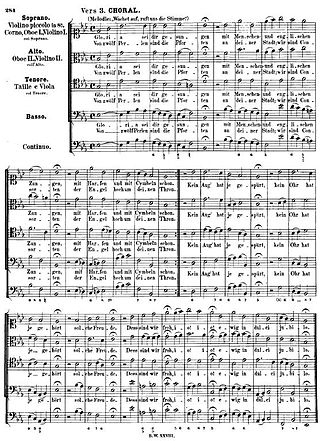
A Lutheran chorale is a musical setting of a Lutheran hymn, intended to be sung by a congregation in a German Protestant Church service. The typical four-part setting of a chorale, in which the sopranos sing the melody along with three lower voices, is known as a chorale harmonization.

Friedrich Spitta was a German Protestant theologian.

Sigmund Theophil Staden was an important early German composer.

Zell im Wiesental is a town in the district of Lörrach in Baden-Württemberg, Germany. It is situated in the Black Forest, on the river Wiese, 26 km northeast of Basel, and 32 km south of Freiburg.

Johann Just Winckelmann, also Johann Justus Winckelmann was a German writer, historian and mnemonist.
Dieter Senghaas is a German social scientist and peace researcher.
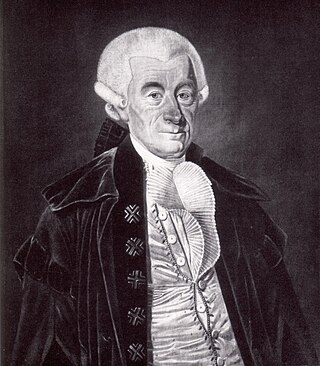
Johann Stephan Pütter was a German law lecturer and publicist. He was professor of law at the university of Göttingen from 1746 until his death. He exerted great influence on the law institutions of his time. His principal work is Historische Entwicklung der heutigen Staatsverfassung des Deutschen Reichs.
Manfred Cordes is a German conductor of early music, musicologist and teacher. He is professor at the Hochschule für Künste Bremen and was its rector from 2007 to 2012.

Johann Stobäus was a composer and lutenist.
Johann Müller was a German composer and organist.

Erhalt uns, Herr, bei deinem Wort, BWV 126, is a cantata by Johann Sebastian Bach for use in a Lutheran service. He composed the chorale cantata in 1725 in Leipzig for the Sunday Sexagesimae, the second Sunday before Lent, and first performed it on 4 February 1725. It is based on the hymn "Erhalt uns, Herr, bei deinem Wort" by Martin Luther, published in 1542. The hymn text at Bach's time also included two stanzas by Justus Jonas and Luther's "Verleih uns Frieden gnädiglich".
Johann Michael Bach was a German composer, lawyer and music theorist.
In Johann Sebastian Bach's time, the election or inauguration of a new town council, normally an annual event, was celebrated with a church service. A cantata written for such occasion was indicated with the term Ratswahl or Ratswechsel. Bach composed such cantatas for Mühlhausen and for Leipzig. Five of these cantatas are entirely extant. One further cantata, BWV 193.2, lost part of its music, and there are another five that have only been known to exist, or for which only the text is extant.
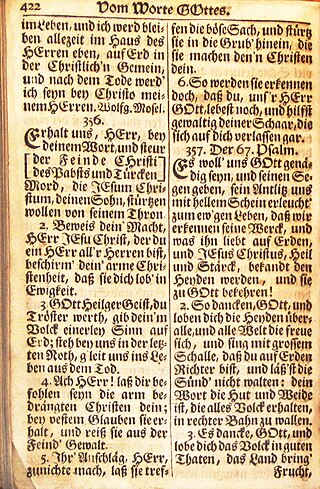
"Erhalt uns, Herr, bei deinem Wort" is a Lutheran hymn by Martin Luther with additional stanzas by Justus Jonas, first published in 1542. It was used in several musical settings, including the chorale cantata by Johann Sebastian Bach, Erhalt uns, Herr, bei deinem Wort, BWV 126.

"O Mensch, bewein' dein' Sünde groß" is a Lutheran Passion hymn with a text written by Sebald Heyden in 1530. The author reflects the Passion of Jesus, based on the Four Evangelists, originally in 23 stanzas. The lyrics were written for an older melody, "Es sind doch selig alle, die im rechten Glauben wandeln". The first and last stanzas have appeared in 11 hymnals. Catherine Winkworth translated it as "O man, thy grievous sin bemoan". The hymn has been used in Passion music and is known in Bach's setting as a chorale fantasia closing Part I of his St Matthew Passion.
Werlin is a surname. Notable people with the name include:

"Christ fuhr gen Himmel" is a German Ascension hymn. The church song is based the medieval melody of the Easter hymn "Christ ist erstanden". It was an ecumenical song from the beginning, with the first stanza published in 1480, then included in a Lutheran hymnal in 1545, and expanded by the Catholic Johannes Leisentritt in 1567. It appears in modern German Catholic and Protestant hymnals, and has inspired musical settings by composers from the 16th to the 21st century.

"Im Frieden dein, o Herre mein" is a three-stanza German Christian communion hymn. In 1527 the early Reformer Johann Englisch wrote two stanzas as a rhyming close paraphase of the Nunc dimittis, or Canticle of Simeon. The hymn is sung to a melody by Wolfgang Dachstein, written before 1530. Friedrich Spitta revised the lyrics in 1898 and added a third stanza. His revision transformed Englisch's prayer of an individual with a focus on a peaceful death to a communal one more about peaceful life in unity.
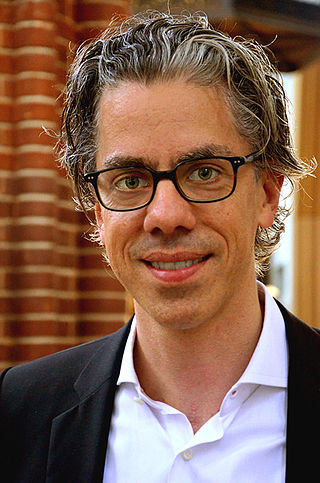
Jörg Breiding is a German choral conductor and academic teacher. He has been the conductor of the Knabenchor Hannover since 2002. He taught at the Musikhochschule Lübeck, and has been professor of choral conducting at the Folkwang Hochschule.
The Rheinische Kantorei is a German vocal ensemble of baroque music accompanied by an instrumental ensemble called Das Kleine Konzert.
References
- ↑ 31 geistl. Konzerte zu 2, 3 und 4 Stimmen in unterschiedlichen Besetzungen und B.c. Neuausgabe: Denkmäler der Tonkunst in Bayern, Druck i. Vb.
| International | |
|---|---|
| National | |
| People | |
| Other | |

 | This article about a German composer is a stub. You can help Wikipedia by expanding it. |