
John Harris (16 July 1812 - 20 July 1869) was a railway engineer who worked on the Stockton and Darlington Railway from 1836 to 1847.
John Harris (16 July 1812 - 20 July 1869) was a railway engineer who worked on the Stockton and Darlington Railway from 1836 to 1847.
He was born on 16 July 1812 in Maryport, Cumbria, the son of William Harris, a sailcloth manufacturer who was bankrupted in the financial crisis of 1816, and his wife Sarah.
He married Mary Ann Mason on 24 September 1838 at the Friends' Meeting House, Penrith, but she died in 1839. He married secondly Mary Wilson on 11 April 1844 at Kendal and they had 5 children:
He died on 20 July 1869 in Kendal after an attack of jaundice. [1]
He trained under Thomas Storey, Civil and Mining Engineer in St Helen Auckland.
In 1836 he was appointed resident engineer to the Stockton and Darlington Railway, replacing Thomas Storey, a position he held until around 1847. During this tenure he was responsible for the railway approaches to the Middlesbrough Dock and the coal staithes.
He also built a railway bridge across the River Tees at Stockton which was designed by Robert Stephenson, replacing an earlier suspension bridge. [2] He also designed the Middlesbrough and Redcar railway, and the Weardale Extension Railway from Crook to Waskerley, part of the Wear Valley Railway.
He was also involved in the construction of the railway between Wakefield, Pontefract and Goole railway and the Kendal to Windermere Railway.
He was appointed a Member of the Institute of Civil Engineers in 1841.
In 1853 he became involved in the Hope Town Foundry, Darlington, and later went into partnership with Mr. Summerson. From 1863 - 1869, the foundry constructed about twelve steam locomotives. He was also a partner in the South Durham Iron Company.
Later in life he became the principal assistant to Joseph Pease in his political career. [3]
He is thought to have been significantly affected by the collapse of the bank of Overend, Gurney and Company in 1866 which resulted in him selling many of his assets. [4]

Darlington is a large market town in County Durham, England. The Borough of Darlington is governed from the town. In 2011, the town had a population of 92,363 and the larger Borough of Darlington‘s population was recorded as 105,564.
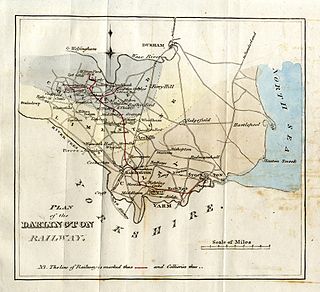
The Stockton and Darlington Railway (S&DR) was a railway company that operated in north-east England from 1825 to 1863. The world's first public railway to use steam locomotives, its first line connected collieries near Shildon with Darlington and Stockton-on-Tees in County Durham, and was officially opened on 27 September 1825. The movement of coal to ships rapidly became a lucrative business, and the line was soon extended to a new port at Middlesbrough. While coal waggons were hauled by steam locomotives from the start, passengers were carried in coaches drawn by horses until carriages hauled by steam locomotives were introduced in 1833.

Stockton-on-Tees, simply Stockton, is a large market town in the Borough of Stockton-on-Tees, County Durham, England. It is between the towns of Darlington, Hartlepool and Middlesbrough; to the west, north-east and east respectively.

The North Eastern Railway (NER) was an English railway company. It was incorporated in 1854 by the combination of several existing railway companies. Later, it was amalgamated with other railways to form the London and North Eastern Railway at the Grouping in 1923. Its main line survives to the present day as part of the East Coast Main Line between London and Edinburgh.
Edward Pease, a woollen manufacturer from Darlington, England, was the main promoter of the Stockton and Darlington Railway, which opened in 1825. He is sometimes referred to as the "Father of the Railways".

Darlington railway station is on the East Coast Main Line in the United Kingdom, serving the town of Darlington, County Durham. It is 232 miles 50 chains north of London King's Cross and on the main line it is situated between Northallerton to the south and Durham to the north. Its three-letter station code is DAR.
The Tees Valley Line is a rail route, in Northern England, following part of the original Stockton and Darlington Railway route of 1825. The line covers a distance of 38 miles (61 km), and connects Bishop Auckland to Saltburn via Darlington, Middlesbrough and 14 other stations in the Teesdale.

Thornaby is a railway station on the Tees Valley Line, which runs between Bishop Auckland and Saltburn via Darlington. The station, situated 3 miles 17 chains (5.2 km) south-west of Middlesbrough, serves the market town of Thornaby-on-Tees, Borough of Stockton-on-Tees in North Yorkshire, England. It is owned by Network Rail and managed by TransPennine Express.

Stockton is a railway station on the Durham Coast Line, which runs between Newcastle and Middlesbrough via Hartlepool. The station, situated 5 miles 45 chains (9.0 km) west of Middlesbrough, serves the market town of Stockton-on-Tees in County Durham, England. It is owned by Network Rail and managed by Northern Trains.

Bishop Auckland is a railway station that serves the market town of Bishop Auckland in County Durham, North East England, 11 miles 77 chains (19.3 km) north-west of Darlington. The station is the Western terminus of the Tees Valley Line, which links it to Saltburn via Darlington. It is owned by Network Rail and managed by Northern Trains.
Stillington is a village in the civil parish of Stillington and Whitton, in County Durham, England, northwest of Stockton-on-Tees.

The South Durham & Lancashire Union Railway (SD&LUR) built a railway line linking the Stockton & Darlington Railway near Bishop Auckland with the Lancaster and Carlisle Railway at Tebay, via Barnard Castle, Stainmore Summit and Kirkby Stephen. The line opened in 1861 and became known as the Stainmore Line.

John Vaughan, known as Jacky, born in Worcester on "St Thomas' Day" in 1799, the son of Welsh parents. He worked his way up the iron industry, becoming an ironmaster and co-founder of the largest of all the Victorian iron and steel companies, Bolckow Vaughan. Where Henry Bolckow provided the investment and business expertise, Vaughan contributed technical knowledge, in a long-lasting and successful partnership that transformed Middlesbrough from a small town to the centre of ironmaking in Britain.

John Marley was an English mining engineer from Darlington who together with ironmaster John Vaughan made the "commercial discovery" of the Cleveland Ironstone Formation, the basis of the wealth of their company Bolckow Vaughan and the industrial growth of Middlesbrough. He was an effective leader of engineering operations at Bolckow Vaughan's mines and collieries. He ended his career as a wealthy independent mine-owner and president of the North of England Institute of Mining and Mechanical Engineers (NEIMME).

The Clarence Railway was an early railway company that operated in north-east England between 1833 and 1853. The railway was built to take coal from mines in County Durham to ports on the River Tees and was a competitor to the Stockton and Darlington Railway (S&DR). It suffered financial difficulty soon after it opened because traffic was low and the S&DR charged a high rate for transporting coal to the Clarence, and the company was managed by the Exchequer Loan Commissioners after July 1834. An extension of the Byers Green branch was opened in 1839 by the independent West Durham Railway to serve collieries in Weardale.

Tees Marshalling Yard is a railway marshalling yard, used to separate railway wagons, located near Middlesbrough in North Yorkshire, Northern England.
Thomas Richardson (1771–1853) was a shareholder and director of the Stockton & Darlington Railway, a partner in Robert Stephenson & Co. and a founding member of the Owners of the Middlesbrough Estate.

The Surtees Rail Bridge is a rail bridge on the Tees Valley Line over the River Tees in the Borough of Stockton-on-Tees. The bridge is south of Stockton-on-Tees town centre and just north of the adjacent Surtees Bridge which carries the A66 road. The bridge is built on the site of a series of Tees Bridges alternating between two adjacent crossing sites.

The Stockton and Darlington Railway (S&DR) was a railway company that operated in north-east England from 1825 to 1863. The world's first public railway to use steam locomotives, its first line connected collieries near Shildon with Stockton-on-Tees and Darlington, and was officially opened on 27 September 1825. The movement of coal to ships rapidly became a lucrative business, and the line was soon extended to a new port and town at Middlesbrough. While coal waggons were hauled by steam locomotives from the start, passengers were carried in coaches drawn by horses until carriages hauled by steam locomotives were introduced in 1833.