
Julia Morgan was an American architect and engineer. She designed more than 700 buildings in California during a long and prolific career. She is best known for her work on Hearst Castle in San Simeon, California.

Arthur Brown Jr. (1874–1957) was an American architect, based in San Francisco and designer of many of its landmarks. He is known for his work with John Bakewell Jr. as Bakewell and Brown, along with later works after the partnership dissolved in 1927.

Bernard Ralph Maybeck was an American architect in the Arts and Crafts Movement of the early 20th century. He was an instructor at University of California, Berkeley. Most of his major buildings were in the San Francisco Bay Area.

Joseph Esherick was an American architect. He is known for his work in Sea Ranch, California and in the San Francisco Bay Area.

Greene and Greene was an architectural firm established by brothers Charles Sumner Greene (1868–1957) and Henry Mather Greene, influential early 20th Century American architects. Active primarily in California, their houses and larger-scale ultimate bungalows are prime exemplars of the American Arts and Crafts Movement.

Joseph Jacinto Mora was a Uruguayan-born American cowboy, photographer, artist, cartoonist, illustrator, painter, muralist, sculptor, and historian who lived with the Hopi and wrote about his experiences in California. He has been called the "Renaissance Man of the West".

Willis Jefferson Polk was an American architect, best known for his work in San Francisco, California. For ten years, he was the West Coast representative of D.H. Burnham & Company. In 1915, Polk oversaw the architectural committee for the Panama–Pacific International Exposition (PPIE).

William Wilson Wurster was an American architect and architectural teacher at the University of California, Berkeley, and at the Massachusetts Institute of Technology, best known for his residential designs in California.
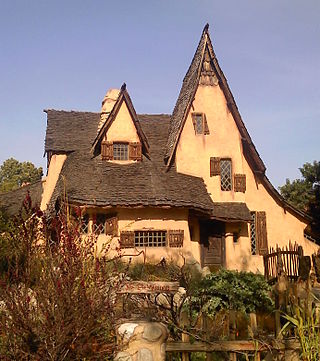
Storybook architecture or fairytale architecture is a style popularized in the 1920s in England and the United States. Houses built in this style may be referred to as storybook houses.
Albert Lincoln Farr was an American residential architect, who designed homes in the Craftsman and Georgian styles.
Ernest Albert Coxhead (1863–1933) was an English-born architect, active in the United States. He was trained in the offices of several English architects and attended the Royal Academy and the Architectural Association School of Architecture, both in London. He moved to California where he was the semi-official architect for the Episcopal Church. At the beginning of his career, Ernest Coxhead focused on designing churches, primarily in the Gothic Revival style. After the mid-1890s, Coxhead focused on residential designs. He was involved in the emergence of the Arts and Crafts style in California. He succeeded in designing residences that incorporated the elements and character of the English country house - shingled, Arts and Crafts style English Vernacular Cottages that combined elements from different periods for dramatic effect.
Albert Henry Hill was an American architect.

Gottardo Fidele Piazzoni was a Swiss-born American landscape painter, muralist and sculptor of Italian heritage, a key member of the school of Northern California artists in the early 1900s.
Walter Harris Ratcliff Jr. (1881—1978) was an English-born American architect, active in Berkeley, California. His work includes local landmarks and buildings listed on the National Register of Historic Places. He served as Berkeley's first city architect for part of his career and is credited with helping develop the first zoning regulations in the state.

Mrs. Clinton Walker House, also known as Cabin on the Rocks, is located on Carmel Point, near Carmel-by-the-Sea, California. It has the appearance of a ship with a bow cutting through the waves. The house was designed by Frank Lloyd Wright in 1948 and completed in 1952 for Mrs. Clinton "Della" Walker of Pebble Beach. It was listed on the National Register of Historic Places on November 17, 1977.

The Harrison Memorial Library is a historic building designed by architect Bernard Maybeck and built by Michael J. Murphy in 1928. It houses a public library for the city of Carmel-by-the-Sea, California. The library provides books, materials and programs that support the pursuit of education, information, recreation, and culture. It includes documents about the history and development of Carmel and the Monterey Peninsula. The Harrison Memorial Library was named after California Supreme Court Justice Ralph C. Harrison. It was designated as an important commercial building in the city's Downtown Historic District Property Survey and was recorded with the Department of Parks and Recreation on November 18, 2002.

Outlands in the Eighty Acres, also known as Flanders Mansion is an 8,000-square-foot Tudor Revival house. It is significant as a work of architect Henry Higby Gutterson and for its innovative construction with light grey interlocking Precast concrete blocks. The mansion is preserved within the Mission Trail Nature Preserve in Carmel-by-the-Sea, California. It was listed on the National Register of Historic Places on March 23, 1989.

The La Ribera Hotel, also known as the Cypress Inn, is a historic Spanish Eclectic hotel in Carmel-by-the-Sea, California. It was designed by architects Blaine & Olsen of Oakland, California and built in 1929, by Meese & Briggs. The building was designated as a significant commercial building in the city's Downtown Historic District Property Survey, and was recorded with the Department of Parks and Recreation on February 13, 2003.

Francis W. Wynkoop, was an American architect, known for building educational school buildings in Pacific Grove and San Carlos, and oceanfront homes in Carmel Point at the southern city limits of Carmel-by-the-Sea, California. One of them is the noted Butterfly House on Scenic Drive.

Robert R. Jones was an American architect in Carmel-by-the-Sea, California best known for his Modern architecture. Jones designed numerous residences and commercial buildings in the Monterey Peninsula. In the post-war period, he emerged as a prominent figure among architects and designers who played a pivotal role in shaping Carmel's modernist landscape from the middle 20th century onward. His was known for his design aesthetic that was a Modern architecture-style, combined with elements from the Second Bay Tradition. His creation, the Monterey Airport Administration building, was honored with a design award by the Smithsonian Institution.

 United States of America
  United States Navy