Related Research Articles

Mallika Sarabhai is an activist and Indian classical dancer and actress from Ahmedabad, Gujarat, India. Daughter of a classical dancer Mrinalini Sarabhai and space scientist Vikram Sarabhai, Mallika is an accomplished Kuchipudi and Bharatanatyam dancer and performer who has specialized in using the arts for social change and transformation.

New York City Ballet (NYCB) is a ballet company founded in 1948 by choreographer George Balanchine and Lincoln Kirstein. Balanchine and Jerome Robbins are considered the founding choreographers of the company. Léon Barzin was the company's first music director. City Ballet grew out of earlier troupes: the Producing Company of the School of American Ballet, 1934; the American Ballet, 1935, and Ballet Caravan, 1936, which merged into American Ballet Caravan, 1941; and directly from the Ballet Society, 1946.

Alvin Ailey Jr. was an American dancer, director, choreographer, and activist who founded the Alvin Ailey American Dance Theater (AAADT). He created AAADT and its affiliated Alvin Ailey American Dance Center as havens for nurturing Black artists and expressing the universality of the African-American experience through dance.
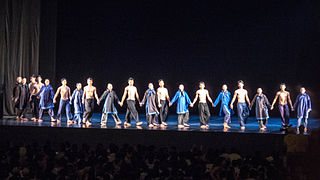
Cloud Gate Dance Theatre is a modern dance group based in Taiwan. It was founded by choreographer Lin Hwai-min in 1973, and later he shared its management with his late protégé, choreographer Lo Man-fei. The troupe was inactive from October 1988 to September 1990. During this time, Lin spent time abroad in India and Indonesia, and studied at New York University.

Indian classical dance, or Shastriya Nritya, is an umbrella term for different regionally-specific Indian classical dance traditions, rooted in predominantly Hindu musical theatre performance, the theory and practice of which can be traced to the Sanskrit text Natya Shastra. The number of Indian classical dance styles ranges from eight to twelve, or more, depending on the source and scholar; the main organisation for Indian arts preservation, the Sangeet Natak Academy, recognizes eight – Bharatanatyam, Kathak, Kuchipudi, Odissi, Kathakali, Sattriya, Manipuri and Mohiniyattam. Additionally, the Indian Ministry of Culture includes Chhau in its list, recognising nine total styles. Scholars such as Drid Williams add Chhau, Yakshagana and Bhagavata Mela to the list. Each dance tradition originates and comes from a different state and/or region of India; for example, Bharatanatyam is from Tamil Nadu in the south of India, Odissi is from the east coast state of Odisha, and Manipuri is from the northeastern state of Manipur. The music associated with these different dance performances consists many compositions in Hindi, Malayalam, Meitei (Manipuri), Sanskrit, Tamil, Odia, Telugu, and many other Indian-Subcontinent languages; they represent a unity of core ideas, and a diversity of styles, costumes and expression.
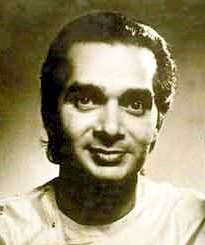
Uday Shankar was an Indian dancer and choreographer, best known for creating a fusion style of dance, adapting European theatrical techniques to Indian classical dance, imbued with elements of Indian classical, folk, and tribal dance, which he later popularised in India, Europe, and the United States in the 1920s and 1930s. He was a pioneer of modern dance in India.

The Joffrey Ballet is an American dance company and training institution in Chicago, Illinois. The Joffrey regularly performs classical and contemporary ballets during its annual performance season at the Civic Opera House, including its annual presentation of The Nutcracker.
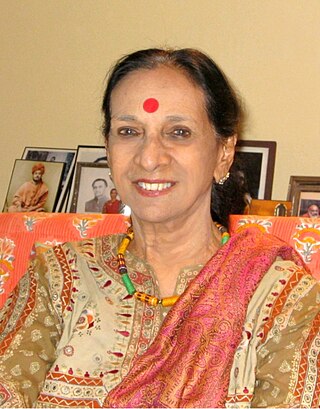
Mrinalini Vikram Sarabhai was an Indian classical dancer, choreographer and instructor. She was the founder and director of the Darpana Academy of Performing Arts, an institute for imparting training in dance, drama, music and puppetry, in the city of Ahmedabad. She received Padma Bhushan in 1992 and Padma Shri in 1965. She also received many other citations in recognition of her contribution to art.
Rosalind Newman is veteran choreographer who has created a body of over 70 works.
Paul Taylor Dance Company is a modern dance company, formed by dancer and choreographer Paul Taylor (1930—2018). The modern dance company is based in New York, New York and was founded in 1954.

The Alvin Ailey American Dance Theater (AAADT) is a modern dance company based in New York City. It was founded in 1958 by choreographer and dancer Alvin Ailey. It is made up of 32 dancers, led by artistic director Robert Battle and associate artistic director Matthew Rushing.
Neila Sathyalingam was a Singaporean classical Indian dancer, choreographer and instructor of Sri Lankan Tamil origin. An alumna of Kalakshetra in Madras under the tutelage of Srimathi Rukmini Devi Arundale, she emigrated with her family to Singapore in 1974. In 1977 she and her husband founded the performance arts company Apsaras Arts, which has staged performances throughout the world. She was the company's artistic director and continued to teach dance.

Astad Deboo was an Indian contemporary dancer and choreographer. He was considered a pioneer of modern dance in India. Through his career he collaborated with artists including Pina Bausch, Alison Becker Chase and Pink Floyd, and performed across the world.
Darshana Jhaveri, the youngest of the four Jhaveri sisters, is a leading Indian exponent of Manipuri dance, an Indian classical dance form. She is a disciple of Guru Bipin Singh, and started performing on stage in 1958 along with her sisters. She is one of the founders of the Manipuri Nartanalaya in 1972, which popularized Manipuri dance in India, and is currently headed by her, with centres at Mumbai, Kolkata and Imphal.
The Indo-American Arts Council (IAAC) is an American non-profit cultural organization that promotes Indian theatre, art, film, fashion, music, dance, and literature in the United States. The Council was established in 1998 in New York City and is headed by Aroon Shivdasani. IAAC hosts cultural and artistic events throughout the year, including the annual New York Indian Film Festival, which showcases Indian and diaspora-related films.

Gopi Krishna was an Indian Kathak dancer, actor and choreographer. He also studied Bharatnatyam. In 1952, at the age of seventeen, Gopi Krishna became one of the youngest choreographers in Hindi film history when he was hired to choreograph dances.
Grethe Barrett Holby is an American theatre producer, stage director, choreographer, and dramaturge best known for her work in opera. Holby is noted as the founder of American Opera Projects, where she served as Artistic Director from 1988 until 2001. She serves as Executive Artistic Director of Family Opera Initiative which she founded in 1995, and Ardea Arts, Inc., which she founded in 2006. The Rockefeller Foundation awarded Holby a 2006 Creative Arts Residency The Bellagio Center.
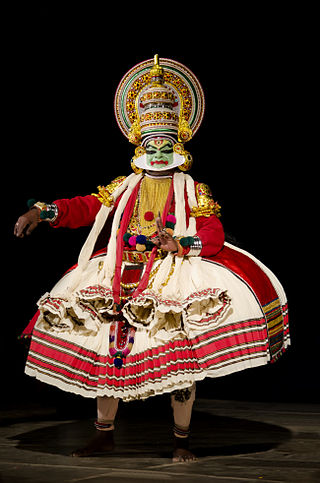
Kavungal Chathunni Panicker (1922-2007) was an Indian classical dancer, known for his proficiency in Kathakali, the traditional dance form of Kerala. He was an exponent of the Kavungal School of Kathakali, noted for its rigorous training methods and overt physical interpretation of abhinaya. He is known to have brought innovations to the dance form, especially in the decorative movements (kalasam) and his contributions are reported in the development of grammar and costumes for the Kavungal School. A recipient of the Sangeet Natak Akademi Award in 1973, Panicker was honored again by the Government of India, in 2006, with the fourth highest Indian civilian award of Padma Shri.
Milena Salvini was an Italian-born French exponent and teacher of Indian classical dance. Especially known for her services to Kathakali, in 2019 she was awarded India's fourth highest civilian award, the Padma Shri.

Geeta Sarabhai Mayor was an Indian musician, well known for her patronage in music. She was among the first women to play the pakhavaj, a traditional barrel-shaped, two-headed drum. She promoted exchanges between Indian and Western music, particularly for bringing Ahmedabad to New York City. During a study stay in New York, she taught Indian music and philosophy to the experimental composer John Cage, in exchange for a course on the theory of Western music. The course included the twelve-tone technique of Arnold Schoenberg. In 1949, Geeta Sarabhai founded the Sangeet Kendra in Ahmedabad, whose mission is to document and promote classical and popular Indian musical traditions. Gita was a part-time faculty of music at National Institute of Design, Ahmedabad.
References
- ↑ Staub, Mary (August 14, 2007). "Turning the Audience into the Act". The New York Sun. Retrieved 2019-11-05.
- ↑ Macaulay, Alastair (August 19, 2010). "Hindu Deities Conjure Magic in Movement Downtown". The New York Times. Retrieved 2019-11-05.
- ↑ Johnson, Robert (August 14, 2008). "Indian Dance: A Rare Look at the Diaspora". The Star-Ledger. Retrieved 2019-11-05.
- ↑ Irwin, Victoria (May 25, 1988). "Dance class keeps phys-ed students on their toes". The Christian Science Monitor. Astoria, Queens. Retrieved 2019-11-05.
- ↑ Zimmer, Elizabeth (January 2016). "Dancing to Connect". Studio Life.
- ↑ Ratnakar, Seetha (June 22, 2017). "The Twain Shall Meet". The Hindu. Retrieved 2019-11-05.
- ↑ Dunning, Jennifer (August 26, 2006). "An Onrushing Tidal Wave Powered by Currents Out of India and New Orleans". The New York Times. Retrieved 2019-11-05.
- ↑ Datta, Jyotirmoy (October 16, 1998). "Council set up exclusively to support arts of India". INDIA in NEW YORK.
- 1 2 3 Shepard, Richard F. (November 3, 1979). "About New York: A Ballet Company Among Big Business". The New York Times. p. 26. Retrieved 2019-11-05.
- ↑ Klatte, Arlene (September 13–26, 1994). "18 Years Spent Proving 'Dance is not a Frill'". Downtown Express.
- ↑ Saltzman, Cynthia (August 21, 1980). "Wall Street Proves Shaky Turf for the Arts". The Wall Street Journal.
- ↑ McDonagh, Don (August 10, 1977). "Dance: Bit of Joy on the Streets". The New York Times. p. 61. Retrieved 2019-11-05.
- ↑ Kinetz, Erika (October 29, 2006). "The Battle for Hearts, Minds, and Toes". The New York Times. Retrieved 2019-11-05.
- 1 2 3 Kothari, Sunil (February 19, 1994). "Through a Prism of Moods". The Economic Times.
- 1 2 3 Sankaranarayanan, Vasanthi (March 13, 1994). "Spirit of Freedom". Indian Express.
- ↑ Verghese, Jincy (March 6, 1997). "Fine-tuned to Perfection". The Times of India.
- ↑ Gowri, R (August 27, 1995). "Purush--Reasserting Male Position in Dance". The Economic Times (Madras).
- ↑ Johnson, Robert (August 23, 2006). "Troupes Unwrap Treats at Lunch Hour". The Star-Ledger.
| International | |
|---|---|
| National | |
