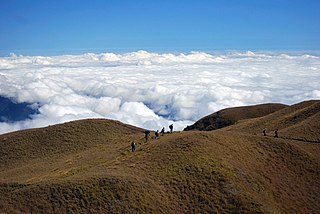
Benguet, officially the Province of Benguet, is a landlocked province of the Philippines located in the southern tip of the Cordillera Administrative Region in the island of Luzon. Its capital is La Trinidad.

Mountain Province is a landlocked province of the Philippines in the Cordillera Administrative Region in Luzon. Its capital is Bontoc while Bauko is the largest municipality. Mountain Province was formerly referred to as Mountain in some foreign references. The name is usually shortened by locals to Mt. Province.

The Cordillera Administrative Region, also known as the Cordillera Region and Cordillera, is an administrative region in the Philippines, situated within the island of Luzon. It is the only landlocked region in the archipelago, bordered by the Ilocos Region to the west and southwest, and by the Cagayan Valley Region to the north, east, and southeast.

The Ilocos Region, designated as Region I, is an administrative region of the Philippines. Located in the northwestern section of Luzon, it is bordered by the Cordillera Administrative Region to the east, the Cagayan Valley to the northeast and southeast, Central Luzon to the south, and the South China Sea to the west.

The Cordillera Central or Cordillera Range is a massive mountain range 320 kilometres (200 mi) long north–south and 118 kilometres (73 mi) east-west situated in the north-central part of the island of Luzon, in the Philippines. The mountain range encompasses all provinces of the Cordillera Administrative Region, as well as portions of eastern Ilocos Norte, eastern Ilocos Sur, eastern La Union, northeastern Pangasinan, western Nueva Vizcaya, and western Cagayan.

The Ibaloi are an indigenous ethnic group found in Benguet province of the northern Philippines. Ibaloi is derived from i-, a prefix signifying "pertaining to" and badoy or house, together then meaning "people who live in houses". The Ibaloi are one of the indigenous peoples collectively known as Igorot, who live in the Cordillera Central of Luzon.
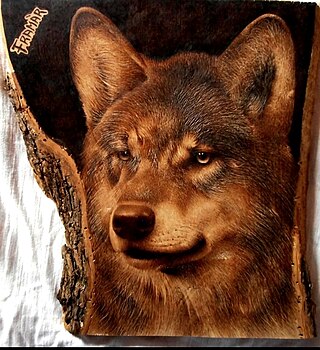
Pyrography or pyrogravure is the free handed art of decorating wood or other materials with burn marks resulting from the controlled application of a heated object such as a poker. It is also known as pokerwork or wood burning.

The indigenous peoples of the Cordillera in northern Luzon, Philippines, often referred to by the exonym Igorot people, or more recently, as the Cordilleran peoples, are an ethnic group composed of nine main ethnolinguistic groups whose domains are in the Cordillera Mountain Range, altogether numbering about 1.8 million people in the early 21st century.

La Trinidad, officially the Municipality of La Trinidad, is a municipality and capital of the province of Benguet, Philippines. According to the 2020 census, it has a population of 137,404 people.

Buguias, officially the Municipality of Buguias,, is a municipality in the province of Benguet, Philippines. According to the 2020 census, it has a population of 44,877 people. The municipality is home to the mummy of Apo Anno, one of the most revered and important folk hero in Benguet prior to Spanish arrival.
The Pangasinan people, also known as Pangasinense, are an ethnolinguistic group native to the Philippines. Numbering 1,823,865 in 2010, they are the tenth largest ethnolinguistic group in the country. In the 2020 census Pangasinan speaking households made up roughly 1.3% of Phillipine households. They live mainly in their native province of Pangasinan and the adjacent provinces of La Union and Tarlac, as well as Benguet, Nueva Ecija, Zambales, and Nueva Vizcaya. Smaller groups are found elsewhere in the Philippines and worldwide in the Filipino diaspora.
The Igorot Revolt of 1601 was a failed expedition in 1601 by Spain in an attempt to subjugate and Christianize the Igorot people of northern Luzon, in the Philippines. The term "revolt" is a misnomer owing to the independence of the Igorots at the time. The Spanish colonial government considered themselves the legitimate government in the entire Philippines and considered any resistance to be illegal.
Mummification was practiced in the Philippines only on those able to prove the loss of baby teeth. The baby teeth represented youth, losing them illustrated wisdom gained in their mouth. It also portrayed the journey of maturity. Dying without losing baby teeth was a sign of someone who never reached their full potential. Once you lose and grow your first grill, the second time you lose the teeth, it's time to go. That's because they were given a chance of proper dental hygiene. The caves containing the mummies were untouched until the 19th century.
The Kalanguya are an Austronesian ethnic group most closely associated with the Philippines' Cordillera Administrative Region, but whose core population can be found across an area which also includes the provinces of Nueva Vizcaya, Nueva Ecija, and Pangasinan. While this area spans Region I, the Cordillera Administrative Region, and Region II, it represents a largely geographically contiguous area. Initially thought by some researchers as a subgroup of the Ifugao people, extensive studies have now shown that the Kalanguya are distinct from the Ifugao.

The Cordillera autonomy movement in the Philippines refers to the campaign for greater autonomy for the Cordilleras.

Mateo Cariño was an Ibaloi chieftain who owned the land that was to become Baguio. He led a successful revolt against the Spanish garrison in La Trinidad and was proclaimed the Capitan Municipal of Baguio by President Emilio Aguinaldo.

The Colors of StoBoSa, officially designated as the StoBoSa Hillside Homes Artwork, is a community artwork designed by the Tam-awan Village group, and is a locally recognized tourist attraction in the town of La Trinidad, Benguet. The paintwork of multiple houses composes the single artwork.
Benguet coffee, also known as Benguet arabica, is a single-origin coffee varietal grown in the Cordillera highlands of the northern Philippines since the 19th century. It belongs to the species Coffea arabica, of the Typica variety. It is one of the main crops of farmers in the province of Benguet, which has a climate highly suitable for arabica cultivation. Benguet coffee is listed in the Ark of Taste international catalogue of endangered heritage foods by the Slow Food movement.

Batok, batek, patik, batik, or buri, among other names, are general terms for indigenous tattoos of the Philippines. Tattooing on both sexes was practiced by almost all ethnic groups of the Philippine Islands during the pre-colonial era. Like other Austronesian groups, these tattoos were made traditionally with hafted tools tapped with a length of wood. Each ethnic group had specific terms and designs for tattoos, which are also often the same designs used in other art forms and decorations such as pottery and weaving. Tattoos range from being restricted only to certain parts of the body to covering the entire body. Tattoos were symbols of tribal identity and kinship, as well as bravery, beauty, and social or wealth status.

The BenCab Museum is an art museum in Tuba, Benguet, Philippines.
