Related Research Articles

The United Society of Believers in Christ's Second Appearing, more commonly known as the Shakers, are a millenarian restorationist Christian sect founded c. 1747 in England and then organized in the United States in the 1780s. They were initially known as "Shaking Quakers" because of their ecstatic behavior during worship services.

Poland is a town in Androscoggin County, Maine, United States. The population was 5,906 at the 2020 census. Set among rolling hills and numerous lakes, the town is home to Range Ponds State Park, which includes hiking trails and a pristine freshwater beach. Poland is also a historic resort area. It is included in the Lewiston-Auburn, Maine metropolitan statistical area, which itself is part of the Greater Portland-Lewiston Combined Statistical Area.

New Gloucester is a town in Cumberland County, Maine, United States. New Gloucester is included in the Lewiston-Auburn, Maine metropolitan New England city and town area. It is home to the Sabbathday Lake Shaker Village, the last active Shaker village in the U.S. The town's population was 5,676 at the 2020 census.

Harvard is a town in Worcester County, Massachusetts, United States. The town is located 25 miles west-northwest of Boston, in eastern Massachusetts. It is mostly bounded by I-495 to the east and Route 2 to the north. A farming community settled in 1658 and incorporated in 1732, it has been home to several non-traditional communities, such as Harvard Shaker Village and the utopian transcendentalist center Fruitlands. It is also home to St. Benedict Abbey, a traditional Catholic monastery, and for over seventy years was home to Harvard University's Oak Ridge Observatory, at one time the most extensively equipped observatory in the Eastern United States. It is now a rural and residential town noted for its public schools. The population was 6,851 at the 2020 census.

Joseph Brackett Jr. was an American songwriter, author, and elder of The United Society of Believers in Christ's Second Appearing, better known as the Shakers. The most famous song attributed to Brackett, "Simple Gifts", is still widely performed and adapted.

State Route 26 (abbreviated SR 26) is part of Maine's system of numbered state highways. It is a major interregional route running for 95.90 miles (154.34 km) from downtown Portland northwest to the New Hampshire border near Upton, where it connects to New Hampshire Route 26. SR 26 runs in Cumberland, Androscoggin and Oxford Counties.

Sabbathday Lake Shaker Village is a Shaker village near New Gloucester and Poland, Maine, in the United States. It is the last active Shaker community, with two members as of 2022. With a new member, it had expanded to three members by 2021. The community was established in either 1782, 1783, or 1793, at the height of the Shaker movement in the United States. The Sabbathday Lake meetinghouse was built in 1794. The entire property was declared a National Historic Landmark in 1974.

Shirley Shaker Village is a historic former Shaker community in Lancaster and Shirley, Massachusetts. Defined as an historic district, it includes about half of the original buildings and is listed on the National Register of Historic Places.

North Union Shaker Site is a historic site in Shaker Heights, Ohio. The site was founded by Shakers in 1822 and was added to the National Register in 1974. The Shakers ran grist and grain mills from the lakes created when they dammed Doan Creek. The community ceased to exist in 1899. All of the buildings that had been part of the North Union Shaker community have been demolished, and 280 of the original 1,000 acres are Shaker Lakes parkland, which includes walking trails and a Shaker archaeological site, the Shaker Historical Museum and Library.
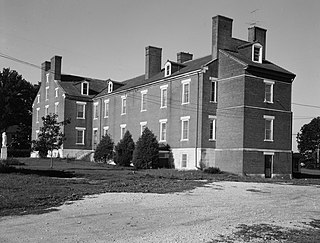
South Union Shaker Center House and Preservatory is a historic Shaker building on U.S. 68 in South Union, Kentucky. It was built in 1822 and added to the National Register in 1974. Located within the building is the Shaker Museum at South Union.

Alfred Shaker Historic District is a historic district in Alfred, Maine, with properties on both sides of Shaker Hill Road. The area had its first Shaker "believers" in 1783 following visiting with Mother Ann Lee and became an official community starting in 1793 when a meetinghouse was built. It was home to Maine's oldest and largest Shaker community. Two notable events were the songwriting of Joseph Brackett, including, according to most accounts, Simple Gifts, and the spiritual healing of the sick by the Shakers. When the Alfred Shakers products and goods were no longer competitive with mass-produced products and the membership had dwindled significantly, the village was closed in 1931 and members moved to Sabbathday Lake Shaker Village, also in Maine.
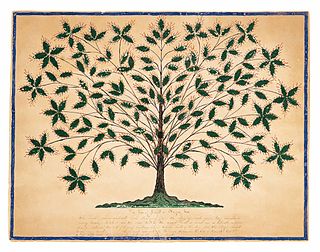
The chronology of Shakers is a list of important events pertaining to the history of the Shakers, a denomination of Christianity. Millenarians who believe that their founder, Ann Lee, experienced the Second Coming of Jesus Christ, the Shakers practice celibacy, confession of sin, communalism, ecstatic worship, pacifism, and egalitarianism. This spans the emergence of denomination in the mid-18th century, the emigration of the Shakers to New York on the eve of the American Revolution, subsequent missionary work and the establishment of nineteen major planned communities, and the continued persistence of the faith through decline into the 21st century.
The Shakers are a sect of Christianity which practices celibacy, communal living, confession of sin, egalitarianism, and pacifism. After starting in England, it is thought that these communities spread into the cotton towns of North West England, with the football team of Bury taking on the Shaker name to acknowledge the Shaker community of Bury. The Shakers left England for the English colonies in North America in 1774. As they gained converts, the Shakers established numerous communities in the late-18th century through the entire 19th century. The first villages organized in Upstate New York and the New England states, and, through Shaker missionary efforts, Shaker communities appeared in the Midwestern states. Communities of Shakers were governed by area bishoprics and within the communities individuals were grouped into "family" units and worked together to manage daily activities. By 1836 eighteen major, long-term societies were founded, comprising some sixty families, along with a failed commune in Indiana. Many smaller, short-lived communities were established over the course of the 19th century, including two failed ventures into the Southeastern United States and an urban community in Philadelphia, Pennsylvania. The Shakers peaked in population by the 1840s and early 1850s, with a membership between 4,000 and 9,000. Growth in membership began to stagnate by the mid 1850s. In the turmoil of the American Civil War and subsequent Industrial Revolution, Shakerism went into severe decline. As the number of living Shakers diminished, Shaker communes were disbanded or otherwise ceased to exist. Some of their buildings and sites have become museums, and many are historic districts under the National Register of Historic Places. The only active community is Sabbathday Lake Shaker Village in Maine, which is composed of at least three active members.

The Louis St. Gaudens House and Studio was a historic house at Dingleton Hill and Whitten Roads in Cornish, New Hampshire. The 2+1⁄2-story gambrel-roofed wood-frame structure was designed by Moses Johnson and built in 1793–94 at the Shaker village in Enfield, New Hampshire. At that site the building served as the main meeting space for the Shakers, with a main meeting space on the ground floor, offices on the second floor, and guest living quarters in the attic space. The building was similar in construction to buildings designed by Johnson for the Shaker villages in Canterbury, New Hampshire and Sabbathday Lake, Maine.

Ethel "Billie" Wilson Gammon was an American educator and living history museum founder and director. In 1974 she founded the Washburn-Norlands Living History Center on the former estate of Israel Washburn in Livermore, Maine, and served as its volunteer executive director until 1991. Her educational and outreach programs brought 40,000 visitors to the site annually by the end of the twentieth century. She was inducted into the Maine Women's Hall of Fame in 1997.
The Shaker Quarterly was a periodical published by the Sabbathday Lake Shaker Village from 1961 to 1996. It served as a journal and newsletter about the Shakers, and at times also doubled as a mail order catalog advertising products created by the Shaker community at Sabbathday Lake. It was the first regular Shaker publication since the Manifesto ceased publication in 1899.
The Shakers is a 1974 documentary film directed by Tom Davenport and produced by Davenport and Frank DeCola. It studies the last dozen remaining Shakers in their communities, focusing on their daily lives, music, and spirituality, as well as containing Shaker history and interviews with Shakers. It received positive reviews from critics, and won a Blue Ribbon at the 1975 American Film Festival.
Kevin Siegfried is an American composer. He has been composer-in-residence with the Capitol Hill Chorale since 2014, and teaches at the Boston Conservatory at Berklee.
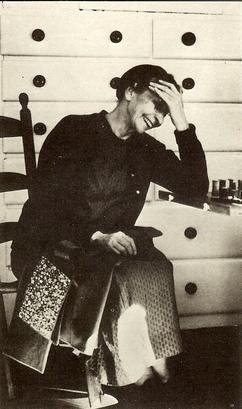
Ruth Mildred Barker was a musician, scholar, manager, and spiritual leader from the Alfred and Sabbathday Lake Shaker villages. A prominent and respected Shaker during her long life, she worked to preserve Shaker music. With the help of Daniel Patterson, she recorded Early Shaker Spirituals, a collection of Shaker songs. In recognition of her achievements in the field, in 1983 she received the National Heritage Fellowship. She also co-founded and managed The Shaker Quarterly, a magazine and journal focused on the Shakers, to which she was also a regular contributor.
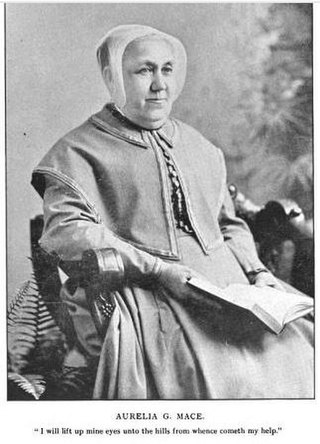
Aurelia Mace was a Shaker eldress, thinker, and writer. She is known for her letters and essays which were compiled into the book The Aletheia: Spirit of Truth.
References
- ↑ "The dying out of the sect's last members may not mean the end for the Shakers". The Economist. ISSN 0013-0613 . Retrieved 2024-05-11.
- ↑ Paterwic, Stephen (2008). Historical dictionary of the Shakers. Internet Archive. Lanham, Md. : Scarecrow Press. p. 307. ISBN 978-0-8108-5959-3.
- ↑ "Cultural Anthropology--University of Minnesota Duluth". www.d.umn.edu. Retrieved 2024-05-11.
- ↑ Wood, Monica (2014-10-13). "The Last of the Shakers?". Down East Magazine. Retrieved 2024-05-11.
- ↑ "Sabbathday Lake Shaker Village". Meander Maine. Retrieved 2024-05-11.
- ↑ "Herbal Heritage: A Renovation Project for the Sabbathday Lake Shakers". The National Endowment for the Humanities. Retrieved 2024-05-11.
- ↑ Kevin, Brian (2022-06-02). "Restoring the World's Last Shaker Herb House". Down East Magazine. Retrieved 2024-05-11.