Related Research Articles

Glass is an amorphous (non-crystalline) solid. Because it is often transparent and chemically inert, glass has found widespread practical, technological, and decorative use in window panes, tableware, and optics. Some common objects made of glass like "a glass" of water, "glasses", and "magnifying glass", are named after the material.

In optics, the refractive index of an optical medium is a dimensionless number that gives the indication of the light bending ability of that medium.

Ruby is a pinkish red to blood-red colored gemstone, a variety of the mineral corundum. Ruby is one of the most popular traditional jewelry gems and is very durable. Other varieties of gem-quality corundum are called sapphires. Ruby is one of the traditional cardinal gems, alongside amethyst, sapphire, emerald, and diamond. The word ruby comes from ruber, Latin for red. The color of a ruby is due to the element chromium.

Fluorite (also called fluorspar) is the mineral form of calcium fluoride, CaF2. It belongs to the halide minerals. It crystallizes in isometric cubic habit, although octahedral and more complex isometric forms are not uncommon.

A corrective lens is a transmissive optical device that is worn on the eye to improve visual perception. The most common use is to treat refractive errors: myopia, hypermetropia, astigmatism, and presbyopia. Glasses or "spectacles" are worn on the face a short distance in front of the eye. Contact lenses are worn directly on the surface of the eye. Intraocular lenses are surgically implanted most commonly after cataract removal but can be used for purely refractive purposes.
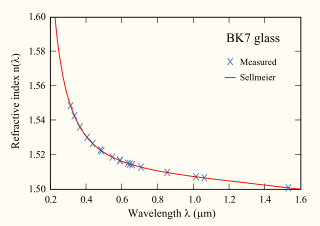
The Sellmeier equation is an empirical relationship between refractive index and wavelength for a particular transparent medium. The equation is used to determine the dispersion of light in the medium.
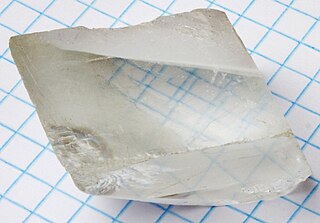
Birefringence is the optical property of a material having a refractive index that depends on the polarization and propagation direction of light. These optically anisotropic materials are described as birefringent or birefractive. The birefringence is often quantified as the maximum difference between refractive indices exhibited by the material. Crystals with non-cubic crystal structures are often birefringent, as are plastics under mechanical stress.

Flint glass is optical glass that has relatively high refractive index and low Abbe number. Flint glasses are arbitrarily defined as having an Abbe number of 50 to 55 or less. The currently known flint glasses have refractive indices ranging between 1.45 and 2.00.

A halo is an optical phenomenon produced by light interacting with ice crystals suspended in the atmosphere. Halos can have many forms, ranging from colored or white rings to arcs and spots in the sky. Many of these appear near the Sun or Moon, but others occur elsewhere or even in the opposite part of the sky. Among the best known halo types are the circular halo, light pillars, and sun dogs, but many others occur; some are fairly common while others are extremely rare.
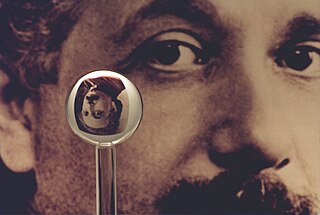
Fused quartz, fused silica or quartz glass is a glass consisting of almost pure silica (silicon dioxide, SiO2) in amorphous (non-crystalline) form. This differs from all other commercial glasses, such as soda-lime glass, lead glass, or borosilicate glass, in which other ingredients are added which change the glasses' optical and physical properties, such as lowering the melt temperature, the spectral transmission range, or the mechanical strength. Fused quartz, therefore, has high working and melting temperatures, making it difficult to form and less desirable for most common applications, but is much stronger, more chemically resistant, and exhibits lower thermal expansion, making it more suitable for many specialized uses such as lighting and scientific applications.
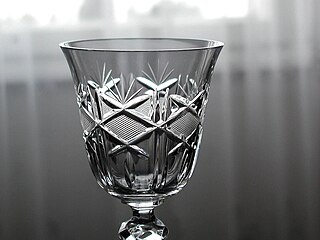
Lead glass, commonly called crystal, is a variety of glass in which lead replaces the calcium content of a typical potash glass. Lead glass contains typically 18–40% lead(II) oxide (PbO), while modern lead crystal, historically also known as flint glass due to the original silica source, contains a minimum of 24% PbO. Lead glass is often desirable for a variety of uses due to its clarity. In marketing terms it is often called crystal glass.

An opacifier is a substance added to a material in order to make the ensuing system opaque. An example of a chemical opacifier is titanium dioxide (TiO2), which is used as an opacifier in paints, in paper, and in plastics. It has very high refraction index (rutile modification 2.7 and anatase modification 2.55) and optimum refraction is obtained with crystals about 225 nanometers. Impurities in the crystal alter the optical properties. It is also used to opacify ceramic glazes and milk glass; bone ash is also used.
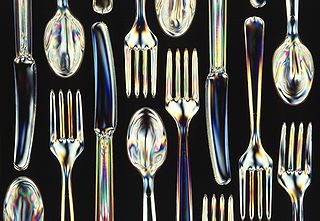
In materials science, photoelasticity describes changes in the optical properties of a material under mechanical deformation. It is a property of all dielectric media and is often used to experimentally determine the stress distribution in a material.
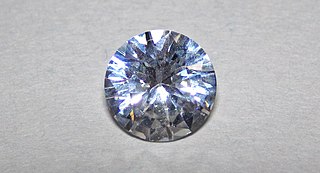
Yttrium aluminium garnet (YAG, Y3Al5O12) is a synthetic crystalline material of the garnet group. It is a cubic yttrium aluminium oxide phase, with other examples being YAlO3 (YAP) in a hexagonal or an orthorhombic, perovskite-like form, and the monoclinic Y4Al2O9 (YAM).
A glass code is a method of classifying glasses for optical use, such as the manufacture of lenses and prisms. There are many different types of glass with different compositions and optical properties, and a glass code is used to distinguish between them.

Plastic optical fiber (POF) or polymer optical fiber is an optical fiber that is made out of polymer. Similar to glass optical fiber, POF transmits light through the core of the fiber. Its chief advantage over the glass product, other aspect being equal, is its robustness under bending and stretching.
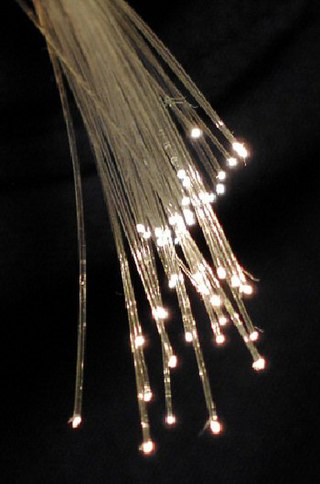
An optical fiber, or optical fibre, is a flexible glass or plastic fiber that can transmit light from one end to the other. Such fibers find wide usage in fiber-optic communications, where they permit transmission over longer distances and at higher bandwidths than electrical cables. Fibers are used instead of metal wires because signals travel along them with less loss and are immune to electromagnetic interference. Fibers are also used for illumination and imaging, and are often wrapped in bundles so they may be used to carry light into, or images out of confined spaces, as in the case of a fiberscope. Specially designed fibers are also used for a variety of other applications, such as fiber optic sensors and fiber lasers.
Crown glass is a type of optical glass used in lenses and other optical components. It has relatively low refractive index (≈1.52) and low dispersion. Crown glass is produced from alkali-lime silicates containing approximately 10% potassium oxide and is one of the earliest low dispersion glasses.

Barium borate is an inorganic compound, a borate of barium with a chemical formula BaB2O4 or Ba(BO2)2. It is available as a hydrate or dehydrated form, as white powder or colorless crystals. The crystals exist in the high-temperature α phase and low-temperature β phase, abbreviated as BBO; both phases are birefringent, and BBO is a common nonlinear optical material.
Optical glass refers to a quality of glass suitable for the manufacture of optical systems such as optical lenses, prisms or mirrors. Unlike window glass or crystal, whose formula is adapted to the desired aesthetic effect, optical glass contains additives designed to modify certain optical or mechanical properties of the glass: refractive index, dispersion, transmittance, thermal expansion and other parameters. Lenses produced for optical applications use a wide variety of materials, from silica and conventional borosilicates to elements such as germanium and fluorite, some of which are essential for glass transparency in areas other than the visible spectrum.
References
- ↑ Zhang, Chenglong; Cong, Weilong; Feng, Pingfa; Pei, Zhijian J. (2014). "Rotary ultrasonic machining of optical K9 glass using compressed air as coolant: a feasibility study". Proceedings of the Institution of Mechanical Engineers, Part B: Journal of Engineering Manufacture. 228 (4): 504. doi:10.1177/0954405413506195. hdl: 2097/17898 . S2CID 53380862.
- ↑ Hong Hua Tan (13 August 2010). Applied Mechanics And Mechanical Engineering. Trans Tech Publications Ltd. p. 49. ISBN 978-3-03813-388-9.
- 1 2 "K9(BK7) Yinxing Optical" . Retrieved May 29, 2023.
- ↑ "Refraction (The Physics Hypertextbook)" . Retrieved May 29, 2023.
- ↑ "What Is K9 Crystal?". Reference.com. 4 August 2015.
 | This glass-related article is a stub. You can help Wikipedia by expanding it. |