
Diyarbakır, formerly Diyarbekir, is the largest Kurdish-majority city in Turkey. It is the administrative center of Diyarbakır Province.

Femicide or feminicide is a term for the murdering of females, often because of their gender. In 1976, the feminist author Diana E. H. Russell first implicitly defined the term as a hate killing of females by males but then went on to redefine it as "the killing of females by males because they are female" in later years. Femicide can be perpetrated by either sex but is more often committed by men. This is most likely due to unequal power between men and women as well as harmful gender roles, stereotypes, or social norms.
Kurdish women have traditionally played important roles in Kurdish society and politics. In general, Kurdish women's rights and equality have improved dramatically in the 21st century due to progressive movements within Kurdish society. However, despite the progress, Kurdish and international women's rights organizations still report problems related to gender inequality, forced marriages, honor killings, and in Iraqi Kurdistan, female genital mutilation (FGM).

Turkish Kurdistan or Northern Kurdistan is the southeastern part of Turkey where Kurds form the predominant ethnic group. The Kurdish Institute of Paris estimates that there are 20 million Kurds living in Turkey, the majority of them in the southeast.
The Kurds are the largest ethnic minority in Turkey. According to various estimates, they compose between 15% and 20% of the population of Turkey. There are Kurds living in various provinces of Turkey, but they are primarily concentrated in the east and southeast of the country within the region viewed by Kurds as Turkish Kurdistan.

Snow is a novel by Turkish writer Orhan Pamuk. It was originally published in Turkish in 2002, followed by an English translation by Maureen Freely that was published in 2004. The story encapsulates many of the political and cultural tensions of modern Turkey, including a real suicide epidemic among teenage girls, which took place in the city of Batman.
Nāmūs is an Arabic word describing an ethical category in Middle Eastern patriarchal character. Often literally translated as "virtue", it is now more popularly used in a strong gender-specific context of relations within a family described in terms of honor, attention, respect/respectability, and modesty.
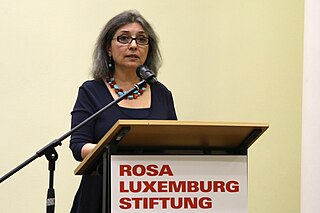
Shahrzad Mojab is an academic activist and professor, teaching at the Department of Leadership, Higher and Adult Education and Women and Gender Studies Institute, at the University of Toronto. Shahrzad has been living in Canada since 1986 with her lifelong partner, colleague and comrade, Amir Hassanpour, and their son, Salah.
Kurds have had a long history of discrimination perpetrated against them by the Turkish government. Massacres have periodically occurred against the Kurds since the establishment of the Republic of Turkey in 1923. Among the most significant is the massacre that happened during the Dersim massacre, when 40,000-70,000 civilians were killed by the Turkish Army and 11,818 people were sent into exile. According to McDowall, 40,000 people were killed. The Zilan massacre of 1930 was a massacre of Kurdish residents of Turkey during the Ararat rebellion, in which 5,000 to 47,000 were killed.
An honor killing, honour killing, or shame killing is a traditional form of murder in which a person is killed by or at the behest of members of their family or their partner, due to culturally sanctioned beliefs that such homicides are necessary as retribution for the perceived dishonoring of the family by the victim. Honor killings are often connected to religion, caste, other forms of hierarchical social stratification, or sexuality. Most often, it involves the murder of a woman or girl by male family members, due to the perpetrators' belief that the victim has lost her innocence by bringing dishonor or shame upon the family name, reputation or prestige. Honor killings are believed to have originated from tribal customs.

Crime in Turkey is combated by the Turkish police and other agencies. Since the 1990s, overall crime in Turkey rose until its peak in 2014. As of 2014, Turkey has seen a 400% rise in crimes, but has steadily declined since then. In 1994, the number of arrested prisoners was recorded as 38,931; 20 years later, as of the beginning of October 2014, the number of prisoners has reached 152,335. According to the data provided by the Ministry of Justice, terrorism and homicide rate has been decreasing year by year after 2014 in Turkey and terrorism is almost never seen.

Women obtained full political participation rights in Turkey, including the right to vote and the right to run for office locally, in 1930, and nationwide in 1934. Article 10 of the Turkish Constitution bans any discrimination, state or private, on the grounds of sex. It is the first country to have a woman as the President of its Constitutional Court. Article 41 of the Turkish Constitution reads that the family is "based on equality between spouses".

Gültan Kışanak is a Kurdish journalist, author and politician from Turkey. Kışanak was born in Elazığ in 1961. Her family is originally from Dersim. She is a former member of the Grand National Assembly of Turkey and Head of Municipality of Diyarbakır. She has been imprisoned since October 2016.

Mazlum Doğan was a journalist and a founding member of the Kurdistan Workers' Party (PKK). He was a Kurdish Alevi which was often told to attract new recruits to PKK. He was the first chief editor of the propaganda newspaper Serxwebûn of PKK. In 1979, he had planned to leave Turkey towards Syria, but was arrested and served time in the infamous Diyarbakir No. 5 prison. Mazlum Doğan committed suicide in protest of the Turkish coup d'état and the inhumane conditions he and other prisoners were facing inside of the penitentiary. Today he is presented as a hero and a martyr by PKK and related organisations.
The status of women in Iraq has been affected by wars, Islamic law, the Constitution of Iraq, cultural traditions, and secularism. Hundreds of thousands of Iraqi women are war widows, and Women's rights organizations struggle against harassment and intimidation while they work to promote improvements to women's status in the law, in education, the workplace, and many other spheres of Iraqi life. Abusive practices such as honor killings and forced marriages remain problematic.

Dengbêjî is a Kurdish music genre sung by Dengbêj. Dengbêjs are singing storytellers. There have been many terms to describe Dengbêjs throughout history, but today Dengbêj is the best known, and also several singing storytellers use Dengbêj as part of their own (artistic) name. Dengbêjs are viewed as a way to transmit the traditions of their Kurdish ancestors in times as it was not possible to publish in Kurdish or about Kurdish history. Since many documents about certain Kurdish events don't exist, today there exist attempts to analyze them through the songs of the Dengbêjs. They sing about Kurdish geography, history, recent events, but also lullabies and love songs.
Yeşim Arat (born September 5, 1955), is a Turkish political scientist and author specialized in gender politics, Turkish politics, women in Turkish politics, and women's movements in Turkey. She is a professor in the department of political science and international relations at Boğaziçi University.
Women were active in a number of roles during the Gulf War.
An honor killing, honour killing, or shame killing is the murder of an individual, either an outsider or a member of a family, by someone seeking to protect what they see as the dignity and honor of themselves or their family. Honor killings are often connected to religion, caste and other forms of hierarchical social stratification, or to sexuality, and those murdered will often be more liberal than the murderer rather than genuinely "dishonorable". Most often, it involves the murder of a woman or girl by male family members, due to the perpetrators' belief that the victim has brought dishonor or shame upon the family name, reputation or prestige. Honour killings are believed to have originated from tribal customs. They are prevalent in various parts of the world, it traditionally happens in the Philippines, Latin America, MENA countries and in South Asia especially in India, Pakistan and Nepal. They also occur in immigrant communities in countries which do not otherwise have societal norms that encourage honor killings. Historically, this form of murder was practiced in Mediterranean Europe in countries such as Italy, Greece, and France. Honor killings are often associated with rural and tribal areas, but they occur in urban areas too. Although condemned by international conventions and human rights organizations, honor killings are often justified and encouraged by various communities.
Zeynep Kınacı (1972–1996) was a member of the Kurdistan Workers' Party (PKK) known for having committed its first suicide attack. The way she carried it out has influenced women's role within the PKK.


