Related Research Articles

Heart of Darkness (1899) is a novella by Polish-English novelist Joseph Conrad in which the sailor Charles Marlow tells his listeners the story of his assignment as steamer captain for a Belgian company in the African interior. The novel is widely regarded as a critique of European colonial rule in Africa, whilst also examining the themes of power dynamics and morality. Although Conrad does not name the river on which most of the narrative takes place, at the time of writing, the Congo Free State—the location of the large and economically important Congo River—was a private colony of Belgium's King Leopold II. Marlow is given a text by Kurtz, an ivory trader working on a trading station far up the river, who has "gone native" and is the object of Marlow's expedition.

Joseph Conrad was a Polish-British novelist and story writer. He is regarded as one of the greatest writers in the English language; though he did not speak English fluently until his twenties, he came to be regarded a master prose stylist who brought a non-English sensibility into English literature. He wrote novels and stories, many in nautical settings, that depict crises of human individuality in the midst of what he saw as an indifferent, inscrutable and amoral world.

The Nigger of the "Narcissus": A Tale of the Forecastle, first published in the United States as The Children of the Sea, is an 1897 novella by Polish-British novelist Joseph Conrad. The central character is an Afro-Caribbean man who is ill at sea while aboard the trading ship Narcissus heading towards London. Due to the offensiveness of the word nigger in the title, it was renamed The Children of the Sea: A Tale of the Forecastle for the 1897 US edition.
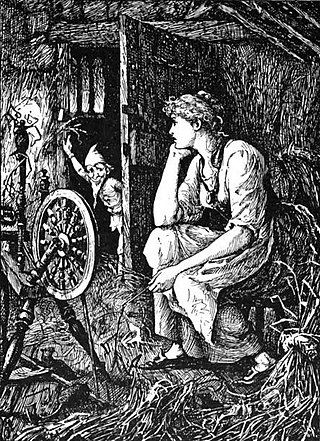
"Rumpelstiltskin" is a German fairy tale. It was collected by the Brothers Grimm in the 1812 edition of Children's and Household Tales. The story is about an imp who spins straw into gold in exchange for a woman's firstborn child.
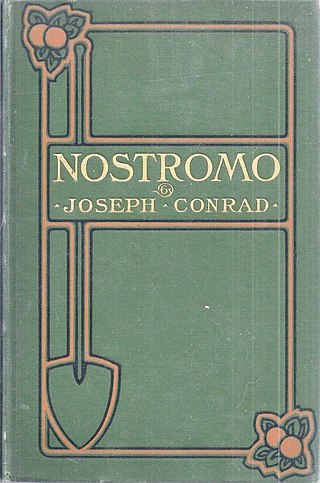
Nostromo: A Tale of the Seaboard is a 1904 novel by Joseph Conrad, set in the fictitious South American republic of "Costaguana". It was originally published serially in monthly instalments of T.P.'s Weekly.
Aušrinė is a feminine deity of the morning star (Venus) in the Lithuanian mythology. She is the antipode to "Vakarinė", the evening star.

Isobel Violet Hunt was a British author and literary hostess. She wrote feminist novels. She founded the Women Writers' Suffrage League in 1908 and participated in the founding of International PEN.

The Rover is the last complete novel by Joseph Conrad, written between 1921 and 1922. It was first published in 1923, and adapted into the 1967 film of the same name.

Blackwood's Magazine was a British magazine and miscellany printed between 1817 and 1980. It was founded by the publisher William Blackwood and was originally called the Edinburgh Monthly Magazine. The first number appeared in April 1817 under the editorship of Thomas Pringle and James Cleghorn. The journal was unsuccessful and Blackwood fired Pringle and Cleghorn and relaunched the journal as Blackwood's Edinburgh Magazine under his own editorship. The journal eventually adopted the shorter name and from the relaunch often referred to itself as Maga. The title page bore the image of George Buchanan, a 16th-century Scottish historian, religious and political thinker.

Beyond Chutzpah: On the Misuse of Anti-Semitism and the Abuse of History is a book by Norman Finkelstein published by the University of California Press in August 2005. The book provides a critique of arguments used to defend Israel's stance in the Israel-Palestine conflict, including the use of the weaponization of antisemitism to deflect criticism of Israel. The book also compares Alan Dershowitz's earlier book, The Case for Israel, with the findings of mainstream human rights organisations, such as Human Rights Watch and Amnesty International. It includes an epilogue entitled Dershowitz v. Finkelstein: Who’s Right and Who’s Wrong? by Frank Menetrez, a former Editor-in-Chief of the UCLA Law Review.

An Outcast of the Islands is the second novel by Joseph Conrad, published in 1896, inspired by Conrad's experience as mate of a steamer, the Vidar.

Norman Gary Finkelstein is an American political scientist and activist. His primary fields of research are the politics of the Holocaust and the Israeli–Palestinian conflict.
Charles Marlow is a fictional English seaman and recurring character in the work of novelist Joseph Conrad.
Richard Curle (1883–1968) was a Scottish author, critic, and journalist. He was a friend of the novelist Joseph Conrad, who was also the subject of several of his critical works.

Tales of Unrest is a collection of five works of short fiction by Polish-British author Joseph Conrad. Four of the five works were previously published as serials in literary journals before appearing in the volume, published in 1898 by T. Fisher Unwin.

The Three Ages of Man is a painting by Titian, dated between 1512 and 1514, and now displayed at the Scottish National Gallery in Edinburgh. The 90 cm high by 151 cm wide Renaissance art work was most likely influenced by Giorgione's themes and motifs of landscapes and nude figures—Titian was known to have completed some of Giorgione's unfinished works after Giorgione died at age 33 of the plague in 1510. The painting represents the artist's conception of the life cycle. Childhood and manhood are synonymous with earthly love and death. These and the approaching old age are drawn realistically. Titian's widely chosen topic in art history, ages of man, mixed with his own allegorical interpretation make The Three Ages of Man one of Titian's most famous works.
James Brand Pinker was a literary agent who represented James Joyce, Joseph Conrad, Henry James, Stephen Crane, H.G. Wells, D.H. Lawrence and many of the other leading British and American writers of the age. He is considered to be one of the first literary agents in the modern sense and to have placed relations between authors and publishers on a more professional and fair basis.

Gabriel Wilfrid Stephen Brodsky is a research scholar and author in Literature of War and in Joseph Conrad studies.
Joseph Hardman was an English merchant and contributor to Blackwood's Magazine.

Perriton Maxwell was an American author, editor and artist.
References
- Adams, David (2001). ""REMORSE AND POWER": CONRAD'S KARAIN AND THE QUEEN". Modern Fiction Studies. 47 (4). The Johns Hopkins University Press: 723–752. ISSN 0026-7724. JSTOR 26286495 . Retrieved 2024-04-27.
- Conrad, Joseph (2008-05-08). Heart of Darkness and Other Tales. Oxford: OUP Oxford. ISBN 978-0-19-953601-6.
- Conroy, Mark (1994). "GHOSTWRITING (IN) 'KARAIN'". The Conradian. 18 (2). Joseph Conrad Society UK: 1–16. ISSN 0951-2314. JSTOR 20874053 . Retrieved 2024-04-27.
- Finkelstein, David (2009). "Decent Company: Conrad,". Conradiana. 41 (1). Texas Tech University Press: 29–47. ISSN 0010-6356. JSTOR 24635191 . Retrieved 2024-04-27.
- Gogwilt, Christopher (1991). "The Charm of Empire: Joseph Conrad's". Mosaic: A Journal for the Interdisciplinary Study of Literature. 24 (1). University of Manitoba: 77–91. JSTOR 24780696 . Retrieved 2024-04-27.
- Herbert, Wray C. (1976). "CONRAD'S PSYCHIC LANDSCAPE: THE MYTHIC ELEMENT IN "KARAIN"". Conradiana. 8 (3). Texas Tech University Press: 225–232. ISSN 0010-6356. JSTOR 24633918 . Retrieved 2024-04-27.
- Paccaud, Josiane (2019). "The "Obscure Odyssey" of the Object in Conrad's "Karain"". Fathom. 6. doi:10.4000/fathom.1416.
- Peters, John (2006). The Cambridge Introduction to Joseph Conrad. Cambridge University Press.
- Watts, Cedric (2003). "Fraudulent Signifiers: Saussure and the Sixpence in". The Conradian. 28 (2). Joseph Conrad Society UK: 12–28. ISSN 0951-2314. JSTOR 20874225 . Retrieved 2024-04-27.