
Look up Kaur in Wiktionary, the free dictionary.
Kaur is the surname used by Sikh women and some Hindu women
Contents
Kaur may also refer to:
Kaur is the surname used by Sikh women and some Hindu women
Kaur may also refer to:


Ranjit Singh was the founder and first maharaja of the Sikh Empire, in the northwest Indian subcontinent, ruling from 1801 until his death in 1839.

Chand Kaur was the regent of the Sikh Empire, proclaimed as Malika Muqaddisa on 2 December 1840. She was born to Sardar Jaimal Singh of the Kanhaiya Misl. In 1812, she was married to Crown Prince Kharak Singh, son and heir apparent of Maharaja Ranjit Singh and Maharani Datar Kaur. In 1821 she gave birth to their only son Nau Nihal Singh, who became second in line of succession to the throne of Punjab.

Rajkumari Dame Bibiji Amrit Kaur DStJ was an Indian activist and politician. Following her long-lasting association with the Indian independence movement, she was appointed the first Health Minister of India in 1947 and remained in office until 1957. She also held the charge of Sports Minister and Urban Development Minister and was instrumental in setting up the National Institute of Sports, Patiala. During her tenure, Kaur ushered in several healthcare reforms in India and is widely remembered for her contributions to the sector and her advocacy of women's rights. Kaur was also a member of the Constituent Assembly of India, the body that framed the Constitution of India.
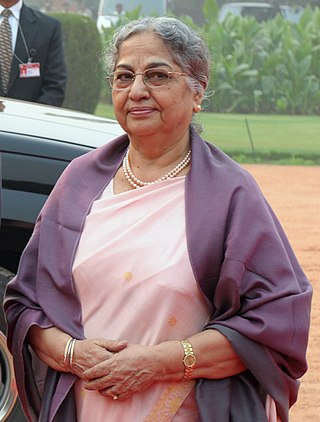
Gursharan Kaur Kohli is an Indian history professor, author and widow of the former prime minister of India, Dr. Manmohan Singh.
The principles of Sikhism state that women have the same souls as men and thus possess an equal right to cultivate their spirituality with equal chances of achieving salvation. Women participate in all Sikh religious, cultural, social, and secular activities including lead religious congregations, take part in the Akhand Path, perform Kirtan, perform Gatka and work as a Granthis.
Aisha is an Arabic female given name. It originated from Aisha, the third wife of the Islamic prophet, Muhammad, and is a very popular name among Muslim women.
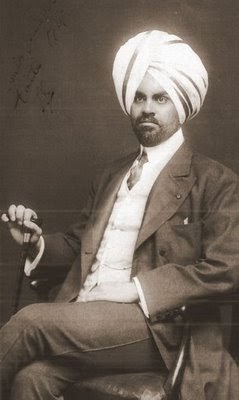
Colonel Maharajah Sir Jagatjit Singh Sahib Bahadur was the last ruling Maharaja of the princely state of Kapurthala during the British Raj in India, from 1877 until his death, in 1949. He ascended to the throne of Kapurthala state on 16 October 1877 and assumed full ruling powers on 24 November 1890 as well indulging in traveling the world and being a Francophile.
Helene is a female given name, a variant of Helen, using the French spelling. Helen is ultimately from Greek Ἑλένη.
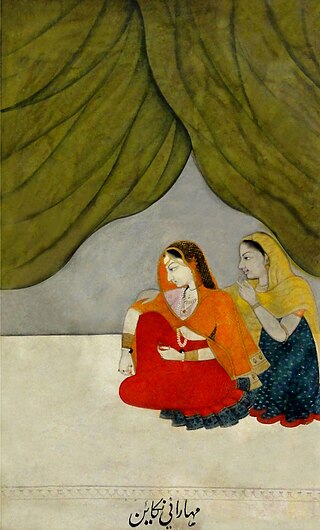
Maharani Datar Kaur (born Bibi Raj Kaur Nakai; was the queen consort of Maharaja Ranjit Singh, the founder of the Sikh Empire and the mother of his successor, Maharaja Kharak Singh. She was the daughter of Sardar Ran Singh Nakai, third ruler of the Nakai Misl and Sardarni Karmo Kaur.
Leila is a feminine given name primarily found in the Middle East, including Semitic speaking countries, Iran, Pakistan and Turkey. In the Latin alphabet, the name is commonly spelled in multiple ways, including Leila, Layla, Laylah, Laila, Leyla, and Leylah.
Upinder Singh is an Indian historian who is a professor of History and Dean of Faculty at Ashoka University. She is the former head of the History Department at the University of Delhi. She is also the recipient of the inaugural Infosys Prize in the category of Social Sciences (History).
Larissa is a female given name of Greek origin that is common in Eastern European nations of Orthodox church heritage. It is derived either from Larissa, a nymph in Greek mythology who was a daughter of Pelasgus, or from the name of the ancient city of Larissa in Greece which meant "citadel" or "fortress" in a now extinct Pre-Greek substrate language.
Parveen is a Persian-Kurdish given name meaning Pleiades. It is commonly used in Iran, Afghanistan, Tajikistan, Pakistan and India. It is also used as a last name.

The Nakai Misl, founded by Sandhu Jats, was one of the twelve Sikh Misls that later became part of the Sikh Empire. It held territory between the Ravi and Sutlej rivers southwest of Lahore in what became Pakistan. The misl fought against the Sials, the Pathans and the Kharals before it was incorporated into the Sikh Empire of the Sukerchakia Misl by Ranjit Singh.
Daman Singh is an Indian writer and daughter of former Prime Minister of India, Manmohan Singh.

Parveen Kaur is a Canadian actress. Her credits include The Strain (2015), Saving Hope (2015), American Gods (2017), Beyond (2016-2018), Workin' Moms (2018), and American Hangman (2019). However, she is most notable for playing scientist Saanvi Bahl in Manifest (2018-2023).
Kunwar Rattan Singh (1805–1845) was the second son of Maharaja Ranjit Singh, the founder of the Sikh Empire and his queen consort, Maharani Datar Kaur His elder, Maharaja Kharak Singh was the second Maharaja of the Sikh Empire and nephew, Maharaja Nau Nihal Singh was the third Maharaja. The former reigned for less than four months, and the latter barely four weeks.
Sardar Ran Singh Nakai was the third chief of the Nakai Misl, which was one of the Sikh groupings and guerilla militia that later became part of the Sikh Empire. He was born to the Sandhu family of Jat Sikhs. He distinguished himself at an early age in campaigns with his father, Natha Singh Sandhu and uncle, the legendary Heera Singh Sandhu who was the founder of the Misl. Ran Singh was a fierce warrior and a powerful misldar; under his leadership the misl was at its highest. He was the father of Maharani Datar Kaur and the father-in-law of Maharaja Ranjit Singh, the founder of the Sikh Empire. He was the grandfather of Maharaja Kharak Singh, the second king of the Sikh Empire and Sardar Kahan Singh Nakai, the last chief of the Nakai Misl.
Sardarni Karam Kaur popularly known as Karmo Kaur was the wife of Ran Singh Nakai, the third ruler of the Nakai Misl, one of the groupings with its distinct guerilla militia that later became part of the Sikh Empire. Karmo Kaur served as the regent of the Nakai Misl during the reign of her sons, Bhagwan Singh and Gyan Singh. She was the mother of Maharani Datar Kaur, one of the wives of Maharaja Ranjit Singh, the founder of the Sikh Empire. She was the grandmother of Maharaja Kharak Singh, the second king of the Sikh Empire and Sardar Kahan Singh Nakai, the last chief of the Nakai Misl.
Nanaki Kaur Atariwala (1823-1856) was the queen consort of Maharaja Nau Nihal Singh, the third Maharaja of the Sikh Empire. She was the daughter of the legendary general Sham Singh Atariwala.