
Amsterdam is the capital and most populated city of the Netherlands. It has a population of 921,402 within the city proper, 1,457,018 in the urban area and 2,480,394 in the metropolitan area. Located in the Dutch province of North Holland, Amsterdam is colloquially referred to as the "Venice of the North", for its large number of canals, now a UNESCO World Heritage Site.

The Office for Metropolitan Architecture (OMA) is an international architectural firm with offices in Rotterdam, New York, Hong Kong, Doha, and Australia. The firm is currently led by eight partners - Rem Koolhaas, Reinier de Graaf, Ellen van Loon, Shohei Shigematsu, Iyad Alsaka, Chris van Duijn, Jason Long, and managing partner and architect David Gianotten.
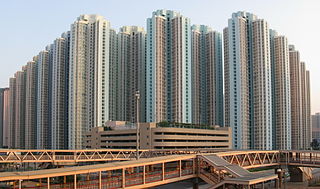
The Home Ownership Scheme (HOS) is a subsidised-sale public housing programme managed by the Hong Kong Housing Authority. It was instituted in the late 1970s as part of the government policy for public housing with two aims – to encourage better-off tenants of rental flats to vacate those flats for re-allocation to families in greater housing need; and also to provide an opportunity for home ownership to families unable to afford to buy in the private sector.

Amsterdam-Zuidoost is a borough (stadsdeel) of Amsterdam, Netherlands. It consists of four residential neighborhoods—Bijlmermeer, Venserpolder, Gaasperdam and Driemond—as well as the Amstel III/Bullewijk Business Park and the Amsterdam Arena entertainment and shopping district.

The Bijlmermeer, or colloquially the Bijlmer, is a neighborhood in the Amsterdam-Zuidoost borough in Amsterdam, Netherlands. The other neighborhoods in Amsterdam-Zuidoost are Gaasperdam, Bullewijk, Venserpolder and Driemond.

The Olympic Stadium is a sporting venue which was used as the main stadium for the 1928 Summer Olympics in Amsterdam. The venue is currently used mostly for athletics, other sports events and music concerts.
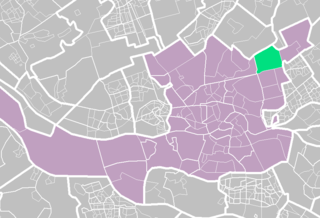
Ommoord is a neighbourhood in the former borough Prins Alexander, part of the municipality of Rotterdam, South Holland, the Netherlands. Ommoord is surrounded by the neighbourhoods Zevenkamp, Het Lage Land and Terbregge. It has around 25,000 inhabitants across 12,500 households. Ommoord shares postal codes 3068 and 3069 with Zevenkamp.

Boyle Street is a neighbourhood located in central Edmonton, Alberta, Canada, immediately east of the downtown core. The neighbourhood is bounded by Grierson Hill to Rowland Road until Alex Taylor Road and then Jasper Avenue east until 82 Street by the south, 82 Street by the east, 97 Street by the west, and the LRT tracks to the north, with Jasper Avenue and 103A Avenue running through the neighbourhood.

Katendrecht is a neighbourhood of Rotterdam, on the south bank of the Nieuwe Maas. It is located between the Rijnhaven and the Maashaven. Katendrecht was a separate municipality from 1817 to 1874, when it merged with Charlois.
Mecanoo is an architecture firm based in Delft, Netherlands. Mecanoo was founded in 1984 by Francine Houben, Henk Döll, Roelf Steenhuis, Erick van Egeraat and Chris de Weijer.

Structuralism is a movement in architecture and urban planning that evolved around the middle of the 20th century. It was a reaction to Rationalism's (CIAM-Functionalism) perceived lifeless expression of urban planning that ignored the identity of the inhabitants and urban forms.
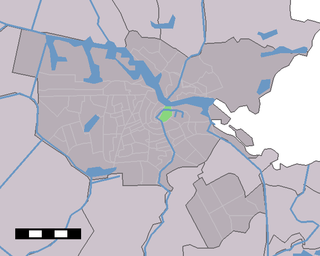
Lastage is a neighborhood in the Centrum borough of Amsterdam, Netherlands. It is located between the Geldersekade and Oudeschans canals, just east of old medieval city. Today, the neighbourhood is also known as Nieuwmarktbuurt due to the fact that the Nieuwmarkt is comprised in the area; it is protected as a heritage site.

Slotermeer is a neighborhood of Amsterdam, Netherlands, in the Dutch province of North Holland. The name of Slotermeer comes from the Slootermeer Lake that used to be in this area

Nieuwmarkt is an underground metro station in the city centre of Amsterdam, Netherlands. Served by metro lines 51, 53, and 54 of the Amsterdam Metro, the station was constructed by sinking caissons with a length of 40 metres (130 ft). This construction method resulted in the demolition of parts of the Nieuwmarkt neighbourhood and was met with protests.

Weesperplein is an underground metro station in the city centre of Amsterdam, Netherlands. Served by lines 51, 53, and 54 of the Amsterdam Metro, it was constructed using caissons with a length and width of 40 metres (130 ft). It has two floors: the upper floor, with a station hall and stores, and the lower floor, containing the tracks. Construction started in August 1970, and the first test rides passed through in January 1977. Extensive tests were carried out in September that year before it opened on 16 October.
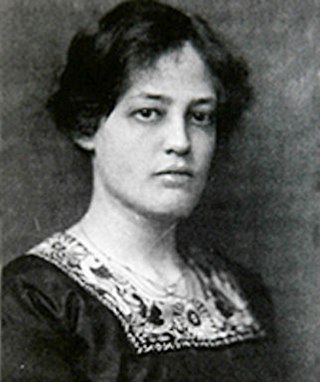
Margaret Staal-Kropholler, frequently referred to as Margaret Kropholler, was the first woman in the Netherlands to practice as a professional architect.

The Schielandtoren is a 101 metres tall apartment building in the Dutch city Rotterdam. The building is situated along Bulgersteyn, a street, and is part of a city block with shops among other things. The city block is part of the multipurpose complex Beursplein. Het Schielandshuis, a 17th-century building, is located across the street. The building has a total of 32 aboveground floors with 109 apartments. The floor area amounts to 18,300 m2 (197,000 sq ft). A parking garage of Q-Park with 435 parking spaces is located in close proximity of the Schielandtoren.

Burrows Court is a high-rise residential building in the Sneinton neighbourhood in Nottingham, United Kingdom. Built in 1967 to a height of 61 metres (200 ft) with 21 floors, the tower block is the third tallest residential building in Nottingham. The building originally consisted of 130 one- and two-bedroom flats. Decommissioned by Nottingham City Council in 2005 due to low demand and drug dealing in the area, the building stood empty and was described as an "eyesore" until renovations were completed in 2021.

The Granby Four Streets is an area in Toxteth, Liverpool, England, comprising four streets at the tip of a triangle near the Grade II* listed Princes Park. The streets, designed by Welsh architect Richard Owens and built by Welsh workers during the late 19th century are Beaconsfield Street, Cairns Street, Jermyn Street and Ducie Street. A fifth street, Granby Street, connects the four streets together and mostly contains commercial units.

Barclays House is an office block in Poole, Dorset, in England. It was constructed by Barclays bank from 1972 to 1975 as part of a move to decentralise its offices from London. Barclays left the site in January 2022 and put the structure up for sale by sealed bid auction. The highest bidder was Bournemouth, Christchurch and Poole Council but they withdrew from the purchase in September 2022.

