
The White House, also known as the Russian White House and previously known as the House of Soviets of Russia, is a government building in Moscow. It stands on the Krasnopresnenskaya Embankment. The building serves as the primary office of the government of Russia and is the official workplace of the Russian Prime Minister.
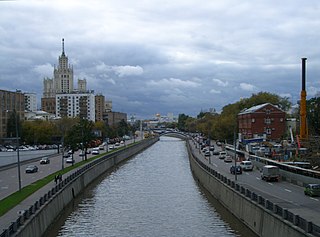
The Yauza is a river in Moscow and Mytishchi, Russia, a tributary of the Moskva. It originates in the Losiny Ostrov National Park northeast of Moscow, flows through Mytishchi, enters Moscow in the Medvedkovo District and flows through the city in an irregular, meandering, generally north-south direction. The Yauza joins the Moskva River in Tagansky District just west of Tagansky Hill, now marked by the Kotelnicheskaya Embankment tower. Valleys of the Yauza, from the MKAD beltway in the north to the Moscow-Yaroslavl railway west of Sokolniki Park, are protected as natural reserves.
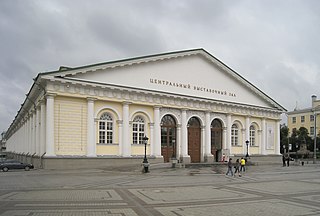
The Moscow Manege is an oblong building along the west side of Manege Square, which was cleared in the 1930s and lies adjacent to Red Square. It is the site of Moscow Design Museum since 2012.

The Rossiya Hotel was a hotel in Moscow and was the largest hotel in the world from 1967 to 1980. Until its closure in 2006, it remained the second largest hotel in Europe, with 3,182 rooms. Throughout its existence, the hotel welcomed about ten million guests, including more than two million foreigners. Famous hotel guests included Mikhail Gorbachev, George H. W. Bush and Mike Tyson.

Krasnopresnenskaya is a Moscow Metro station in the Presnensky District, Central Administrative Okrug, Moscow. It is on the Koltsevaya line, between Kiyevskaya and Belorusskaya stations. It was named for the street, Krasnaya Presnya, on which it is situated. Passengers may transfer to Barrikadnaya station on the Tagansko–Krasnopresnenskaya line.
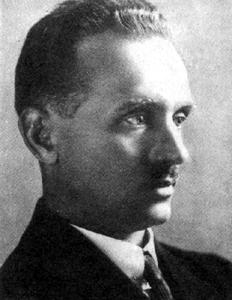
Konstantin Stepanovich Melnikov was a Russian architect and painter. His architectural work, compressed into a single decade (1923–33), placed Melnikov on the front end of 1920s avant-garde architecture. Although associated with the Constructivists, Melnikov was an independent artist, not bound by the rules of a particular style or artistic group. In 1930s, Melnikov refused to conform with the rising Stalinist architecture, withdrew from practice and worked as a portraitist and teacher until the end of his life.
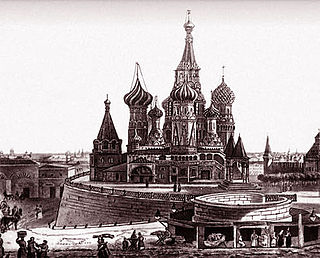
Lobnoye mesto is a 13-meter-long stone platform situated on Red Square in Moscow in front of Saint Basil's Cathedral.

Bolshoy Kamenny Bridge is a steel arch bridge spanning Moskva River at the western end of the Moscow Kremlin. Its predecessor was the first permanent stone bridge in Moscow, Russia. The existing bridge was completed in 1938 by engineer Nikolai Kalmykov.
The name Krasnoluzhsky Bridge refers to three existing bridges across Moskva River, located between Kievsky Rail Terminal and Luzhniki in Moscow.
The Eighth Sister is the unbuilt project for a skyscraper in Zaryadye, Moscow. It would have been the eighth sister to the group of Stalinist skyscrapers known as Seven Sisters. The architect was Dmitry Chechulin.

Kuznetsky Most is a Moscow Metro station in the Meshchansky District, Central Administrative Okrug, Moscow. It is on the Tagansko-Krasnopresnenskaya Line. Designed by Nina Aleshin and N. Samoylova the station was the first column type to be built since the 1950s. It was opened in 1975 as part of the linking segment between the Zhdanovskaya and Krasnopresnenskaya Line. Decoratively the station is a column tri-vault. The columns are faced with "gazgan" marble archways. The floor is covered with polarised black granite. The snow-white marble of the walls is decorated with decorative artworks created by M. Alekseyev. The vestibule of the station is located in the courtyard of Rozhdestvenka Street, 6. At the opposite end of the station is a transfer to the Lubyanka station on the Sokolnicheskaya Line.
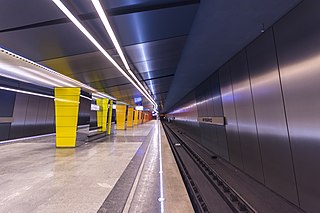
Zhulebino is a station on Moscow Metro's Tagansko-Krasnopresnenskaya Line. It is named after Zhulebino district and situated at the intersection of General Kuznetsov and Aircraft designer Mil streets. Zhulebino was opened on 9 November 2013. The construction lasted for two years. The station was to be opened on 6 November 2013, however due to a technical failure of a train at neighbouring Lermontovsky Prospekt station it was delayed until the 9th. Its location is outside the Moscow Ring Road beltway.

Moskvoretskaya Embankment is a major street, located in the Kitay-Gorod administrative district in central Moscow, running along the Moskva River.

The Moscow International Performing Arts Centre was officially opened on September 28, 2003 with the debut of a new orchestra, the National Philharmonic of Russia under musical director Vladimir Spivakov. Also known as the Moscow International House of Music, it is situated on the Kosmodamianskaya Embankment off the Garden Ring Road.

Church of All Saints at Kulishki is one of the oldest churches in Moscow, located at 2 Slavyanskaya Square. A notable feature of the church is its leaning bell-tower.
Smolensky Metro Bridge is a steel arch bridge that spans Moskva River in Dorogomilovo District of Moscow, Russia. It is the first bridge built for the Moscow Metro in 1935–1937, designed by N.P.Polikarpov, P.K.Antonov and Yakovlev brothers. It is one of two bridges over Moskva River that are used exclusively by Metro (subway) trains, while the other Metro bridges combine road and rail.

The House on the Embankment is a block-wide apartment building on the banks of the Moskva River on Balchug in downtown Moscow, Russia. It faces Bersenevskaya Embankment on one side and Serafimovicha Street on the other side. Until 1952, it was the tallest residential building in Moscow. It is considered an example of constructivist architecture. It is most known as the place of residence of the Soviet elite, many of whom were arrested and executed during Stalin's Great Purge.

Shlyuzovoy Bridge is a concrete cantilever bridge in Moscow, Russia, spanning the eastern extremity of Vodootvodny Canal and connecting right-bank embankments of Moskva River. Existing bridge was completed in 1965 by engineer Z.V. Freydina.
Taynitsky Garden is an urban park located within the walls of the Moscow Kremlin, in Russia. The park is named after the Taynitskaya Tower in the Kremlin Wall, and is part of the portion of the Kremlin which is a UNESCO World Heritage Site.


