
Islamic Revolutionary Guard Corps Ground Forces, acronymed NEZSA, are the land force which the Islamic Revolutionary Guard Corps (IRGC), maintain in parallel to the regular army of Iran. In addition to their conventional military role, the revolutionary guards' ground forces are more geared towards internal disorder than the regular army. However, in late years, the IRGC Ground Forces and by extension the entire IRGC, have transitioned to becoming an expeditionary force, capable of projecting power abroad, through conventional military operations or via proxies and unconventional warfare. There are at least around 150,000 IRGC Ground Force troops.

Operation Fath-ol-Mobin was a major Iranian military operation conducted during the Iran–Iraq War, in March 1982. The operation was led by Lt. General Ali Sayad Shirazi, and was conducted in four phases.

Operation Beit-ol-Moqaddas or Operation Toward Beit-ol-Moqaddas was an Iranian operation conducted during the Iran–Iraq War. The operation was a success, as it achieved its standing aim of liberating Khorramshahr and pushed Iraqi troops back to the border. This operation, coupled with Operation Tariq-ol-Qods, and Operation Fath-ol-Mobin, succeeded in evicting Iraqi troops from southern Iran and gave Iran the momentum.
General Mohsen Vezvaei was an officer of the Islamic Revolutionary Guard Corps who was killed during the Iran–Iraq War in Operation Beit ol-Moqaddas. He was also involved in street protests against the Shah of Iran, and later in the 1979 Iranian hostage crisis.
Intelligence Protection Organization of the Islamic Revolutionary Guard Corps is an Iranian intelligence agency within the Islamic Revolutionary Guard Corps (IRGC) and part of Council for Intelligence Coordination.

Special Unit of NEDSA, also known as Sepah Navy Special Force(S.N.S.F.), is a Takavar unit in the Islamic Revolutionary Guard Corps (IRGC) Navy stationed in the Greater Farur Island of Persian Gulf.
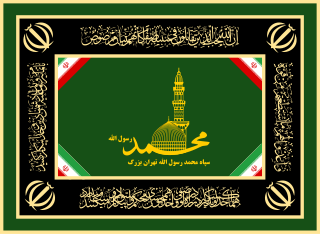
27th Mohammad Rasulullah Division was a division of the Islamic Revolutionary Guard Corps Ground Forces based in Tehran.
The 41st Tharallah Division was a division of the Islamic Revolutionary Guard Corps from 1980 until it was merged into the Sarallah Corps of Kerman Province in 2008.
33rd Al-Mahdi Division was a brigade of the Islamic Revolutionary Guard Corps. It was established on 24 February 1982 before Operation Fath ol-Mobin in the Iran–Iraq War, with Ali Fazli as its commander. It was part of the 7th Fajr Division for some time during the war. After Operation Beit ol-Moqaddas, there was some reform in the structure of the brigade, and Mohammad Jaafar Asadi was made as the commander, and remained the commander of the unit until the end of the war. On 24 April 1983 the brigade was separated from the 19th Fajr Division and became part of the newly founded 7th Corps. The brigade was turned into the 33rd Al-Mahdi Division after the successful Operation Dawn 8.
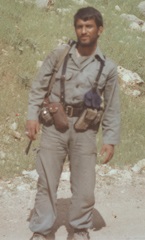
Hossein Qajeyi was one of the commanders of 27th Mohammad Rasulullah Division in the Iran-Iraq war.

The several branches of the Armed Forces of the Islamic Republic of Iran are represented by flags. Within the Iranian military, various flags fly on various occasions, and on various ships, bases, camps, and military academies.

Reza Moatarian is an Iranian photojournalist.
The Thar-Allah Headquarters is an Islamic Revolutionary Guard Corps command. It is in charge of security for Tehran area and doubles as Headquarters with territorial responsibilities.

Islamic Revolutionary Guard Corps Research and Self-Sufficiency Jihad Organization is a R&D unit institution established in 1993. According to IRGC, it was attacked in 2021. It has buildings based in Isfahan and Tehran.

Popular is a 2020 Iranian film written and directed by Soheil Beiraghi. The film screened for the first time at the 38th Fajr Film Festival.
Amir Al-Momenin University of Military Sciences and Technology is the biggest IRGC staff military college for ground forces officers based in Isfahan. This academy has hosted international armed forces games matches. It was established in 2006, 1385

Mohammad Saleh Meftah is an Iranian jurist, political activist and journalist. He is a member of the Central Council and chairman of Progress and Justice Population of Islamic Iran. He is known as an activist of the Persian-language Twitter community and as someone who makes demands of the authorities. He was born in Estahban, Fars province, and lives in Tehran. He is known as a Principlist political figure and media activist, and he is a member of the Central Council of the Muslim Bloggers Association.

Hamidreza Moghaddamfar is an Iranian university professor, expert on strategic issues, cultural and media adviser to the commander of the Islamic Revolutionary Guard Corps of Iran, deputy of the Office of Preservation and Publication of Seyyed Ali Khamenei's Works, secretary of the People's Headquarters of Commemoration of Qassem Soleimani and cultural adviser of the Islamic Azad University. He is in charge of publishing and advertising the works of Seyyed Ali Khamenei to the youth of Europe and North America. He was the CEO of Fars News Agency from 2007 to 2011. Then, he became the cultural and social deputy of the Islamic Revolution Guards Corps (IRGC) and was in this position until September 2014. In 2015, Moghadamfar received the official Iran honorary badge of The Striving in the Field of Culture and Art. He is also a member of the board of trustees of the shrine of Sultan Ali ibn Muhammad Baqir.
Bahman Reyhani is an Iranian commander. On June 20, 2014, he was appointed as the commander of the Kermanshah Nebi Akram Corps, a Kurdish force in the IRGC located in Kermanshah province, based on the order of Mohammad Ali Jafari, the commander of the IRGC at the time, in a ceremony attended by Hossein Salami, the deputy commander of the IRGC at the time. Reyhani has played a decisive role in helping the victims of the 2018 Sarpol-e Zahab earthquake. Bahman Reyhani was included in the sanctions list of the European Union on December 21, 2022, due to gross violations of human rights in Iran.

Kermanshah Nebi Akram Corps is a military unit under IRGC and Basij. Their headquarters are located in Kermanshah, and they are the main unit in Kermanshah and are responsible for commanding all Corps and Basij units located in Kermanshah province.

 Iran
Iran