Jacobo Morales is a Puerto Rican actor, poet, writer, playwright, filmmaker, and auteur. Many consider him the most influential film director in Puerto Rico's history.

Major General Luis Raul Esteves was the Puerto Rican military officer who commanded the United States military forces that in 1950 carried out airstrikes and shelled the towns of Jayuya and Utuado in his own native Puerto Rico.

Miguel Ángel Suárez was a Puerto Rican soap opera and movie actor.
Puerto Rican literature is the body of literature produced by writers of Puerto Rican descent. It evolved from the art of oral storytelling. Written works by the indigenous inhabitants of Puerto Rico were originally prohibited and repressed by the Spanish colonial government.

Paquito Cordero, was a pioneer of Puerto Rican television. He was also a comedian and a musical and television producer.
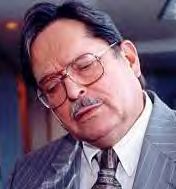
Raúl Dávila was an actor, who is best remembered in the United States for his role of Hector Santos in the American soap opera All My Children. In his home country of Puerto Rico, he is perhaps better remembered as the titular "Carmelo" of the hit WAPA-TV sitcom, "Carmelo y Punto".

The history of the Cinema industry in Puerto Rico predates Hollywood, being conceived after the first industries emerged in some locations of the United States, Switzerland, Denmark, Italy, France, Great Britain and Germany. During the US invasion of the island in 1898, American soldiers brought cameras to record what they saw. By 1912, Puerto Ricans would begin to produce their own films. After the early images recorded by the American soldiers in 1898, most of the films produced in the island were documentaries. It wasn't until 1912 that Rafael Colorado D'Assoy recorded the first non-documentary film titled Un drama en Puerto Rico. After that, Colorado and Antonio Capella Martínez created the Film Industrial Society of Puerto Rico in 1916, producing their first film titled Por la hembra y el gallo. Other film companies formed during the time were the Tropical Film Company (1917) and the Porto Rico Photoplays (1919). Puerto Rico was the second Latin American market to produce a sound film, filming Luis Pales Matos's script for Romance Tropical (1934). The film featured Jorge Rodríguez, Raquel and Ernestina Canino, Sixto Chevremont and Cándida de Lorenzo. In the late 1930s Rafael Cobián produced films starring Blanca de Castejón such as Mis dos amores and Los hijos mandan at Hollywood. In 1951, he would produce Mi doble with San Juan as its setting. Mapy and Fernando Cortés would also participate in the Hollywood industry, as well as throughout Latin America.

Héroes de Otra Patria is a 1998 Puerto Rican film, written and directed by Iván Dariel Ortíz. The film was selected as the Puerto Rican entry for the Best Foreign Language Film at the 71st Academy Awards, but was not accepted as a nominee.

Luis Raúl Martínez Rodríguez, better known as Luis Raúl, was a Puerto Rican actor, comedian and television host. He was known for his stand-up comedy and his various characters. He also hosted TeleOnce's talk and variety show Anda Pa'l Cará from 2001 to 2003 and Telemundo Puerto Rico's game show Pa' Que Te Lo Goces in 2006. He died early in the morning of February 2, 2014 from kidney failure which in turn led to cardiac and respiratory arrest.
Linda Sara is a 1994 Puerto Rican film directed by Jacobo Morales and starring former Miss Universe Dayanara Torres and singer Chayanne. The film was selected as the Puerto Rican entry for the Best Foreign Language Film at the 67th Academy Awards, but was not accepted as a nominee.

Ángel is a 2007 Puerto Rican film written and directed by Jacobo Morales. Morales also performs one of the lead roles in the film. The film was released on August 16, 2007, in Puerto Rico. It was produced by Cinesí Productions.

Thieves and Liars is a 2006 Puerto Rican film directed by Ricardo Méndez Matta. It was Puerto Rico's submission to the 79th Academy Awards for the Academy Award for Best Foreign Language Film, but was not accepted as a nominee.

The Blind Sunflowers is a 2008 Spanish film directed by José Luis Cuerda and written by Rafael Azcona and Cuerda, based on the 2004 novel The Blind Sunflowers by Alberto Méndez. The film stars Maribel Verdú, Javier Cámara and Raúl Arévalo.

Tangos, the Exile of Gardel is an Argentine-French film released on 20 March 1986, directed by Fernando Solanas, starring Marie Laforêt, Miguel Ángel Solá and Philippe Leotard. The film was selected as the Argentine entry for the Best Foreign Language Film at the 59th Academy Awards, but was not accepted as a nominee.
Phi Delta Gamma (ΦΔΓ) of Puerto Rico is the first Puerto Rican organization of Greek letters, which was founded in the western town of Mayagüez, on April 25, 1942.
The Realm of Fortune is a 1986 Mexican drama film directed by Arturo Ripstein. The film was selected as the Mexican entry for the Best Foreign Language Film at the 59th Academy Awards, but was not accepted as a nominee.


