In Hawaiian Religion, Kumu-Honua is the first man.
In Hawaiian mythology, Nāmaka appears as a sea goddess in the Pele family. She is an older sister of Pele-honua-mea.
The aliʻi were the traditional nobility of the Hawaiian islands. They were part of a hereditary line of rulers, the noho aliʻi.
Hawaiʻiloa is a mythical Hawaiian fisherman and navigator who discovered the island of Hawaiʻi.

Abraham Fornander was a Swedish-born emigrant who became an important journalist, judge, and ethnologist in Hawaii.
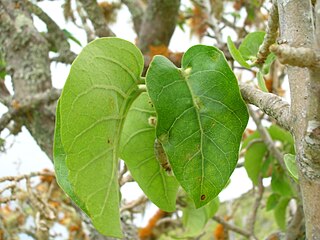
Nothocestrum is a genus of flowering plants in the nightshade family, Solanaceae. It contains four species of large shrubs or small trees that are endemic to Hawaii, where they are known as ʻaiea.

Kameʻeiamoku was a Hawaiian high chief and the Counselor of State to King Kamehameha I. He was called Kamehameha's uncle, but he was really the cousin of Kamehameha's mother, Kekuiapoiwa II.

Kamakahelei, was alii nui, or Queen regnant, of the island of Kauaʻi. She was the ruling chiefess of Kauaʻi reigning from 1770 - 1794. In some historical references she has been described as a regent for her sons Keawe and Kaumualii. She was the sovereign of the Island of Kauai at the time Captain James Cook landed on its shores. The Chiefess Kamakahelei Middle School in the district of Puhi is named after her. This school serves the Kalaheo to Hanamaulu districts on the island of Kauai.
Kalanikeʻeaumoku was an aliʻi (noble) of Hawaii (island) of the Kona district and part of Kohala district and grandfather of Kamehameha I.
Kalanikauleleiaiwi was a Chiefess on the island of Hawaiʻi in the late 17th century and early 18th century. She was considered to be the co-ruler of the island of Hawaiʻi with her half-brother, Keaweʻīkekahialiʻiokamoku, the 21st King of Hawaii. Their shared mother was Keakealaniwahine, the ruling Queen of Hawaii. Their son, Keʻeaumoku Nui, was considered the highest rank of Piʻo and the rightful successor in rank to his father and mother.
Peleʻioholani (?–1770) was a Hawaiian High Chief, Alii nui of Kauai and Alii nui of Oahu. He ruled an empire stretching from Niihau to Molokai.
Kaneʻalai was a Queen regnant of the Hawaiian island of Molokai, who lived in the 18th century. She ruled as Alii nui of Molokai.

Energy in Hawaii is a mixture of fossil fuel and renewable resources. It is complicated by the state's isolated location and lack of fossil fuel resources. The state relies heavily on imports of petroleum and coal for power. Renewable energy production is increasing. Hawaii has the highest share of petroleum use in the United States, with about 62% of electricity coming from oil in 2017. As of 2016, 26.6% of electricity was from renewable sources, including solar, wind, hydro and geothermal. By 2021 Hawaiian Electric announced that it had reached 34.5% renewable.

Paul (Paulo) Kanoa was a Hawaiian high chief who served many political posts in the Kingdom of Hawaii, including Governor of Kauaʻi from 1847 to 1877.
Keleanohoanaapiapi, short name Kelea, was an ancient Hawaiian noblewoman who is mentioned in ancient legends, and her genealogy is given in chants. She was a Princess of Maui, one of the Hawaiian Islands. She was a High Chiefess, but not of the highest known rank.
Chief Kumuhonua was a High Chief in ancient Hawaii, who was Aliʻi Nui ("king") of Oahu, one of the Hawaiian Islands, and is mentioned in the chants. He was named after the first man in Hawaiian mythology.
Keawepoepoe was the son and keiki aliʻi of aliʻi nui Lonoikahaupu and aliʻi nui wahine Kalanikauleleiaiwi who became father of the royal twins, Kamanawa and Kameʻeiamoku.
Kawelo a Maihunaliʻi, also known as Kaweloleimakau, was the usurping aliʻi nui of Kauai, who overthrew Kaweloaikanaka and the old hereditary line of Kauai rulers.
Kalaikuʻahulu was a kānaka maolialiʻi and kahuna nui of Kamehameha I in pre-Christian Hawaii who was considered a prophet for his prediction of; "Ke Akua maoli" and a message to Hawaiians never seen before. After the arrival of the Christian missionaries in 1820, Kaʻahumanu and others believed the prophecy to be fulfilled. He was also genealogist for Kamehameha, who placed his wives, Kekāuluohi and Hoapiliwahine, under his tutelage as genealogy students.

Kaʻiana, also known as Keawe-Kaʻiana-a-Ahuula, was a Native Hawaiian warrior and aliʻi (noble) of Puna, Hawai‘i, who turned against Kamehameha I in 1795 during his conquest of Oahu and then sided with the island's ruler, Kalanikupule.
