Related Research Articles

Safi-ad-din Ardabili was a Kurdish poet, mystic, teacher and Sufi master. He was the son-in-law and spiritual heir of the Sufi master Zahed Gilani, whose order—the Zahediyeh—he reformed and renamed the Safaviyya, which he led from 1301 to 1334.

Tahmasp II (1704? – 11 February 1740) was one of the last Safavid rulers of Persia (Iran).
Div Sultan Rumlu was a Turkmen military commander and politician from the Rumlu clan, one of the seven chief Qizilbash tribes which provided crack troops for Safavid guard. In 1516-1527, he served as the governor (hakem) of the Erivan Province. From 1524 to 1527, he was a powerful regent to Shah Tahmasp I, who was then underage. Div Sultan Rumlu had summer quarters at Lar Valley in the Alborz Mountains. He was killed in a power struggle in 1527.

The Nakhichevan Khanate was a khanate that was established in Afsharid Persia in 1747.
The Treaty of Zuhab, also called Treaty of Qasr-e Shirin, was an accord signed between the Safavid Empire and the Ottoman Empire on May 17, 1639. The accord ended the Ottoman-Safavid War of 1623–1639 and was the last conflict in almost 150 years of intermittent wars between the two states over territorial disputes. It can roughly be seen as a confirmation of the previous Peace of Amasya from 1555.
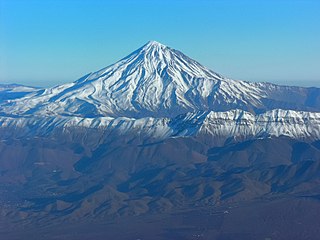
Amol County is a county in Mazandaran Province in Iran. The capital of the county is Amol. At the 2006 census, the county's population was 343,747, in 93,194 families. The county is subdivided into three districts: the Central District, Larijan District, and Dabudasht District. The county has five cities: Amol, Rineh, Gazanak, Dabudasht and Amamzadeh Abdallah.

Allahverdi Khan was an Iranian general and statesman of Georgian origin who, initially a gholām, rose to high office in the Safavid state.

The Treaty of Constantinople, also known as the Peace of Istanbul or the Treaty of Ferhad Pasha, was a treaty between the Ottoman Empire and the Safavid Empire ending the Ottoman-Safavid War of 1578–1590. It was signed on 21 March 1590 in Constantinople. The war started when the Ottomans, then ruled by Murad III, invaded the Safavid possessions in Georgia, during a period of Safavid weakness. With the empire beleaguered on numerous fronts and its domestic control plagued by civil wars and court intrigues, the new Safavid king Abbas I, who had been placed on the throne in 1588, opted for unconditional peace, which led to the treaty. The treaty put an end to 12 years of hostilities between the two arch rivals. While both the war and the treaty were a success for the Ottomans, and severely disadvantageous for the Safavids, the new status quo proved to be short lived, as in the next bout of hostilities, several years later, all Safavid losses were recovered.

The Marashiyan or Marashis were an Iranian Sayyid Twelver Shiʿite dynasty of Mazandarani origin, ruling in Mazandaran from 1359 to 1596. The dynasty was founded by Mir-i Buzurg, a Sayyid native to Dabudasht. Their capitals were Amol, Sari, and vatashan.
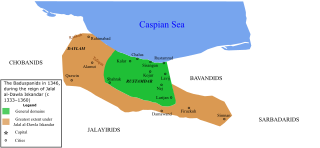
The Baduspanids or Badusbanids were a local dynasty of Tabaristan which ruled over Ruyan/Rustamdar. The dynasty was established in 665, and ended in 1598 when the Safavids invaded their domains.
Mirza Kamal al-Din Shah Hossein Isfahani, better simply known as Mirza Shah Hossein, was an Iranian nobleman, who served as the vakil (vicegerent) and vizier of the Safavid Empire. He also briefly held the post of commander of the empire's musketeer corps (tofangchi-aghasi).
Hatem "Beg" Ordubadi, was an Iranian aristocrat from the Ordubadi family, who served as the grand vizier of the Safavid king (shah) Abbas I from 1591 to 1610/1.
Farhād Khān Qarāmānlu, also known by his honorific title of Rokn al-Saltana, was a Turkoman military officer from the Qaramanlu family, and was the last member of the Qizilbash to serve as commander-in-chief (sipah-salar) of the Safavid Empire.
The Military of Safavid Iran covers the military history of Safavid Iran from 1501 to 1736.
Allahverdi Khan was a Safavid military officer of Armenian origin. He was the son of a certain Khosrow Khan, and had a brother named Emamverdi Beg.
Safiqoli Khan was a Safavid official of Georgian origin, who served as the governor (hakem) of Lar in 1629-1630 and in 1632 during the reign of king Safi.
Mansur Beg was a Safavid official, who served as the first Safavid governor (hakem) of Derbent (Darband), in 1509, during the reign of king Ismail I. Following his brief tenure, he was succeeded by members of the Shirvanshah family who governed the city under Safavid suzerainty, usually through castellans, until 1538. After that, directly appointed Safavid officials came to govern it again.
Evaz Beg was a 17th-century Safavid official and royal gholam. Of Georgian origin, he served during the reign of Abbas II (1632–1666), and was the brother of one of the most prominent court eunuchs at the time, Mehtar Davud, as well as of the imperial treasurer and eunuch Mohammad Beg. In 1640, Evaz Beg was appointed governor (vizier) of Lar. A few years later, in 1646–1647, he was briefly made governor (hakem) of the nearby district of Bandar Abbas, which included the islands of Hormuz, Qeshm and Larek. In 1656, he was permitted to resign as governor of Lar and was appointed as divanbegi, while a few years later, in 1660, he was made governor (vizier) of Bia-pas in Gilan and its provincial capital Rasht.

The qurchis or qorchis were the royal bodyguard of the Safavid shah. The head of the qurchis was known as the qurchi-bashi.
References
- ↑ Floor 2008, p. 233.
- ↑ Calmard 1986, pp. 657–659.
- ↑ Melville 2020, p. 36.