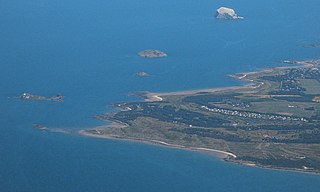
The Bass Rock, or simply the Bass, is an island in the outer part of the Firth of Forth in the east of Scotland. Approximately 2 kilometres (1 mi) offshore, and 5 kilometres (3 mi) north-east of North Berwick, it is a steep-sided volcanic rock, 107 metres (351 ft) at its highest point, and is home to a large colony of gannets. The rock is uninhabited, but historically has been settled by an early Christian hermit, and later was the site of an important castle, which after the Commonwealth period was used as a prison. The island belongs to Sir Hew Hamilton-Dalrymple, whose family acquired it in 1706, and before to the Lauder family for almost six centuries. The Bass Rock Lighthouse was constructed on the rock in 1902, and the remains of an ancient chapel survive.

Dunfermline is a town, parish and former Royal Burgh, in Fife, Scotland, on high ground 3 miles (5 km) from the northern shore of the Firth of Forth. The town currently has an estimated population of 58,508. According to the National Records of Scotland, the Greater Dunfermline area has a population of 76,210.

Dunoon is the main town on the Cowal peninsula in the south of Argyll and Bute, Scotland. It is located on the western shore of the upper Firth of Clyde, to the south of the Holy Loch and to the north of Innellan. As well as forming part of the council area of Argyll and Bute, Dunoon also has its own community council. Dunoon was a burgh until 1976.
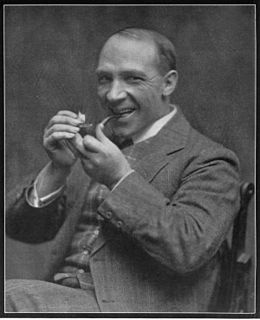
Sir Henry Lauder was a Scottish singer and comedian popular in both music hall and vaudeville theatre traditions; he achieved international success.

The Holy Loch is a sea loch, a part of the Cowal peninsula coast of the Firth of Clyde, in Argyll and Bute, Scotland.

The Cowgate is a street in Edinburgh, Scotland, located about 550 yards (500 m) southeast of Edinburgh Castle, within the city's World Heritage Site. The street is part of the lower level of Edinburgh's Old Town, which lies below the elevated streets of South Bridge and George IV Bridge. Consequently, the Cowgate can be quite gloomy and dark in sections. It meets the Grassmarket at its west end and Holyrood Road to the east.
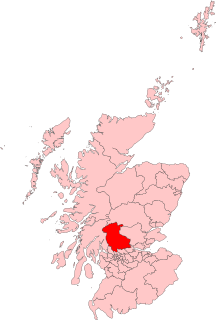
Stirling is a county constituency of the House of Commons of the Parliament of the United Kingdom. It elects one Member of Parliament (MP) by the first past the post system of election.

The Kelvin Hall, located on Argyle Street in Glasgow, Scotland, is one of the largest exhibition centres in Britain and now a mixed-use arts and sports venue that opened as an exhibition venue in 1927. It has also been used as a concert hall, home to the Kelvin Hall International Sports Arena to 2014, and from 1988 to 2010, Glasgow's Museum of Transport. As part of the economic redevelopment of Greater Glasgow promoted by the Scottish Development Agency and local authorities to enhance the city's tourist infrastructure and to attract further national and international conferences, the Scottish Exhibition and Conference Centre was designed as the Hall's successor for exhibitions and entertainments, built and opened on the nearby Queen's Dock in 1985 with an exhibition area equal in size to the Kelvin Hall but with the benefit of extensive car parks and land for other complementary buildings. The Hall is protected as a category B listed building, and is served by city bus services and by Kelvinhall subway station.

Inverleith is an inner suburb in the north of Edinburgh, Scotland, on the fringes of the central region of the city. Its neighbours include Trinity to the north and the New Town to the south, with Canonmills at the south-east and Stockbridge at the south-west.
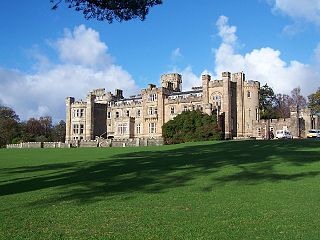
Castle Toward is a nineteenth-century country house on the southern tip of the Cowal peninsula, overlooking Rothesay Bay in Argyll and Bute on the west-coast of Scotland.

George IV Bridge is an elevated street in Edinburgh, Scotland, and is home to a number of the city's important public buildings.

Strachur; and Strathlachlan; are united parishes located on the Cowal peninsula, in Argyll and Bute, Scotland. Strachur is a small village on the eastern coast of Loch Fyne.
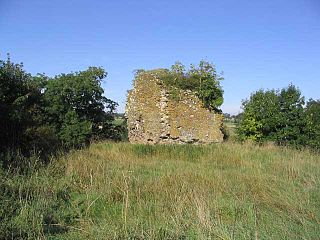
Whitslaid Tower was an ancient Berwickshire seat of the Lauder family for over 300 years. It is today a ruin high above the eastern bank of the Leader Water, 2 miles (3.2 km) south of the burgh of Lauder, in the Scottish Borders. In feudal times it fell within a detached segment of the King's personal Barony of Renfrew.
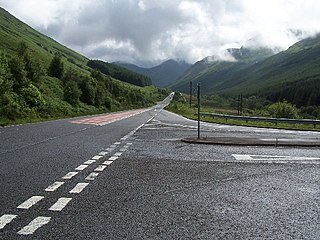
The A815 is a major road in Argyll and Bute, Scotland. It runs for about 37 miles (60 km) from Toward in the south to the A83, near Cairndow, in the north.

Lauderdale is a long narrow geographical district in the Scottish Borders, Scotland, being the valley of the Leader Water,, above which rivulet St. Cuthbert had a vision of St. Aidan's soul being conducted to heaven. It is traversed from end to end by the A68 trunk road which runs from Darlington to Edinburgh.

The River Leader, or Leader Water, is a small tributary of the River Tweed in Lauderdale in the Scottish Borders. It flows southwards from the Lammermuir Hills through the towns of Lauder and Earlston, joining the River Tweed at Leaderfoot.
The action at Lanark was an attack at Lanark, Scotland during the First War of Scottish Independence in May 1297. The Scotsman William Wallace led an uprising against the English and killed the Sheriff of Lanark, William Heselrig. The attack was not an isolated incident, but rather saw Wallace joining in with uprisings taking place across Scotland.

The Dunoon massacre was a massacre that took place around Dunoon on the Cowal Peninsula, Scotland, on 3 June 1646. Men of the powerful Clan Campbell massacred men, women and children of the Clan Lamont.
Cowal RFC is a rugby union side based in Dunoon, Argyll and Bute, Scotland. The club was founded in 1976. They play their home games at Dunoon Stadium.

William Fraser, RIBA was a Scottish-born architect, prominent in the late 19th and early 20th centuries, who initially practised in Great Britain and then in Canada until his death in 1922.

